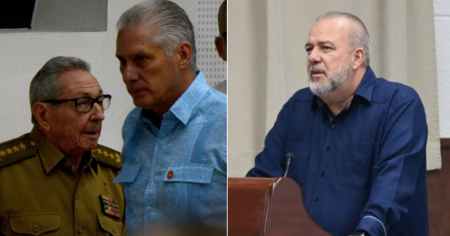
The Cuban ruler Miguel Díaz-Canel described the attitude of those in positions of power who express themselves insensitively towards the reality of the most vulnerable people in Cuba as "arrogant" and "overbearing".
He did this on Tuesday during a parliamentary session, clearly referring to, although not naming, the Minister of Labor and Social Security, Marta Elena Feitó Cabrera, whose recent statements denying the existence of beggars in the country provoked social outrage.
“None of us can act with arrogance, can act with overbearingness, disconnected from the realities our people experience”, Díaz-Canel declared, visibly upset.
The president's words, spoken at the Commission for Youth, Childhood, and Women's Equality Rights of the National Assembly, mark a shift in the official discourse and represent a public distancing from a sitting minister.
Díaz-Canel insisted that the recent claims about the so-called "deambulantes" reveal a "superficial" and "disconnected" approach to the complexity of the phenomenon.
Although she avoided directly referencing Feitó, the context left no doubt: her intervention occurred just hours after the minister denied the existence of beggars, labeled those seeking food on the streets as “disguised,” and accused garbage collectors of being “illegal self-employed workers.”
“I do not share some of the opinions expressed in this commission. And I would not be honest if I didn't say so. It is counterproductive to make judgments like that when we are acknowledging the existence of a problem”, added the leader appointed by Raúl Castro since 2018.
In a speech filled with phrases of strong symbolic weight and fully broadcast on state television, Díaz-Canel emphasized that people who are homeless or abandoned "are ours" and deserve care, not stigmatization.
"If these are the issues present in our society, they are our homeless, our people in vulnerable situations, our communities... And we must resolve them ourselves."
For the leader, denying this reality or criminalizing it is incompatible with the principles of the Revolution. "The Revolution is not defended by hiding problems," he emphasized.
He also stated that recognizing the existence of these situations is not a cause for shame, but rather a demonstration of ethical and political commitment.
At another point in his address, Díaz-Canel urged public officials to be more sensitive to social inequalities:
“If your heart doesn't resonate with the problems we have, you won't find the energy to face them”, he said. “We must act with sensitivity, seriousness, humanitarianism… with respect, humility, human warmth, and decent behavior”.
The president acknowledged that the conditions of vulnerability have worsened due to the economic crisis, which he attributed to the "escalation of the blockade." Nevertheless, he assured that the country has over 30 social programs to address various forms of exclusion.
Break in the official discourse
Although on previous occasions Díaz-Canel has appealed to the language of revolutionary humanism, this time his words come after a wave of national and international outrage over Feitó's speech, and after activists, intellectuals, and citizens demanded her immediate dismissal.
The minister had claimed that the supposed beggars "do not exist" and that the people on the streets "have found an easy way to live without working." These words were interpreted as an attempt to criminalize poverty and deny its growing visibility on the island.
So far, Feitó has not offered any apologies or clarifications. However, his stance has been challenged not only by Díaz-Canel but also by data from the Cuban Observatory of Human Rights, which reveals that 89% of Cuban families live in extreme poverty.
Díaz-Canel's intervention could be seen as an attempt to distance himself from the political cost generated by his minister's words. However, it could also represent a crack in the official discourse that, until now, had either remained silent or downplayed the issue of poverty.
“Yes, those manifestations do exist. We do not feel ashamed to acknowledge it. They exist, but we address them. We feel for the people who are in that situation. We have the will to overcome it. We have the will to transform it,” he concluded.
For the first time in a long time, the power structure in Cuba has had to publicly debate the harshest faces of its crisis: those who sleep in doorways, those who rummage through the trash, those who beg for alms. And this time, the criticism did not come from outside, but from the highest echelons of power.
Filed under: