
Related videos:
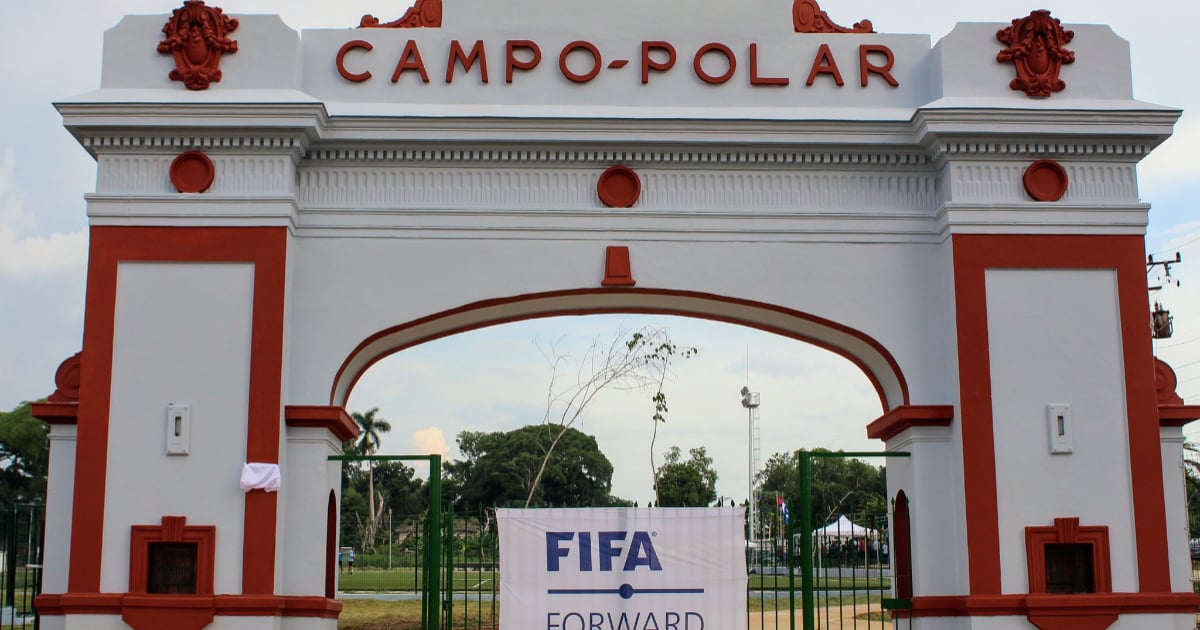
The emblematic La Polar Stadium, one of the historic venues of football in Cuba, officially reopened its doors after a extensive renovation that required an investment of over 1.7 million dollars.
The project, driven by the International Federation of Football Association (FIFA) in collaboration with the Cuban Football Association (AFC) and with the support of the Cuban government, aims to restore prominence to this century-old facility located in Havana, according to the newspaper JIT.
As part of the event, a commemorative plaque was unveiled, and the upcoming replacement of the synthetic turf was announced, a necessary condition for the venue to host official international matches.
A high-standard modernization
The renovations transformed the stadium into a complex with modern infrastructure: new climate-controlled dressing rooms, showers, restrooms, functional offices, perimeter fencing, parking, covered stands, an efficient lighting system, hydraulic networks, and even solar panels for energy generation. Additionally, a high-capacity cistern was built to ensure field irrigation and supply in case of possible interruptions.
The renovation had not only a sporting impact but also a social and community one, with improvements to the pavement of access roads and the extended benefit of the hydraulic network to nearby residents. The reopening also coincided with the launch of the "Football for Schools" program, aimed at promoting sports among Cuban children and adolescents.
From ice factory to revitalized field
La Polar —whose name recalls the brewery that gave rise to it and now lies in ruins— had been a symbol of capital football for decades. However, its deterioration relegated it to marginal use, until in 2017 it was partially revived with the installation of synthetic turf, in a ceremony attended by FIFA President Gianni Infantino.
Now, with this comprehensive renovation, the AFC claims to have settled a historical debt with Cuban football. Oliet Rodríguez, the president of the Association, stated that despite the country's economic difficulties, efforts were intensified to rescue a project that "had been postponed for years."
It was also announced that by 2026, the replacement of the artificial turf is expected to be completed, which will allow for compliance with the standards required by FIFA.
A football party among ruins
The celebrations included a friendly match between veterans of Cuban football. Just a few meters away, however, the remains of the La Polar factory stand abandoned, serving as a reminder that while the stadium is being revitalized, the urban environment surrounding it remains mired in decay.
The reopening of La Polar represents a symbolic victory for Cuban soccer, but it also highlights the contrasts: the enthusiasm for sports development clashes with a national infrastructure that, outside of projects like this, suffers the effects of neglect and economic crisis.
International funds and ruined courts
Although FIFA provides millions of dollars annually through its development programs—such as FIFA Forward—to support the growth of football in countries like Cuba, the reality on the ground is far from the stated goals.
Most of the courts in the country are in deplorable condition, with uneven surfaces, non-existent or dilapidated stands, and lacking basic infrastructure such as changing rooms, bathrooms, or lighting.
While La Polar looks rejuvenated, dozens of fields across the country remain abandoned or unfit for serious football practice, impacting both the development of the sport and the emergence of new talents.
Players, coaches, and parents agree that the investment is not reflected in the daily reality of Cuban football, and many wonder where the money that FIFA regularly provides to the Cuban Football Association is going.
Frequently Asked Questions about the Renovation of La Polar Stadium in Havana
How much did the renovation of Estadio La Polar in Havana cost?
The renovation of the La Polar Stadium cost over 1.7 million dollars. This project was made possible thanks to the joint investment of FIFA and the Cuban Football Association, with the support of the Cuban government, and aims to restore the prominence of this historical site of Cuban football.
What improvements were made to La Polar Stadium after its renovation?
The renovation included the modernization of the La Polar stadium's infrastructure, featuring new air-conditioned locker rooms, showers, restrooms, functional offices, perimeter fencing, parking, covered stands, an efficient lighting system, hydraulic networks, and solar panels for energy generation. Additionally, a cistern was built to ensure the irrigation of the field.
When is it expected that Estadio La Polar will be able to host international matches?
The La Polar Stadium is expected to host official international matches in 2026, once the replacement of the synthetic turf is completed. This change is necessary to meet the standards required by FIFA and will allow the stadium to regain its significance in international football.
What social impact does the renovation of the La Polar Stadium in Havana have?
The renovation of La Polar Stadium not only has a sporting impact but also a social and community one. The improvements include the paving of access roads and the extended benefit of the hydraulic network to nearby residents. Furthermore, the reopening coincides with the "Football for Schools" program, aimed at promoting sports practice among Cuban children and adolescents.
Filed under: