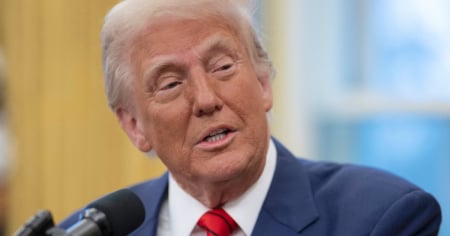
The president Donald Trump celebrated on Wednesday the 3% growth of the Gross Domestic Product (GDP) of the United States in the second quarter of 2025, calling it “much better than expected!” in a post on the Truth Social network.
Since his return to power in January, Trump has made economic performance a central focus of his administration, and he is now demanding an immediate reduction in interest rates: “We need to lower the rate now! No to inflation! Let people buy and refinance their homes!” wrote the president in a message that was shared by the official White House account on X.
The data, published by the Bureau of Economic Analysis (BEA), represents a remarkable recovery compared to the first quarter of the year, when the economy contracted by 0.5% on an annualized basis, marking the first negative figure since 2022, according to EFE.
According to the BEA, the rebound in GDP from April to June was driven by a significant decrease in imports (-30.3%) and moderate growth in consumer spending (+1.4%). The quarter-over-quarter growth was 0.7%.
Despite the pressure from the president, the Federal Reserve (Fed) once again kept interest rates unchanged at their current range of 4.25 to 4.5%, the cited medium reported.
Key factors of the rebound
The official report indicates that the improvement in the second quarter was due to a combination of internal and external factors. The decline in imports —following a 37.9% spike in the previous quarter— was crucial for the net growth of GDP, although analysts warn that this reflects more of an adjustment in foreign trade than a structural increase in production.
Consumer spending, viewed as the main engine of the U.S. economy, showed a recovery after slowing down in the early months of the year. However, national private investment fell by 15.6%, raising concerns about the sustainability of long-term growth, especially against a backdrop of increased uncertainty due to the return of tariff measures.
Risks from the end of the trade truce
The economic momentum may encounter obstacles starting August 1, when new tariffs take effect as part of the trade tightening promoted by the Trump administration. Analysts warn that a more protectionist environment could dampen household spending and further weaken private investment, two essential components of growth.
Moreover, exports fell by 1.8% in the second quarter, reflecting a less dynamic international environment and potential trade retaliations from strategic partners in response to the new tariff scheme.
In summary, although the 3% growth in the second quarter marks a notable recovery following a negative start to the year, the fundamentals of the rebound remain weak. The decline in investment, the drop in exports, and uncertainty regarding the country's trade direction could limit the extent of this progress if measures to strengthen consumption and domestic production are not solidified.
Frequently Asked Questions about the Economic Growth of the U.S. in the Second Quarter of 2025
What factors drove the growth of the U.S. GDP in the second quarter of 2025?
The GDP growth in the second quarter was mainly driven by a significant decrease in imports and moderate growth in consumer spending. The drop in imports, following a rebound in the previous quarter, was crucial for the net GDP growth. However, national private investment fell by 15.6%, raising concerns about the sustainability of long-term growth.
How could the new tariffs affect the U.S. economy?
The new tariffs, which will take effect on August 1, 2025, could curb household spending and further weaken private investment, two essential components of economic growth. A more protectionist environment could limit the current economic recovery, especially if trade reprisals from strategic partners occur. These tariffs could also lead to more expensive products for American consumers.
What risks does the U.S. economy face in the current context?
The U.S. economy faces several risks, including a decline in investment, a drop in exports, and uncertainty regarding the country's trade direction. Furthermore, Trump's tariff policy could lead to a rise in inflation and a slowdown in economic growth. Analysts also warn about the risk of stagflation, a combination of low growth and high inflation, due to current trade policies.
What effects have Donald Trump's policies had on the public perception of his economic management?
The public perception of Trump's economic management has significantly worsened, according to a CNBC survey. The president is facing his lowest economic approval rating since taking office, with a disapproval rate of 55% in this area. The negative perception is driven by discomfort regarding tariffs, inflation, and federal spending. The survey also shows an increase in pessimism about the country's economic outlook in the coming months.
Filed under: