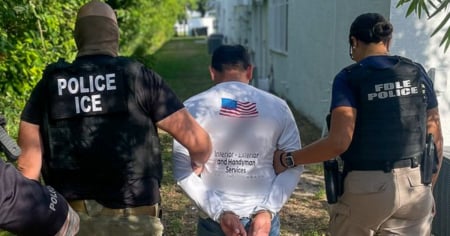
In an unexpected turn within his staunch campaign against irregular immigration, Florida Governor Ron DeSantis has launched strong criticisms against the Immigration and Customs Enforcement (ICE), accusing it of “stealing” personnel from the state’s police departments with hiring bonuses of up to 50,000 dollars.
During an appearance in Orlando last Friday, DeSantis expressed his frustration upon learning that ICE is sending recruitment emails to locally trained agents for immigration duties, as part of a federal effort to expand its workforce with funding from the “One Big Beautiful Bill Act” signed by Donald Trump.
“Why do they have to come to take our agents who are already in the fight?”, the governor complained. “They’re just changing their uniforms”, reported the National Public Radio affiliate in the Tampa Bay area, WUSF.
The sheriff of Polk County, Grady Judd, was one of the first to publicly denounce ICE's maneuver. "We are receiving emails offering bonuses and benefits. Is this how they thank us for helping them do their job?", he said indignantly.
Judd pointed directly at the Secretary of Homeland Security, Kristi Noem, demanding a public apology from her. "She needs to step up and do the right thing," he stated.
The discontent extends to other counties such as Pinellas, where Sheriff Bob Gualtieri also confirmed the recruitment offensive. “It’s a betrayal. ICE is using our collaboration to take personnel away from our agencies,” his office reported.
Florida, the epicenter of the migration machinery
The tension arises in a context where Florida has become the epicenter of the U.S. immigration offensive. With over 10,800 arrests made by ICE so far in 2025, the state leads the 287(g) cooperation agreements, which allow police to act as immigration agents.
In total, 295 local agencies, which is 43% of the national total, actively participate in these operations, often in Latino neighborhoods and workplaces.
Cities like Miami, Orlando, Tampa, and Jacksonville top the list of areas with the highest number of arrests. In this context, the loss of trained personnel raises concerns, as the agents that ICE intends to recruit are the same ones who were trained to act against migrants in their local communities.
While the governor boasts about turning Florida into the toughest state against irregular immigration, with laws that criminalize undocumented individuals, strengthen E-Verify, and allow arrests even without a criminal record, the federal agency is moving forward with its own expansion plan.
DeSantis himself said that “this is not my policy. It comes from ICE. So, if you disagree, speak up”. A direct message to the sheriffs of the state, but also a sign of division within the conservative front.
The human impact: more raids, more fear
While the authorities fight over personnel and prominence, the human toll continues to rise. According to the Deportation Data Project, at least 36% of those detained in Florida have no criminal record, and hundreds have been arrested at their jobs or in public spaces. Reports of family separations, expedited deportations, and questionable conditions in centers like “Alligator Alcatraz” in the Everglades are multiplying.
In communities where many migrants, including Cubans, have spent years building a life, the fear is palpable. And now, the same network of collaboration between police and ICE that put thousands at risk is facing an internal crisis that could result in an even more aggressive system.
Filed under: