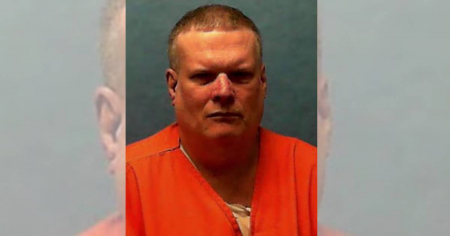
Florida is on track to set an unprecedented record in the application of the death penalty. In a span of just 30 days, the state has scheduled three executions by lethal injection, establishing itself as the jurisdiction with the most executions in the United States this year.
The established dates are this July 31, August 19, and August 28, which will raise the annual total of executions in the state to 11.
This is a figure that not only exceeds its own historical record - eight executions in 2014 - but also represents more than a third of the capital punishments in the entire country so far this year, as reported by the agency EFE.
Republican Governor Ron DeSantis has personally signed the execution orders, reflecting an increasingly aggressive state policy toward the use of the death penalty, backed by lawmakers and prosecutors from the same party.
This intensification of the execution rate has generated controversy across the country, with civil organizations, religious activists, and legal experts expressing concern over the expedited nature of the judicial process and its moral implications.
A system that reduces wait times
Most death row inmates in Florida spend decades waiting on death row, but state authorities have expedited the appeal processes.
This strategy has been interpreted by analysts as a political maneuver aimed at reaffirming hardline positions on crime in an increasingly divided national context regarding the death penalty.
Florida not only leads in the number of executions in 2025, but it is also the second state with the most people on death row (278), surpassed only by California (585).
Paradoxically, it also has the highest number of exonerations: 30 people sentenced to death have been declared innocent since 1973.
The three cases: Terrifying murders and decades of waiting
1. Edward J. Zakrzewski II – July 31, 2025
Air Force veteran Edward J. Zakrzewski was convicted of murdering his wife, Sylvia (34 years old), and their two young children, Edward (7) and Anna (5), in June 1994 in Okaloosa County.
He committed the crimes in the context of a marital crisis: his wife had filed for divorce.
According to the trial, he first attacked Sylvia with a crowbar, strangled her with a rope, and then, believing she was still alive, finished her off with a machete.
He then killed his children with the same weapon.
Zakrzewski fled to Hawaii, where he sought refuge in a religious commune. His case appeared on the television program Unsolved Mysteries, which prompted him to turn himself in the following day.
In 1996, he was found guilty and sentenced to death by a divided jury (7-5), a margin that would not comply with the current state law today.
The Supreme Court of the United States denied his final appeal on July 30. His execution is scheduled for July 31 at 6:00 p.m. at the Florida State Prison.
2. Kayle Barrington Bates – August 19, 2025
Convicted of aggravated homicide in 1982, 67-year-old Kayle Bates abducted a 24-year-old woman from an insurance office in Bay County and brutally murdered her.
The evidence presented in his trial included details of premeditation and extreme cruelty.
He has been on death row for over four decades.
Its execution, scheduled for Monday, August 19, will also be by lethal injection, according to the order signed by DeSantis.
3. Curtis Windom – August 28, 2025
Curtis Windom, 59 years old, was convicted of a series of murders committed in the Orlando area in 1992.
He killed Johnnie Lee over a debt of $2,000, then his ex-partner Valerie Davis, and later his mother-in-law Mary Lubin, whom he encountered by chance at a traffic light while fleeing from the police.
During the escape, he also injured another person who survived.
Windom was sentenced to death in 1992. After exhausting his legal appeals, he will be executed on August 28.
The lethal cocktail and the ethical debate
Florida uses a lethal injection protocol consisting of three drugs: a sedative, a paralytic agent, and a substance that stops the heart.
This procedure, although legal, has been questioned by medical experts and human rights organizations due to the risk of extreme suffering if not administered correctly.
Despite these criticisms, the state continues to use this method as its legal execution standard.
Protests and voices against
The wave of executions has sparked strong reactions from civil and religious groups. The organization Floridians for Alternatives to the Death Penalty (FADP) has launched campaigns to request a moratorium on executions, stating that “each execution dehumanizes us all.”
The Archbishop of Miami, Thomas Wenski, published an article strongly opposing the death penalty.
He argued that a life sentence without the possibility of parole represents a severe punishment, but one that is compatible with human dignity.
Wenski questioned whether a truly just society needs to resort to death as an instrument of justice.
Additionally, the Action Network organized a petition requesting clemency in the Zakrzewski case, pointing out that his jury would not have been able to impose the maximum penalty under current regulations.
National context and trend
According to data from the Death Penalty Information Center, as of 2025, 27 people have been executed across the United States. After Zakrzewski's execution, Florida will have conducted a third of all executions in the country.
Texas and South Carolina, tied for second place, each have four.
This resurgence of the death penalty in Florida contrasts with the national trend: support for capital punishment has fallen to one of its lowest levels since the 1970s.
A survey by Gallup in 2024 revealed that only 53% of Americans support it, compared to peaks close to 80% in past decades.
Frequently Asked Questions About the Wave of Executions in Florida in 2025
Why has Florida increased the number of executions in 2025?
Florida has increased the number of executions as part of a more aggressive state policy toward capital punishment, led by Governor Ron DeSantis. This policy aims to reinforce tough stances on crime, in a national context where support for the death penalty has significantly declined. Furthermore, the state has expedited the appeals process to reduce the time that condemned individuals spend on death row.
Who are the three death row inmates in Florida over a 30-day period in 2025?
The three sentenced to death in Florida within a span of 30 days are Edward J. Zakrzewski II, Kayle Barrington Bates, and Curtis Windom. Edward J. Zakrzewski II was executed on July 31 for the murder of his wife and children in 1994. Kayle Barrington Bates is scheduled to be executed on August 19 for an aggravated homicide in 1982, and Curtis Windom on August 28 for a series of murders committed in 1992.
What methods of execution are being used in Florida?
Florida uses lethal injection as its primary method of execution. This protocol involves the administration of three drugs: a sedative, a paralytic agent, and a substance that stops the heart. Despite criticism regarding the risk of extreme suffering if not administered correctly, the state continues to employ this method as its legal standard for execution.
What is the impact of the increase in executions in the national context of the death penalty?
The increase in executions in Florida contrasts with the national trend of reducing the use of the death penalty. While support for capital punishment has fallen to low levels since the 1970s, Florida has adopted more aggressive policies, focusing on harsher penalties. This resurgence in Florida occurs in a context where only a few states, such as Texas and South Carolina, account for the majority of executions in 2025.
Filed under: