The President of the United States, Donald Trump, has made a last-minute announcement: he will raise tariffs on imports from India to 50% in direct response to the Indian government's purchase of Russian oil under Narendra Modi.
This decision marks a turning point in U.S. foreign and trade policy, as it implements "secondary sanctions" for the first time against a strategic partner like India, with the explicit aim of curbing the Kremlin's war machine in Ukraine.
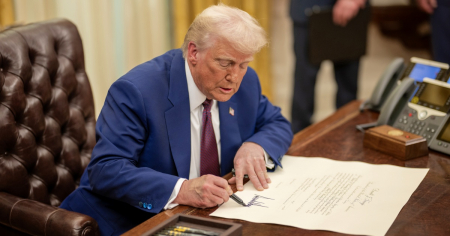
According to the decree signed by Trump and published by the White House, Indian imports will be subject to an immediate tariff increase of 25%, with an additional increase of the same amount to follow in 21 days.
The official document states that this decision is based on the fact that India "is currently importing oil directly or indirectly from the Russian Federation,” and therefore “it is necessary and appropriate” to impose this trade penalty.
"I have received additional information from several high-ranking officials regarding, among other things, the actions of the Government of the Russian Federation concerning the situation in Ukraine," the decree states.
With these measures, India joins the small group of countries facing such high U.S. tariffs, alongside Brazil (50%), Syria (41%), Myanmar (40%), and Switzerland (39%).
Trump has justified his decision as part of a strategy to pressure Russia to agree to a ceasefire in Ukraine, but the measure also aims to change India's energy trajectory.
“India is not only buying enormous amounts of Russian oil, but then sells a large portion of the oil acquired in the open market for significant profits. They do not care how many people in Ukraine are being killed by the Russian war machine,” wrote Trump on Truth Social.
The announcement came after a visit to Moscow by Trump's envoy, Steve Witkoff, who met with Vladimir Putin.
The next day, the U.S. president issued a 10-day ultimatum to the Kremlin to cease hostilities, a deadline that expires this Friday.
Meanwhile, the Indian Foreign Minister, Subrahmanyam Jaishankar, described Trump's measures as “unjust, unjustified, and irrational”, emphasizing that imports of Russian crude are driven by “market factors” and aim to ensure the energy security of 1.4 billion people.
India's Energy Dilemma
Although India maintains a strong stance in public, adjustments are being made in private.
According to Reuters and Bloomberg, several Indian refineries have canceled purchases of Russian crude oil and are seeking alternatives in the United States, Canada, and the Middle East. Some Russian tankers are even waiting off their coasts, without authorization to unload.
This subtle shift seems to indicate that Modi's government is weighing the economic and geopolitical impact of continuing to challenge Washington.
However, Modi has been firm: “India will never compromise the interests of its farmers, ranchers, and fishermen. And I know that I will have to pay a huge personal price for this, but I am ready.”
Immediate economic repercussions
Trump's announcement shook the Indian markets: major stock indices, such as the Bombay Sensex and the Nifty 50, dropped by 0.4%, with a particularly strong impact on the pharmaceutical and technology sectors.
India exports a wide variety of products to the U.S.: pharmaceuticals, machinery, textiles, and agricultural products.
Some of these -such as the agricultural sector- represent a red line for New Delhi.
In contrast, the main U.S. exports to India include gas, chemicals, and aerospace components, industries that could be adversely affected if India implements retaliatory measures.
Paradoxically, the tightening of tariffs against India coincides with Apple and other American companies relocating some of their production to that country as a result of the tariffs against China.
In 2024, India was the tenth largest supplier of goods to the U.S., with exports valued at $87 billion, as reported recently by the NBC.
In contrast, it imported American goods worth 42 billion.
Products such as smartphones and electronic devices—many of which are manufactured in India by American companies—are exempt from the new tariffs for now.
However, Trump has hinted that this could change. "A while ago, I informed Tim Cook of Apple that I hope the iPhones sold in the United States are made in the United States, not in India or anywhere else," he warned.
A measure against Russia or against India?
Trump's decision is also surrounded by internal criticism and strategic contradictions.
While India is being punished for its energy relationship with Russia, neither China nor the European Union—who continue to buy raw materials from the Kremlin—have faced similar sanctions.
In fact, the United States continues to import palladium, fertilizers, and Russian chemicals for its industries, especially in the energy and nuclear sectors.
All of this has led analysts in New Delhi to wonder whether Trump genuinely seeks to weaken Putin or if he is simply trying to compel India to become an exclusive energy client of the United States.
“Does Trump really want Putin to command his cannons to cease fire, or is it simply that India should stop buying oil from Russia and instead purchase it from the U.S.?” questioned the Spanish newspaper El Mundo.
Filed under: