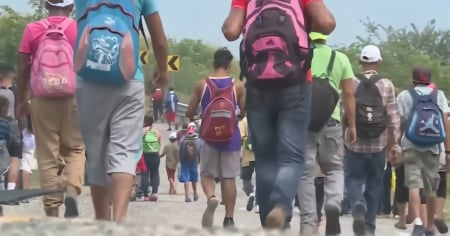
The National Migration Institute (INM) of Mexico began surveying the members of the migrant caravan called "Exodus of Justice" to understand the type of process they have undertaken to regularize their status and to determine the options that will be offered to them.
According to a report by the newspaper El Universal, last Friday, President Claudia Sheinbaum explained that the options for those who left Tapachula in a caravan include everything from repatriation to their home countries to the possibility of accessing employment within Mexican territory.
According to the testimony of Keyla, a Venezuelan migrant, personnel from the National Migration Institute (INM) and Grupo Beta Sur arrived this Saturday at the "Salomón González Blanco" sports complex in Escuintla, where the group was resting, to begin the registration process.
There, migrants, mostly from Cuba, Venezuela, Haiti, Ecuador, and Central America, were asked to line up to verify personal information and confirm the type of process they had undertaken.
Some participants expressed fear of being deceived, but they agreed to answer the interviews and wait for the authorities' decision.
Despite this, they noted that the caravan would resume its march early Sunday morning towards Mapastepec, covering an estimated distance of 35 kilometers.
Among the individual stories is that of Ecuadorians Johnny Fabricio and Jennyfer Magdalena, parents of Itzel Guadalupe, an eight-month-old Mexican baby.
The couple publicly urged President Sheinbaum to waive a fine of 44,000 pesos imposed for their regularization due to their family connection, stating that they lack the resources to pay it.
The family, traveling with their other children, Esteven Ariel, 13, and Teylor Matías, two, began their journey with the caravan after the Mexican Commission for Refugee Assistance (COMAR) denied them refugee status and due to a lack of employment.
Hoping to find a solution, the migrants plan to arrive in Mexico City to obtain documents that will allow them to work legally and access better opportunities.
The caravan made up of hundreds of migrants, including many Cubans, departed last Wednesday from Tapachula, in the Mexican state of Chiapas, heading north in search of relocation or legal pathways to migrate.
According to a report by CNN, the group, consisting of around 300 individuals, is made up of migrants from at least 12 nationalities, including Cuba, Venezuela, Nicaragua, and Honduras.
Many of these individuals spent months stranded at the southern Mexican border, attempting to regularize their status without success, after giving up on the American dream.
The return of Donald Trump to the White House and the have forced many to change their plans.
Now, migrants are aiming for cities like Monterrey or the Mexican capital, where they hope to present themselves to diplomatic representations of countries like Canada, Germany, Australia, or Switzerland that offer work visas.
Frequently Asked Questions about the Migrant Caravan in Mexico
What measures is the National Migration Institute (INM) taking regarding the caravan of migrants?
The INM has begun to survey the members of the migrant caravan called "Exodus of Justice" to understand the type of procedures they have completed and to determine the options that will be offered to them, such as repatriation or the possibility of accessing employment in Mexico.
What is the destination of the migrant caravan that left Tapachula?
The caravan, made up of migrants from various nationalities such as Cuba, Venezuela, and Haiti, is heading towards Mexico City with the intention of obtaining documents that will allow them to work legally and access better opportunities.
What fears do migrants face on their journey through Mexico?
Migrants express fear of being deceived by the authorities and face risks of kidnapping, extortion, and violence, especially in border areas such as Chiapas, where criminal networks operate.
Why have migrants changed their destination from the United States to Mexico?
The tightening of immigration policies in the United States under the administration of Donald Trump has forced many migrants to reconsider their destinations, choosing to stay in Mexico where they hope for job opportunities and stability.
What are the main challenges faced by Cuban migrants in Mexico?
Cuban migrants face bureaucratic obstacles to regularize their status, challenges in securing formal employment, and low wages. Additionally, asylum offices are overwhelmed, causing delays in obtaining residency permits.
Filed under: