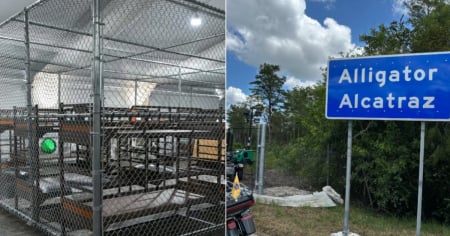
An employee of the Alligator Alcatraz detention center, located in the Everglades of Florida, resigned after just 10 days on the job, having witnessed abuse, medical negligence, and degrading treatment of migrants.
He pointed out that while in theory, detained individuals should not remain there for more than two weeks, in some cases they have been there for over 25 days.
The former employee, who in an interview with the television station Univisión Noticias requested to remain anonymous, described an environment where critically ill patients do not receive proper care.
He pointed out the case of a young man with colon cancer who lacked the necessary diet and conditions for his treatment, and another with an open wound on his foot that could cost him his leg.
He stated that he never saw a doctor at the facility, only nursing staff or trainees, and that the protests from the detainees regarding the treatment they received often resulted in transfers to punishment cells, sometimes with visible bruises and marks.
The complainant also accused some guards who do not speak Spanish of mocking the migrants, insulting them, pushing them, and even shouting at them for basic actions.
According to him, the conditions are worse than in high-security federal prisons.
Desperation, he added, has led several detainees to express suicidal thoughts due to the unbearable pressure and the conditions they are in.
For the former worker, what he witnessed during those days was enough to leave his job and publicly expose what he considers serious violations of human rights.
A few days ago, a former employee of Alligator Alcatraz described the place as "an oversized dog kennel" and reported "inhuman" conditions in the treatment of detainees.
"It is inhumane the way they treat their residents," said Lindsey, who worked at the facility for a week before being fired after contracting covid.
"They have no sunlight. There is no clock. They don't even know what time of day it is. They don't have access to showers. They shower every two days or every four days," he recounted.
Similarly, the immigration lawyer Víctor Martínez revealed that he had to wait 10 days for the authorities to approve his entry request to the controversial center, where he currently represents six individuals in custody.
The lawyer also criticized the presence of a surveillance camera that recorded the entire meeting with his clients, which he believed violated the right to confidentiality between client and legal representative.
Such statements align with the concerns of activists, families, and other former employees regarding an establishment surrounded by complaints about overcrowding, lack of medical care, poor nutrition, and absence of privacy.
Inaugurated in July 2025 at an old airport in the Everglades, Alligator Alcatraz has been labeled by activists and human rights organizations as a "concentration camp" for migrants.
With a capacity for 2,000 detainees, which will be expanded to 4,000, it has been the scene of protests, lawsuits, and allegations of inhumane conditions.
A recent report from Human Rights Watch concluded that nearly 72% of those detained by Immigration and Customs Enforcement (ICE) have no criminal record.
Last week, a federal judge in Miami, Kathleen Williams, ordered the temporary suspension of the expansion work on the center for a period of 14 days, while allegations that the project violates federal environmental laws are reviewed.
The measure does not prevent the facility from continuing to house detainees for Immigration and Customs Enforcement (ICE), but it does prohibit adding new fill, paving, or constructing more infrastructure during the restriction period.
The judicial decision was in response to the lawsuit filed on July 17 by environmental groups and the Miccosukee tribe, who argue that the center threatens protected wetlands and jeopardizes years of investment in the restoration of the Everglades ecosystem.
Frequently asked questions about the conditions at the Alligator Alcatraz detention center
What are the main complaints against the Alligator Alcatraz detention center?
The main allegations against the Alligator Alcatraz detention center include abuse, medical negligence, and inhumane conditions. Testimonies from former employees and detainees have revealed situations of overcrowding, lack of adequate medical care, degrading treatment, and human rights violations. Additionally, there have been reports of prolonged detentions without formal charges and without access to adequate legal assistance.
What healthcare issues have been reported in Alligator Alcatraz?
A serious lack of appropriate medical care has been reported at Alligator Alcatraz. Specific examples include the lack of adequate treatment for detainees with severe illnesses such as cancer, as well as the absence of doctors on site. There have also been reports of detainees not receiving timely care for open wounds and other serious conditions, which worsens their health situation.
How does the location of the facility affect the conditions of the detainees?
The location of the center in the Everglades adversely affects the conditions of the detainees due to environmental issues such as extreme heat, oppressive humidity, and mosquito infestations. These conditions, along with the center's inadequate infrastructure, contribute to the deterioration of the physical and mental health of the detained individuals.
What legal actions have been taken against Alligator Alcatraz?
Multiple legal claims have been filed against Alligator Alcatraz. These include accusations of human rights violations and environmental law breaches, as well as the lack of access to legal advice for the detainees. Environmental and civil rights groups have taken the case to court, and the expansion works at the facility have been temporarily suspended while these claims are reviewed.
Filed under: