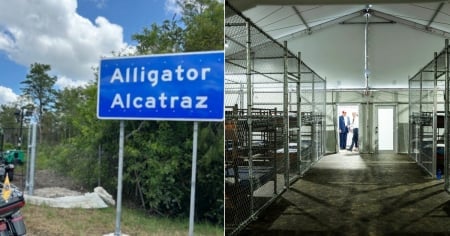
The immigration lawyer Víctor Martínez revealed that he had to wait 10 days for authorities to approve his request to enter the controversial immigrant detention center "Alligator Alcatraz," where he currently represents six individuals in custody.
In statements to Telemundo 51, Martínez detailed that, despite the authorization, he was unable to access the cells where his clients are located, but instead entered a visiting area that he described as "cages."
"Within that area, there is a cage where they are confined. I was very struck by the fact that they brought them in handcuffs because I have visited many immigration detention centers, including high-security ones, and I had never seen a detainee brought in handcuffed," she stated.
The lawyer also reported the presence of a surveillance camera that recorded the entire meeting with his clients, which he believes infringes on the right to confidentiality between the client and legal representative.
Martínez's testimony adds to a growing wave of criticism against "Alligator Alcatraz," a facility located in the heart of the Everglades that has faced scrutiny since its opening regarding its conditions and the legality of its construction.
This same week, a federal judge in Miami, Kathleen Williams, ordered the temporary suspension of the expansion works for the center for a period of 14 days, while complaints are reviewed regarding allegations that the project violates federal environmental laws.
The measure does not prevent the facility from continuing to house detainees for the Immigration and Customs Enforcement (ICE) service, but it does prohibit adding new fill, paving, or constructing additional infrastructure during the restriction period.
The judicial decision was in response to the lawsuit filed on July 17 by environmental groups and the Miccosukee tribe, who argue that the center threatens protected wetlands and jeopardizes years of investment in the restoration of the Everglades ecosystem.
“The construction of ‘Alligator Alcatraz’ violates the sovereign rights of the Miccosukee and jeopardizes a cultural and ecological landscape of great importance. It also infringes on the human rights of immigrants and their families. It is illegal and immoral,” stated Judith LeBlanc, executive director of the Native Organizers Alliance.
In addition to the environmental battle, the center is facing a second lawsuit filed by civil rights organizations, which accuses the authorities of preventing detainees from accessing lawyers, holding them without charges, and canceling bail hearings. The hearing for this case is scheduled for August 18.
Frequently Asked Questions about the "Alligator Alcatraz" Detention Center
¿Cuáles son las condiciones de detención en "Alligator Alcatraz"?
The detention conditions in "Alligator Alcatraz" have been described as inhumane, with migrants confined in cages, handcuffed, and lacking proper access to basic health and hygiene services. The conditions include overcrowding, extreme heat, and insufficient access to safe drinking water.
Why has the expansion of "Alligator Alcatraz" been ordered to be suspended?
Federal Judge Kathleen Williams ordered a temporary halt to the expansion of "Alligator Alcatraz" due to allegations that the project violates federal environmental laws. Environmental groups and the Miccosukee tribe argue that the construction threatens protected wetlands and could harm the ecosystem of the Everglades.
What legal rights are being violated in "Alligator Alcatraz"?
The legal rights of detainees in "Alligator Alcatraz" are being violated by restricting their access to attorneys, holding them without charges, and canceling bail hearings. Furthermore, there have been reports of violations of the right to confidentiality between lawyer and client.
What environmental impact does "Alligator Alcatraz" have?
"Alligator Alcatraz" could have a significant impact on the environment, as it was built without an environmental impact assessment in an ecologically fragile area like the Everglades. The presence of protected species and the potential harm to wetlands are causes for concern.
Filed under: