
Related videos:
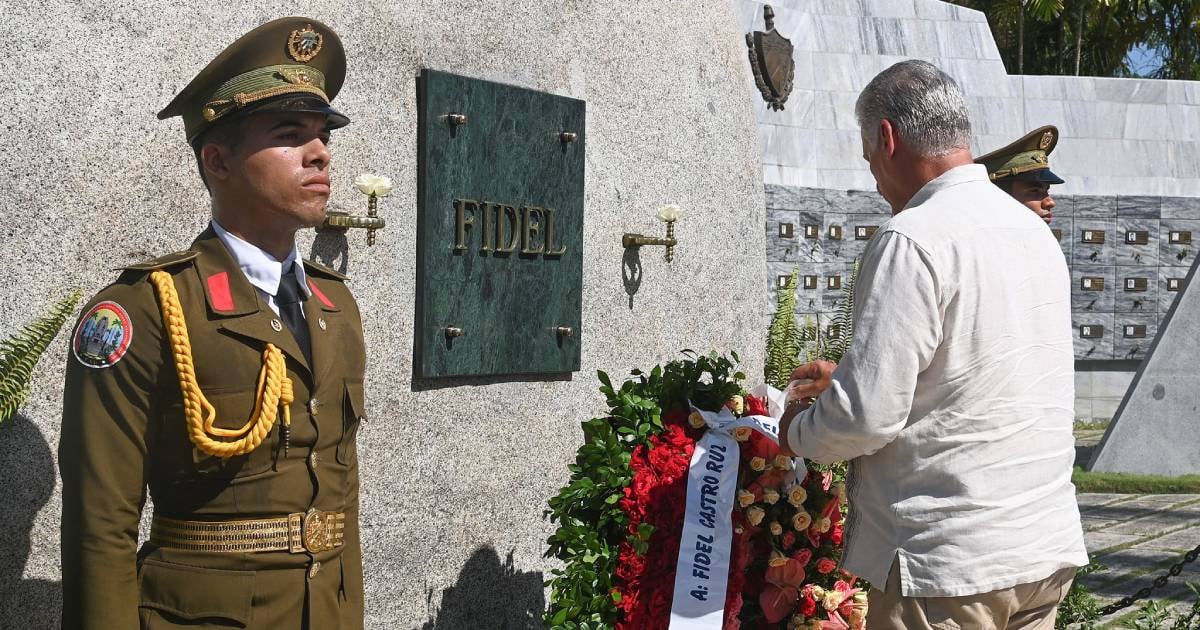
The Cuban leader Miguel Díaz-Canel Bermúdez and his wife, Lis Cuesta, visited on Wednesday in Santiago de Cuba the stone that holds the ashes of Fidel Castro, located in Santa Ifigenia Cemetery, as part of the official activities for the 99th anniversary of the dictator's birth.
"From our feelings and clear ideas, we share the fidelista conviction that there are no setbacks in the fight for the homeland, only multiple possible victories. This is the best tribute to the Commander in Chief this August 13th: knowing how to honor his legacy by achieving successive triumphs and tangible results in these difficult times," he posted on his X account.
The leader assured that Fidel is "in full life" and described him as "constant, a guide, a challenge, an example, and a source of concern."
Despite the economic and social debacle on the island, Díaz-Canel framed the date as "the beginning of a symbolic year" that will culminate in 2026, when the centenary of Castro's birth will be celebrated.
While the speech of Díaz-Canel insists on the “eternity” of the former leader and on the unity of revolutionary forces, the daily life of the majority of Cubans continues amidst prolonged blackouts, shortages of food and medicine, inadequate salaries, and a collapsed healthcare system.
In unair-conditioned Cuba, families wonder how to make ends meet, how to preserve food without electricity, or how to access medications without relying on luck or external assistance.
The official exaltation of Castro's legacy contrasts sharply with the precariousness that many associate with his extended rule, which new generations prefer to ignore.
Frequently Asked Questions about Díaz-Canel's Visit to Fidel Castro's Stone in Santiago de Cuba
What was the reason for Díaz-Canel's visit to Fidel Castro's stone?
The visit of Miguel Díaz-Canel to Fidel Castro's memorial was part of the official activities for the 99th anniversary of the dictator's birth. In this context, the Cuban leader took the opportunity to exalt Castro's legacy, highlighting the importance of his figure in the history of Cuba.
How did Díaz-Canel describe Fidel Castro during the visit?
Díaz-Canel described Fidel Castro as a "constant, guide, challenge, example, and source of concern." He asserted that Castro is "in the fullness of life," emphasizing that his legacy is a key element in confronting the current challenges of the country.
What is the current situation in Cuba in contrast to the official discourse?
The current situation in Cuba is characterized by prolonged blackouts, shortages of food and medicine, and a collapsed healthcare system. These conditions starkly contrast with the official discourse that praises the legacy of Fidel Castro, overlooking the daily struggles faced by Cuban citizens.
What does the year 2026 symbolize for the Cuban government?
The year 2026 marks the centennial of Fidel Castro's birth. The Cuban government has labeled it a "symbolic year" and plans to use Castro's figure to reinforce the ideology of the regime and confront current challenges, despite the serious economic and social crisis the island is facing.
Filed under: