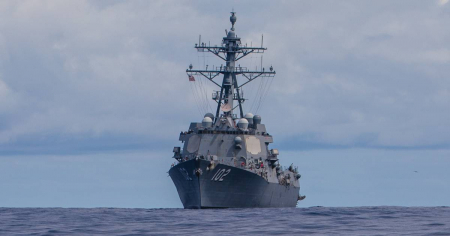
The United States has initiated a broad military mobilization in waters near Venezuela with the stated goal of combating Latin American drug trafficking cartels.
Three guided missile destroyers, accompanied by submarines, reconnaissance planes, and about 4,000 military personnel, are moving toward the boundary of Venezuela's territorial sea in what represents one of the most aggressive deployments in the southern Caribbean region in recent years, according to reports from the agency Reuters.
According to two sources with direct knowledge of the operation, within the next 36 hours, the destroyers USS Gravely, USS Jason Dunham, and USS Sampson will arrive in the area, all equipped with the Aegis guided missile system.
These units are part of a strategy that also includes P-8 surveillance aircraft, several additional warships, and at least one attack submarine.
A senior U.S. official, speaking on condition of anonymity, explained to Reuters that the deployment will last several months and that operations will take place in international airspace and waters.
He added that naval units will not only gather intelligence and conduct surveillance tasks, but they could also be used as platforms for selective strikes, if the administration deems it necessary.
"What will the tyrant Nicolás Maduro do when the 3 U.S. destroyers reach the shores of Venezuela? Nicolás, jester, get out to Cuba before it's too late," wrote Cuban-American congressman Carlos Giménez on X.
Designation of groups as terrorist organizations
The military deployment is directly tied to the Trump administration's decision to classify several organized crime groups as international terrorist organizations.
Among them are the Sinaloa Cartel (Mexico), the Venezuelan criminal group Tren de Aragua, and other gangs that, according to the United States government, operate with impunity in the region and are involved in transnational drug trafficking activities.
This designation took place in February and has served as the legal basis for intensifying military and intelligence operations.
Simultaneously, aerial surveillance over the cartels has increased to gather data that will facilitate the planning of future operations.
The offensive is part of a broader approach aimed at halting the flow of drugs into the United States while also addressing the structural causes of irregular migration.
Reaction of the Venezuelan government
Although the Ministry of Communications of Venezuela has not issued any official comments, Nicolás Maduro referred to the operation in a recent speech.
"Venezuela will defend our seas, our skies, and our lands" against "the unusual and strange threat of a declining empire," the leader stated.
Maduro has been supported by the military high command and the structures of the Venezuelan state.
The Minister of Defense, Vladimir Padrino López, denied that the government is linked to drug trafficking activities and described the accusations as “absurd” and “immoral.”
According to the minister, the criminal organizations mentioned by Washington have been "completely dismantled" in the national territory.
Meetings have also been held with the High Military Command and the Operational Strategic Command to assess the situation, while events in support of the president have been organized by the ruling party in various regions of the country.
Growing threat and regional tensions
The U.S. military operation comes after a series of decisions that increase pressure on the Venezuelan government.
Washington has offered up to 50 million dollars for information leading to the capture of Nicolás Maduro, who is accused of leading the so-called “Cartel de los Soles”, an alleged drug trafficking organization composed of State officials.
In light of this situation, high-ranking officials of the Venezuelan government have declared a state of alert.
Diosdado Cabello, Vice President of the United Socialist Party of Venezuela, stated that there is also a Venezuelan military presence in the territorial sea to "defend our sovereignty."
Like Maduro and Padrino, he rejected the ties to drug trafficking and accused the DEA of being “the only drug cartel that operates in plain sight.”
Frequently asked questions about the U.S. military deployment near Venezuela
Why has the United States deployed warships near Venezuela?
The United States has deployed warships in waters near Venezuela with the aim of combating Latin American drug trafficking cartels, which have been classified as terrorist organizations by the administration of Donald Trump. The deployment is part of a strategy to confront threats to U.S. national security posed by these narco-terrorist groups.
What are the main vessels involved in the deployment near Venezuela?
The main ships involved in the deployment are the destroyers USS Gravely, USS Jason Dunham, and USS Sampson, all equipped with the Aegis guided missile system. These vessels are part of a military operation that includes submarines and reconnaissance aircraft.
What has been the reaction of the Venezuelan government to the military deployment of the U.S.?
The government of Venezuela, led by Nicolás Maduro, has rejected the military deployment of the U.S. and has labeled it an imperial threat. Maduro has stated that Venezuela will defend its seas, skies, and lands against what it considers a threat from a declining empire.
What groups have been designated as terrorist organizations by the U.S.?
The administration of Donald Trump has designated several criminal organizations as terrorist groups, including Mexico's Sinaloa Cartel, the Venezuelan criminal group Tren de Aragua, and Mara Salvatrucha (MS-13). This designation allows the U.S. to intensify military and intelligence actions against these groups.
Filed under: