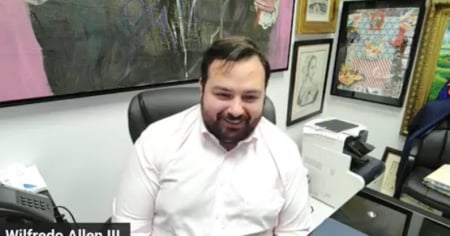
Florida attorney Willy Allen clarified this Monday what the U.S. Citizenship and Immigration Services (USCIS) understands by good moral character in applicants for American citizenship. He explained that the judgment of the officer conducting the interview plays a significant role, but they will certainly take into account traffic fines and debts, both in taxes and child support, when assessing the "good moral character" of the applicant.
Last Friday, the federal agency that oversees the country's immigration system ordered officials to consider additional factors when granting U.S. citizenship to immigrants who apply for it. This announced a tightening of the requirements for determining whether they possess "good moral character."
"Number one, if you are a man and have lived in the United States before turning 28, you must have registered for the draft, which does not exist, but in case of an emergency, it could come back. So, the law requires you to go to your local post office and register for the military service. You need to do it. If you are under 28, do it because it will be an issue that will come up in the citizenship application," Allen suggested.
"If you owe money to the IRS (Internal Revenue Service), remember, the IRS, taxes are like deities. It's the only letter that scares me. If you owe money to the IRS, that is evidence of moral wrongdoing."
"If you owe support to your children, whether they are in Cuba, in France, or in Belgium, that is further evidence of moral misconduct. If you owe money to your ex-wife, that is also evidence of moral misconduct," he added.
"Also, for example, I had a gentleman who took some time to become a citizen. He collected traffic tickets. He was a truck driver and it seems he wanted to have a collection of traffic fines from different counties in Florida and a couple of other states. In fact, the officer determined that the number of traffic tickets he had received over five years was evidence that he did not follow or obey the traffic laws in the United States and was indicative of moral misconduct."
"Of course, any arrest, even if it's denied, reflects moral misconduct. For example, shoplifting, which is a minor offense, is not even deportable, and most people who have done it once or twice go through a program that says, 'I swear I won't steal again.' Well, that may be enough to demonstrate moral misconduct and result in the denial of citizenship," the lawyer insisted.
Willy Allen also emphasized that "you must have at least five years of separation from that crime to obtain citizenship, and now they may make it stricter. Having been a member of the Communist Party requires 10 years of separation from the Communist Party before becoming an American citizen," he stated.
For the lawyer, the citizenship exam is not particularly complex and requires only a basic level of English to maintain a conversation. However, he believes that moving forward, "they are going to make a tougher exam. They are adding 28 more questions that will be a bit more challenging. Still, the citizenship exam has no surprises. The nuns were right. If you read the questions, read the answers, and write down each question and answer ten times, you'll know it. It's not an exam where you walk in and have no idea what they'll ask you. It's not a geometry or algebra exam. It's an exam where you already have the questions and answers prepared. So, if you prepare well, you will pass," he said.
To my clients, I say, look, at this moment there are 100 questions. You will be selected for ten of those questions. One will require you to read it in English and write the answer in English. That is, if you get used to it and take your homework seriously by writing ten questions a day for ten days, then wait a couple of days, and again write the ten questions and answers for another ten days, and continue writing them, your mind will adapt. If you're from Arriete, you only have to do it once or twice, but if you're from the rest of Cuba, you will have to do it about 30 or 40 times. So, the idea is to do it consistently and prepare yourself.
"Emigration is not mathematics, it’s not rocket science to go to the moon, it’s not engineering. It’s knowing what a rule is and applying that rule to each case. For citizenship, they will ask you questions in English and you must answer them in English," clarifies the lawyer.
Filed under: