
Related videos:
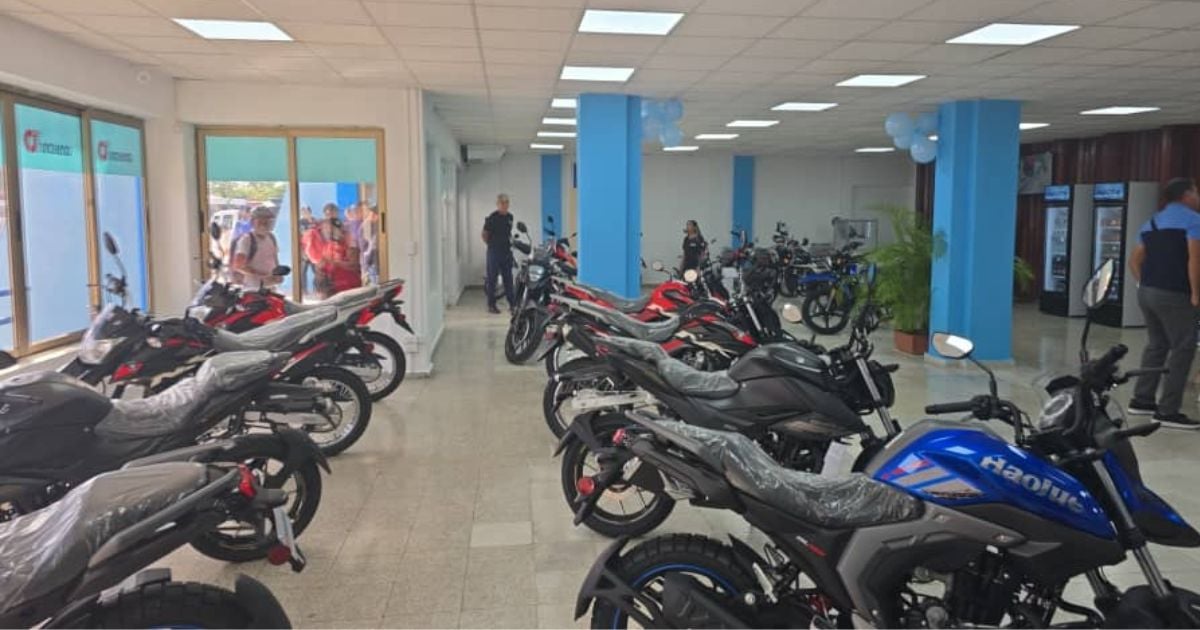
The state chain Tiendas Caribe has inaugurated a new service for selling combustion motorcycles in Holguín, promoted as “good news for motorcyclists,” although the prices in dollars, ranging from 2,130 to 6,590 USD, place these vehicles far beyond the reach of the average salary in Cuba.
The point of sale was opened at the Universal Store on the Central Highway, in the presence of executives from the corporation, who presented the proposal as an "opportunity" to acquire models from the brands Suzuki, Haojue, and Nipponse, featuring various ranges and technical specifications.
On their Facebook page, Tiendas Caribe Holguín emphasized that the service includes “the added value of handling the documentation for vehicle registration,” presenting as a special benefit a process that is considered essential in any country when purchasing a vehicle.
The published prices range from 2,130 USD (Nipponse R1) to 6,590 USD (Suzuki DS250), with intermediate options such as the JC125 at 2,195 USD, the NK150 at 3,320 USD, and the GSX-250 RL at 6,165 USD.
All payments must be made in foreign currency using international magnetic cards (Classic, AIS, or BANDEC prepaid).
And if the customer only has cash, the regime found a way: it requires them to first purchase a Clásica card and load it before paying, thereby ensuring that every dollar goes through their coffers.
The inauguration was presented as a proposal of "guaranteed quality and specialized attention," but the public reaction has centered more on the contrast between prices in dollars and the national economy, characterized by inflation, scarcity, and state salaries that barely exceed 20 USD per month at the real exchange rate.
Thus, while the official discourse speaks of "good news," the sale of motorcycles in Holguín once again highlights the disconnect between the foreign currency offerings of the state sector and the real needs of the Cuban population.
Additionally, many users noticed that the same models, or even better ones, are available in other countries at significantly lower prices.
Andrés Hernández Sánchez called for immediate action against the ticket scalpers: "Is there any solution for the scalpers? When are they going to take action on that? Put police at the entrance."
The debate expanded with Adrián Aguilera, who questioned the access mechanism to the store, and received Hernández's response: “They position themselves in a corner and sell you the spot. 200 USD.”
For his part, Ali Hernández Alameda criticized the official prices and compared them to other markets: “They are crazy with those motorcycle prices. Better ones are available for 2,500, which is 17 times less.”
Rodrigo Torres expressed his outrage when converting the amount to local currency: “3,320 USD is 1,345,000 CUP, abusive scammers; the people are paid in local currency.”
In the same vein, Rey Machado criticized the logic of institutionalized reselling: “What kind of merchants, always selling at double the price, how outrageous.”
Papo López was even harsher, denouncing the price disparity between provinces: "What madness, those same motorcycles are being sold in Havana at a lower price and they are state-run stores. We're killing ourselves. A price here and another in the East is a lack of respect. $1,000 more. Don't buy any motorcycles, let them rot. They are living off the people as if we were paid in USD and they force us to pay in USD."
In 2019, the store Autos y Piezas La Central opened its doors in the city of Holguín as the second sales outlet for freely convertible currency in the eastern part of the country.
Motorcycles and electric bicycles, lithium batteries, car batteries, tires, spare parts for these vehicles, and various components were some of the products they offered.
Isael Zaldívar, at that time the manager of the entity, told the outlet TeleCristal that there were around 22 types of items available in the commercial unit, including not only electric motorcycles but also parts and pieces for Lada and Moskvich cars.
Since the beginning of 2025, the government has promoted the creation and reopening of dozens of establishments that only accept foreign currency, widening the gap between those who have access to the dollar and the majority of the population that relies on the devalued Cuban peso.
In February, the Ministry of Domestic Trade announced the opening of 50 new dollar stores across the country, while shortly after “Las Maravillas” discreetly opened in Holguín, offering perfume, cleaning products, and baby items.
That same month, it was reported that the Altahabana Shopping Center, in Havana, began operating exclusively in dollars, with payments allowed in cash, international cards, or local prepaid cards.
By March, the reopening policy had already established a circuit of currency-based commerce that excluded CUP and MLC. In May, the number of establishments operating solely in dollars surpassed 85 across the Island, according to press reports.
The phenomenon has intensified over the months. In July, it was warned that the dollarization of food and basic products continued to expand, while the use of MLC was declining rapidly.
This trend confirms that access to essential goods is increasingly conditioned by the ability to obtain U.S. dollars, which deepens social inequality in the country.
Frequently Asked Questions about Motorcycle Sales in Dollars in Holguín
What are the motorcycle brands sold in Holguín and their prices?
The state chain Tiendas Caribe offers motorcycles from the brands Suzuki, Haojue, and Nipponse. Prices range from 2,130 USD to 6,590 USD, making them unaffordable for most Cubans who earn a salary in national currency.
What do citizens think about the sale of motorcycles in dollars?
The announcement has generated dissatisfaction among citizens, who believe that the prices are excessive compared to incomes in Cuban pesos. Furthermore, the sale in dollars reinforces economic inequality in the country.
How does the dollarization of trade affect the Cuban population?
The dollarization of commerce in Cuba exacerbates social disparities and limits access to basic products for those without access to foreign currency. Most dollar stores are well-stocked, while those operating in the national currency face shortages.
What does "added value" mean in motorcycle sales in Holguín?
The promotion of motorcycles in Holguín includes the processing of documentation for vehicle registration as an "added value." This procedure is presented as a special benefit, although in most countries it is a standard procedure when acquiring a vehicle.
Filed under: