
Related videos:
In the heart of El Vedado, at the corner of Paseo and Calle 15, stands one of the most unique residences in Cuban domestic architecture, the mansion of Pablo González de Mendoza.
This masterpiece by architects Leonardo Morales y Pedroso was built between 1916 and 1918. It not only synthesizes the aspirations of the Havana upper bourgeoisie of its time but also represents one of the most refined examples of the so-called “Morales Style” or “Vedado Style.”
Who was the original owner of the mansion?
Pablo González de Mendoza, a prominent member of the capital elite in the early twentieth century, commissioned the construction of this residence with the aim of combining comfort, prestige, and elegance.
The blog History of Cuba details that Pablo González de Mendoza Pedroso was born in Spain and in 1911 founded the Banco Mendoza y Compañía, of which he was the sole owner and president until his passing in 1952.
He was also the founder of the Banco Hipotecario Mendoza, a commercial institution with a branch and central office in the Palacio de Aldama. It ranked 24th among the banks in Cuba based on the amount of its deposits, which totaled $4,900,000.
The name of this wealthy businessman is tied to a house that became a symbol of architectural elegance and the meticulous urban design that characterized the neighborhood of El Vedado since its conception in the second half of the 19th century.
What makes the mansion at 15 and Paseo so special?
The residence stands out for its harmonious blend of classic sobriety and functional innovation. From the exterior, the flat roofs coexist with tiled roofs, and the volumes interact with expansive gardens, designed as areas for shelter and contemplation.
The interior of the residence merges with the landscaped space that surrounds it, featuring a harmonious transition from the private to the public, enhanced by terraces, stairs, and walking areas within the premises, which provide rhythm and depth to the structure of this luxurious Cuban mansion.
In the lobby, the marble staircase with a semicircular design is one of the central elements of the layout, illuminated by a stained-glass window that filters the light. Two interconnected salons lead to the terraces, enhancing the sense of spaciousness and spatial continuity.
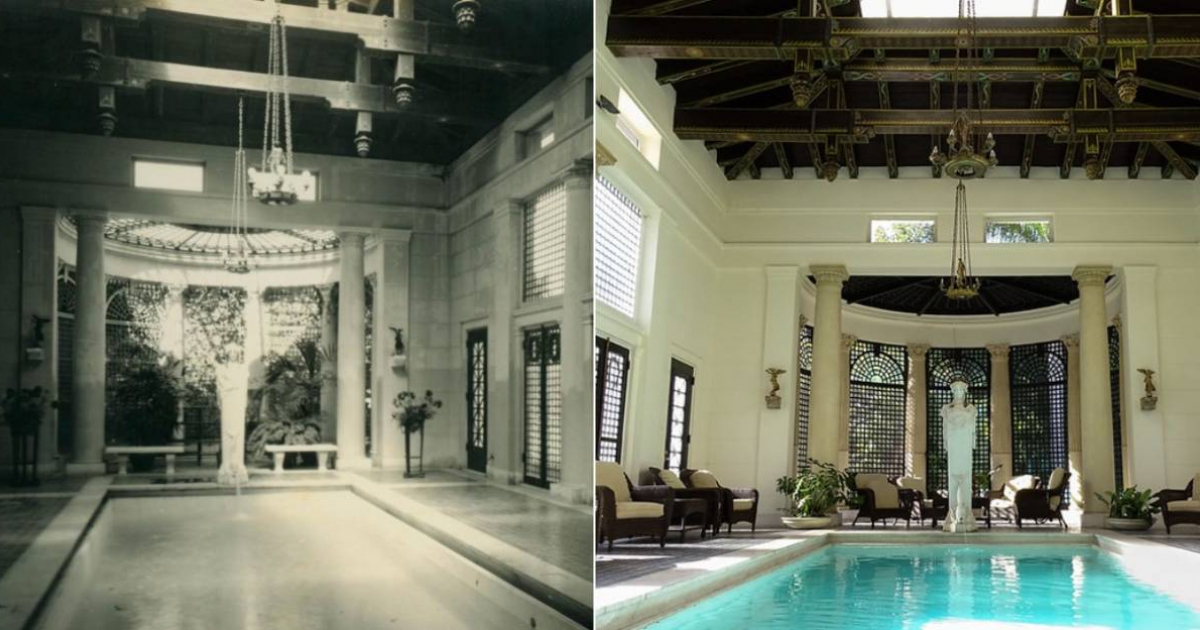
The Office of the Historian emphasized that what makes this mansion a unique heritage asset is its indoor Pompeian-style pool: the first built under a roof in Cuba. It is inspired by the impluvium of Roman houses; however, it was an addition made after the original construction.
Its skylight supported by painted wooden beams, along with its classic design, offered a multifunctional space that, on festive days, transformed into a ballroom thanks to a system of removable planks. A true luxury of its time that speaks to the ingenuity and refinement of its creators.
The Historical Photo Archive of the Office of the Historian of the City of Havana preserves a valuable collection of images of this residence, taken by photographer Luis A. Quintero Framil. These photos allow for a detailed appreciation of the aesthetic evolution of the house and its excellent state of preservation.
CiberCuba had the opportunity, a few years ago, to visit this iconic property and document its untouched interior in images, featuring original furniture, stained glass, and architectural details that have withstood the test of time.
Currently, the mansion is cared for by the British Embassy in Havana, as it serves as the residence of the ambassador of that country in Cuba.
This "luck" that the property has had ensures its maintenance and preservation as part of the architectural heritage of El Vedado, a privilege that other mansions in the capital, which are now in complete ruin, did not enjoy, despite being a part of the history of Cuban architecture.
Filed under: