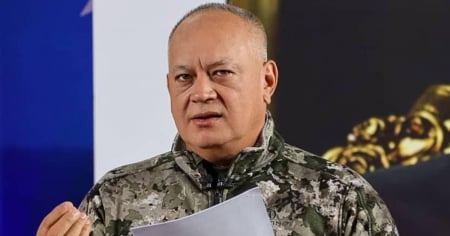
The U.S. congresswoman María Elvira Salazar responded harshly to the accusations from the powerful Interior Minister and key figure of chavismo Diosdado Cabello, who tried to link her along with the opposition leader María Corina Machado to drug trafficking funding.
In a message shared on X, Salazar described it as "ridiculous" that a "corrupt and repressive narco-military" like Cabello would accuse her and Machado of receiving funds from drug trafficking.
He stated that the accusation brings about "laughter and secondhand embarrassment" and asserted that chavismo acts with "nervousness and terror" because "the United States has never been so determined to end the transnational criminal operation that he and dictator Maduro lead."
The congresswoman stated that she will always stand by the Venezuelan people and “brave women” like Machado, whom she described as “the future of a free and prosperous Venezuela” in the face of the “misery” that, according to her, sustains the Chavista regime.
The confrontation occurs at a time of rising political tension in Venezuela, where the opposition insists on defying the government of Nicolás Maduro.
In a previous post, Salazar had already called to "leave alone the cowards who have plundered, oppressed, and divided the country," in support of a message from Machado in which he asserted that "the time has come to disobey the tyranny."
On her part, the Venezuelan opposition leader denounced on X that chavismo is trying to hold on “with lies, blackmail, hatred, and violence,” but emphasized that the dignity of the Venezuelan people has prevailed against authoritarianism.
Machado urged public employees, military personnel, and citizens to disobey the regime, which he described as criminal and isolated, stating that "the empty plazas across Venezuela herald the future that is approaching."
On Wednesday, during his weekly program Con el mazo dando, broadcasted on the state channel VTV, Cabello assured that Venezuela is ready to face “whatever comes, no matter how tough it is”, in direct reference to the movements of ships, submarines, and Marines from the United States that, under the pretext of an anti-drug campaign, have been surrounding the Caribbean Sea for several days.
The message came after the complaint from Nicolás Maduro's government to the United Nations, which warned that the Pentagon is preparing to send a “missile cruiser” and a “fast-attack nuclear submarine” to the Caribbean, which Caracas interprets as a direct provocation and a “serious threat to regional peace and security.”
The Venezuelan "response" was translated into a deployment of warships, drones, helicopters, and surveillance points along the Caribbean Sea and the border with Colombia, under the framework of Operation "Relámpago del Catatumbo."
The Minister of Defense, Vladimir Padrino López, confirmed that more than 15,000 troops are mobilized.
Washington, for its part, has not hidden its cards. According to international media, the Trump administration sent the missile cruiser USS Lake Erie, the submarine USS Newport News, three destroyers, and around 4,500 marines, along with spy planes. All, in theory, to combat drug trafficking.
According to The Washington Post, in addition to the three destroyers, two landing ships, a cruiser, an amphibious assault ship, and a littoral combat ship are part of the flotilla. The vessels carry helicopters, Coast Guard detachments, and federal agents specialized in drug interdiction.
For the chavismo, such a narrative is merely an excuse. Venezuela asserts that it has no illegal crops and that the U.S. deployment is a geopolitical strategy to pressure Maduro's regime and force concessions.
"This has no technical justification; it is tactical pressure," warned analyst Phil Gunson from the International Crisis Group.
This Thursday, Maduro sent a letter to the Secretary-General of the United Nations, Antonio Guterres, in which he denounced an "unprecedented level of threat" from the United States due to its military deployment in the Caribbean, and urged that Washington be called upon to put an end to these actions and to fully respect the sovereignty, territorial integrity, and independence of the Latin American country.
Amid rising tensions, Cuba stood firm with its Venezuelan ally. The leader Miguel Díaz-Canel pledged "unconditional support" to Maduro and denounced the "imperialist threats" from the United States, reinforcing the historic alliance between Havana and Caracas.
Frequently Asked Questions about the accusations against Diosdado Cabello and the response from María Elvira Salazar
Why does Diosdado Cabello accuse María Elvira Salazar and María Corina Machado of receiving funding from drug trafficking?
Diosdado Cabello, a key figure of chavismo, launched these accusations as part of a strategy to delegitimize his political opponents. These accusations occur in a context of increasing political tension in Venezuela, where Nicolás Maduro's government faces internal and external pressures. Cabello seeks to connect opposition figures with illicit activities to discredit their criticisms and proposals for political change.
What has been María Elvira Salazar's response to Cabello's accusations?
María Elvira Salazar responded by calling the accusations "ridiculous," claiming they provoke "laughter and secondhand embarrassment." Salazar emphasized that the Chavista regime acts with "nervousness and terror" in response to the determination of the United States to put an end to what she described as a "transnational criminal operation." Additionally, she reaffirmed her support for the Venezuelan people and opposition leaders like María Corina Machado.
How is the military buildup of the United States in the Caribbean interpreted?
The military deployment of the United States in the Caribbean is interpreted as an anti-drug campaign, although Venezuela sees it as a direct provocation. Washington has sent ships, submarines, and marines to the Caribbean, arguing that the goal is to curb drug trafficking. However, Maduro's government perceives it as a "serious threat to regional peace and security," and has responded with its own military deployment in the region.
What is María Corina Machado's position on the situation in Venezuela?
María Corina Machado has called for disobedience against the Maduro regime, labeling it as criminal and isolated. Machado has denounced that chavismo sustains itself "through lies, blackmail, hatred, and violence," and has urged public employees, military personnel, and citizens to disobey the regime. Furthermore, she has highlighted the bravery of the Venezuelan people in the face of authoritarianism and has promised that freedom is in sight for Venezuela.
Filed under: