
Related videos:
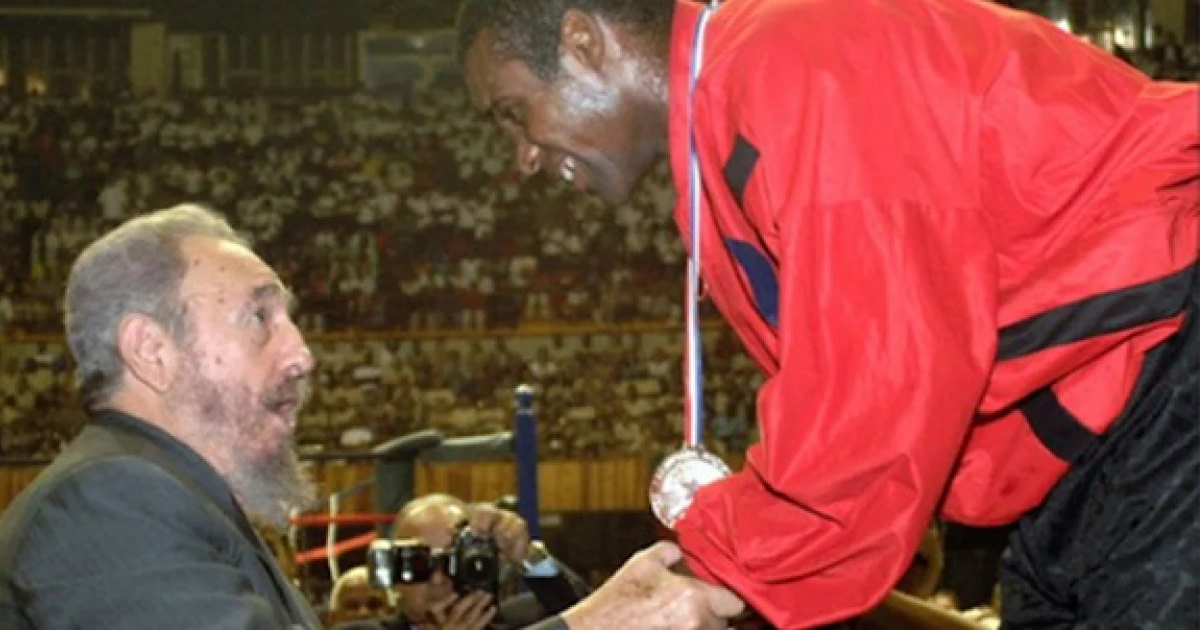
The legendary Cuban boxer Mario Kindelán, a double Olympic champion and three-time world champion, revealed details of his close relationship with Fidel Castro in the podcast La Remontada, which was broadcast on the channel of Youtube Livan Deportes TV.
His statements not only reveal how politics dominated every aspect of Cuban sports but also highlight the unhealthy dependence on a system where an athlete had to turn directly to the dictator to address the injustices of INDER, an organization riddled with bureaucracy, negligence, and corruption.
Fidel Castro, the absolute arbiter of sports
Kindelán recounted that, in the year 2000, shortly before the Sydney Olympic Games, the coaches tried to force him to compete in the 57-kilogram division.
Dissatisfied, he decided to bypass the country's sports structure and call Castro directly. "I had Fidel's personal number because he gave it to me for when I faced any situation in our country," he confessed.
The response was immediate: in less than two hours, the INDER received orders to rectify. Kindelán competed in the 60-kilogram category, won the gold medal, and publicly dedicated it to Castro.
The anecdote highlights how sports operated in communist Cuba: it depended on the will of the supreme leader, not on solid institutions or transparent procedures.
The illusion of support and abandonment after retirement
In an interview in 2023, the former boxer recounted another episode from 2004, when Hurricane Charley destroyed the homes of Odlanier Solís, Yan Bartelemí, and Guillermo Rigondeaux. The then-president of INDER, Humberto Rodríguez, told him that he could not do anything.
Once again, Kindelán turned to Castro and within hours the problem was resolved. Thanks to that intervention, the three athletes were able to reach Athens and be crowned Olympic champions.
But what appeared to be a "stronghold of the system" — a Commander sensitive to athletes — is actually its greatest vulnerability. If the institutions functioned properly, no athlete would need to call the country's ruler to resolve an issue with housing, a sports facility, or an injustice.
Kindelán experienced it himself: when he retired in 2004, he ceased to be useful for official propaganda and was abandoned.
In that interview, the multi-champion confessed that he had to sell one of his Olympic medals to feed his family. "I sold it because I found myself in a critical situation. I practically had nothing to eat or to support my daughters."
Meanwhile, the INDER not only ignored him but also punished him: when he found work in Bahrain as a coach, the organization withdrew the only stipend he was receiving—7,400 Cuban pesos, a laughable amount.
That, after having concealed for years the offers he received from abroad, lying to federations that insisted on hiring him.
The former boxer also reported the theft of the trophies he had donated to the INDER Museum in Holguín, including a valuable dog that he received in Ireland. No one provided explanations or took responsibility.
For Kindelán, the decay of the Cuban sports system is evident: leaders with no sports background who only seek docile coaches and athletes, widespread corruption, benefits reserved for bureaucrats, and a complete abandonment of the sports glories that were once exalted as symbols of the revolution.
The contrast: respect outside, humiliation in Cuba
In 2923, Kindelán finally went to work in Bahrain, where he found the respect that INDER never gave him: "They treat me like an Olympic champion, they hug me, greet me, recognize me. In Cuba, it is the people who love me, not the leaders. For them, Olympic champions do not exist," he said at the time.
The case of Mario Kindelán starkly illustrates the perversion of sport under communism: a system that, while it found him useful, used him as a propaganda tool, only to discard him into oblivion afterward.
His testimony is, at the same time, a confession of how Castroism turned sports into a political tool and a denunciation of a present where Cuba's Olympic glories survive more by their own merit than by state support.
Frequently asked questions about Mario Kindelán and Cuban sports under the Castro regime
What was Mario Kindelán's relationship with Fidel Castro?
Mario Kindelán had a direct relationship with Fidel Castro, to the extent that he had his personal number to resolve issues related to his sports career. Kindelán revealed that on more than one occasion he bypassed the bureaucracy of INDER and contacted Castro directly to address situations that affected his performance as an athlete.
What does Mario Kindelán's case reflect about the Cuban sports system?
The case of Mario Kindelán reflects the dependency of Cuban sports on the figure of Fidel Castro, highlighting the lack of strong and transparent institutions. Athletes, in order to solve problems, had to turn to the supreme leader, a system that, while it seemed to show sensitivity towards the athletes, actually revealed the weakness and corruption of the institutional system.
What was Mario Kindelán's life like after his retirement from boxing?
After his retirement in 2004, Mario Kindelán was abandoned by the system that once exalted him. Despite his achievements, he had to sell one of his Olympic medals to survive, and when he found work in Bahrain, INDER withdrew the only stipend he had. This abandonment reflects the regime's indifference towards sporting glories once they cease to be useful for official propaganda.
Filed under: