
Related videos:
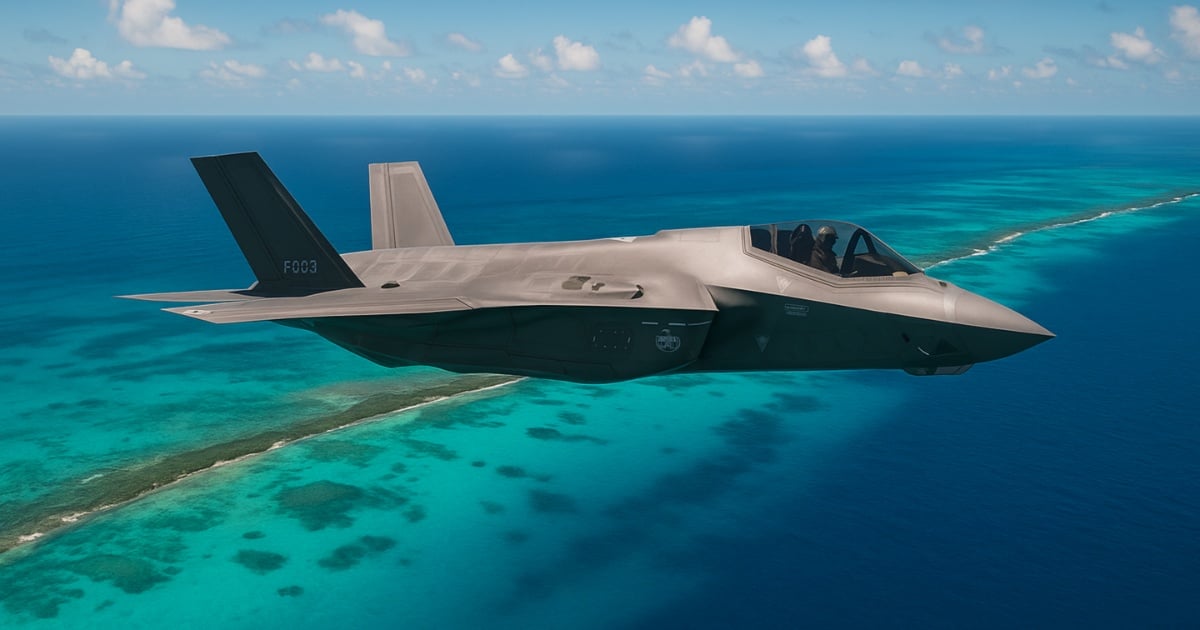
The United States government deployed 10 F-35 fighter jets, regarded as the most advanced in its arsenal, to strengthen operations against drug cartels in the Caribbean.
The measure, confirmed by Fox News, aims to iintensify the fight against drug trafficking that fuels the drug crisis in the United States.
The F-35 have been deployed to Puerto Rico, where they will serve as strategic support in anti-drug missions, providing intelligence, reconnaissance, and deterrent capabilities against transnational criminal organizations.
The F-35 is a "stealth" or "low observable" fighter designed to be difficult to detect by enemy radars. Its design employs specific angles, radar-absorbing coatings, and the internal integration of sensors and weapons to minimize its electromagnetic and thermal signature.
This technology, known as stealth, greatly complicates an adversary's ability to locate and intercept it.
This deployment represents one of Washington's largest military commitments to contain the smuggling routes that traverse the region.
The decision is part of a broader national security plan that links the fight against cartels with the internal stability of the United States.
With this action, the United States sends a message of strength to the criminal groups operating in the Caribbean and reaffirms its commitment to halting the flow of drugs into its territory.
Tensions between the U.S. and Venezuela
This Friday, Venezuelan fighters flew over the USS Jason Dunham destroyer as a provocative action, according to the Pentagon, in order to interfere with the anti-drug and anti-terrorism operations carried out by the United States Navy in the Caribbean.
These types of maneuvers increase tensions between both countries in a context of mutual accusations related to drug trafficking and security in the region.
Maduro, during an unusual press conference in Caracas, accused the United States of "seeking a regime change through military threats."
The USS Jason Dunham is part of a flotilla of at least seven U.S. warships deployed in the Caribbean, with more than 4,500 Marines and sailors on board.
In parallel, troops from the 22nd Marine Expeditionary Unit have been conducting amphibious training and flight operations in southern Puerto Rico.
On Tuesday, a U.S. military attack in the Caribbean resulted in the deaths of 11 people and the sinking of a Venezuelan vessel, which was allegedly involved in drug trafficking.
The U.S. Secretary of Defense, Pete Hegseth, defended the operation and stated that "the poisoning of the American people is over."
Frequently Asked Questions about the U.S. Military Deployment in the Caribbean
Why has the United States deployed F-35 aircraft in the Caribbean?
The United States has deployed 10 F-35 aircraft in the Caribbean as part of its operations to combat drug trafficking, which fuels the drug crisis in its territory. These aircraft are in Puerto Rico to support anti-narcotics missions with intelligence, reconnaissance, and deterrence against transnational criminal organizations.
How has Venezuela reacted to the U.S. military deployment in the Caribbean?
Venezuela has conducted provocative maneuvers, such as the overflight of fighter jets over the USS Jason Dunham, which has heightened tensions with the U.S. The Venezuelan government has accused the U.S. of attempting a regime change through military threats and has mobilized troops and militias to defend its sovereignty.
What does the designation of Venezuelan organizations as terrorists by the U.S. imply?
The designation of the Cartel of the Suns as a terrorist organization by the U.S. allows the American government to intensify military and intelligence actions. This classification serves as a legal basis for more aggressive operations against drug trafficking and increases pressure on Nicolás Maduro's regime.
What consequences could the U.S. military deployment in the Caribbean have?
The U.S. military deployment in the Caribbean could increase regional tensions and the risk of direct confrontations with Venezuela. It also intensifies pressure on the Maduro government and could lead to a military escalation if provocations persist. Furthermore, this move has a significant geopolitical component, as it is positioned against an ally of Havana.
Filed under: