
Related videos:
Education in Cuba continues to be influenced by political indoctrination from a very young age.
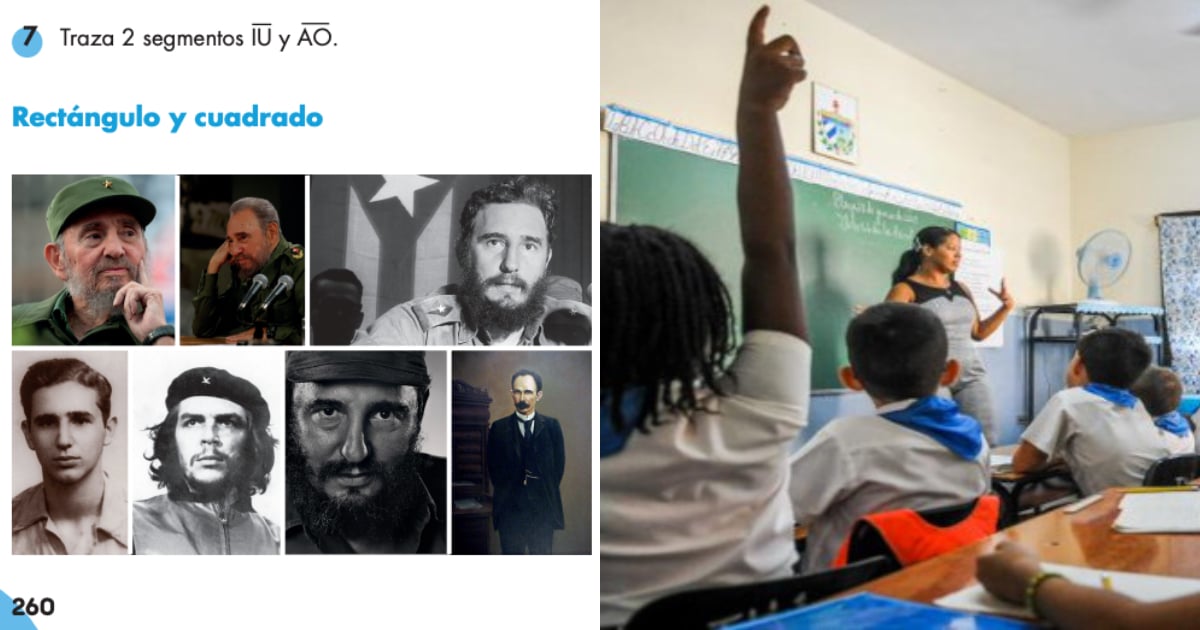
In recent hours, images from the first-grade math book - published by Pueblo y Educación in 2023 - have circulated on social media after singer Inti Santana questioned the inclusion of images of Fidel Castro in exercises for learning geometric shapes.
"This is a mathematics book MATHEMATICS!! for 1st grade in Cuba. It is aimed at 6-year-olds. Honestly, I would like to see equivalents from all other countries and education systems to see if they resort to such blatant indoctrination and personality cult to teach what the hell a square or a geometric shape is," the artist criticized.
"Later, they don't want me to say that the political practice in Cuba, what they call the Revolution, is nothing more than another religion with its holy Trinity, its priests, its fucking liturgy, and its dogmatic system that tells a 5-year-old whom they should believe in, who the messiah is, who is unquestionable..." he emphasized.
Political references and political slogans also appear in other exercises in the book.
What should be material for learning basic addition and subtraction is turning into a propaganda tool, according to reports from activists and parents on the island.
The strategy is not new: for decades, Cuban education has been used as a vehicle to legitimize the system, but the persistence of indoctrination is particularly significant in the current context, when the Prime Minister Manuel Marrero himself has stated that the regime's priority for 2025 will be to strengthen political-ideological work above the economy.
During his speech at the Fourth Ordinary Session of the National Assembly, Marrero emphasized that politics is positioned as "the foundation of everything," placing the defense, internal order, and strengthening of the socialist state system above the country's social and economic urgencies. "This work is essential to guarantee national stability and cohesion," he stated in a speech broadcast on official television.
The insistence on this approach, combined with the precariousness of the educational system—characterized by a shortage of teachers, deteriorated infrastructure, and lack of materials—reflects how the regime prioritizes ideological control over the quality of education.
School indoctrination, which is now evident in simple math problems, is part of a broader social control strategy that includes the glorification of the Communist Party across all subjects, the requirement for political events, and the use of revolutionary slogans as part of daily school life.
Meanwhile, growing social discontent and the economic crisis are deepening tensions in Cuba, where more and more families are questioning whether their children's future is being built on slogans rather than real knowledge.
Frequently Asked Questions about Indoctrination in Cuban Education
How does indoctrination manifest in school textbooks in Cuba?
The indoctrination in Cuba is reflected in school books through the inclusion of images and references to political figures, such as Fidel Castro, in basic exercises. This is even seen in first-grade math books, where political figures appear in problems that should be purely educational. Such practice turns educational materials into tools of political propaganda.
Why does the Cuban government prioritize political indoctrination over quality education?
The Cuban government prioritizes political indoctrination as a strategy to ensure national stability and cohesion under the socialist regime. According to official statements, education must be guided by the principles of socialist society, which implies a focus on ideological training over academic instruction. This occurs in a context of economic crisis, where ideological control is deemed essential for the maintenance of the regime.
What is the current situation of the educational system in Cuba?
The Cuban education system faces serious shortcomings, such as a lack of teachers, deteriorated infrastructure, and a shortage of basic materials. Families must deal with high costs to acquire school supplies in the black market due to state insufficiency. Furthermore, practices such as sharing notebooks between subjects reflect the precariousness of the system, while the official discourse continues to emphasize education as a "conquest of the Revolution."
How does the Cuban political context affect the education of children?
In Cuba, the political context profoundly influences the education of children, directing it towards the training of citizens loyal to the regime. Education is designed to instill revolutionary values and principles from an early age and is used as a means to legitimize the current political system. This ideological orientation is present in school curricula and in the organization of activities that promote the cult of figures from the regime.
Filed under: