
Related videos:
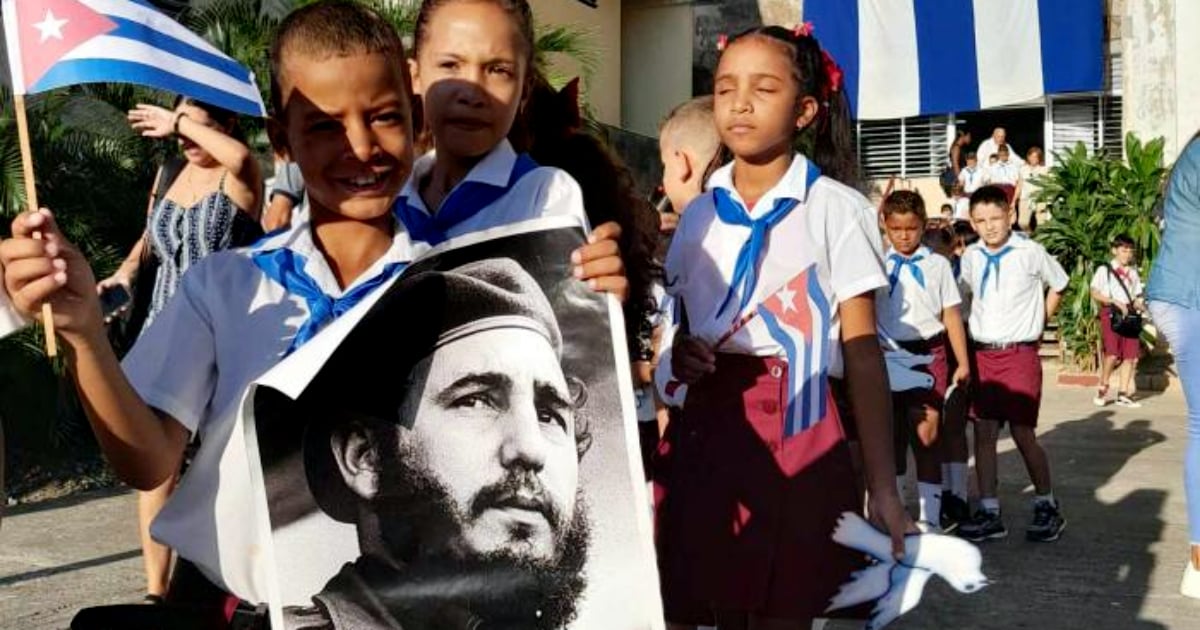
Every September first, millions of Cuban children march to school dressed in the uniform that symbolizes the "equality" promoted by the regime.
White shirts, colorful scarves, trousers, or skirts that replicate the uniform image of socialist childhood. However, this uniform is no longer solely the creation of the Cuban state: an increasing portion of these garments comes from Miami, produced in private workshops and sold in exile shops like ‘Ñooo ¡Qué Barato!’ or ‘El Dollarazo’.
The data reveals a paradox worth analyzing: it is precisely the emigrants—those whom the regime called "worms," "enemies," or "disloyal" for decades—who today support an essential aspect of the Cuban education system with their remittances and entrepreneurial ingenuity.
In practice, they are providing the children of the island with the uniform that will become the centerpiece of an educational ritual marked by fierce ideological indoctrination.
The liturgy of the uniform
In Cuba, the school is not just a space for academic learning; it is, above all, a setting for political education.
Since the age of six, children repeat slogans like “Pioneers for Communism: We will be like Che!” during morning events where the uniform reinforces collective discipline. The blue scarf of first grade, which will later become red, serves as both a symbol of belonging and an ideological pledge.
The uniform, in this context, is not just a simple garment: it is part of the liturgy that ensures uniformity, obedience, and adherence to the socialist project.
Each pressed white shirt and identical skirt or pants helps to erase individual differences, reinforcing the idea that all children and students are part of the same moral army, under the direction and "spiritual guidance" of the Communist Party of Cuba (PCC).
That these garments are now arriving in boxes sent from Miami is a historical irony. The children of exiles often wear brand-name clothing and enjoy complete freedom of choice.
The children of those who remain on the island, on the other hand, must conform to integrate into a system that, far from viewing them as autonomous individuals, shapes them into future activists.
The paradox of the market
According to reports from independent and local media, at least 1,200 pieces of school uniforms are sold in Miami each year, with prices ranging from 2 to 10 dollars depending on the item, in addition to other educational supplies that are scarce on the Island.
For many Cuban families, those dollars come from remittances sent by emigrated relatives who no longer trust the government to cover their basic needs.
The regime, which fails to ensure a uniform for each student every year, has tacitly transferred that responsibility to the diaspora. The State maintains the rhetoric of "free education," but the actual cost is borne by emigrants who finance, purchase, and send these items.
A network of solidarity is activated, but a market niche also opens up that illustrates how the failure of central planning in a totalitarian communist state transforms into a business opportunity for the exile.
The paradox becomes even more pronounced when it is revealed that many of these garments carry the label "Made in Venezuela." In other words, dollars from the Cuban exile community end up indirectly supporting another dictatorship allied with the regime in Havana.
The circle is vicious: those who fled state control and repression in Cuba unwittingly uphold the economic framework that supports the system that expelled them and has exported its model to other countries in the region.
Solidarity, business, or complicity?
It is not about questioning the solidarity of families. No parent in exile wants their child or grandchild in Cuba to go to school in patched clothes or without a uniform. The urge to help is understandable and legitimate.
But what is worth questioning is the political effect of that aid: does it ultimately not reinforce the regime's narrative that everything is functioning, even if it is thanks to external sacrifice?
The Cuban state has perfected a mechanism of structural blackmail: it demonizes the exile in official discourse but relies on their dollars to sustain daily life on the island.
Education is no exception: while the ruler Miguel Díaz-Canel proclaims that classrooms are a "vital conquest of the Revolution", the cost of outfitting students falls on the shoulders of the emigrants.
The uniform purchased in Hialeah and sent by mail to Havana becomes a symbol of that contradiction: without the diaspora, the communist school liturgy would be even more exposed in its precariousness.
The uniform as a political contradiction
That the exile produces and distributes the regime's uniforms says a lot about the nature of power in Cuba.
The government does not recognize emigrants as full citizens: they do not have the right to vote, to freely associate on the island, or to participate in the design of public policies. However, it does benefit from their resources, whether through remittances, consular taxes, or the consumption of services.
The contradiction is stark: those who were socially expelled and labeled as “worms” and “dissidents” are today an essential support for the system. Moreover, they are so in an especially sensitive area: education, turned into a political legitimization apparatus.
The child wearing pants made in Venezuela, bought in Miami and paid for with remittances, repeats in unison every morning: “Pioneers for communism.” This chorus of youthful voices is upheld, paradoxically, by those whom the regime has always considered enemies of the Revolution.
A necessary reflection
The debate is not easy. Family solidarity should never be called into question; no one can ask a grandfather in Hialeah to stop sending his grandchild a uniform for school. However, it is essential to reflect on how the regime transforms that solidarity into support for its own political discourse.
The Cuban school uniform, beyond being a piece of sewn fabric, is a symbol of obedience and uniformity. Each garment sent from exile is both an act of love and a confirmation of the regime's ability to survive thanks to the sacrifices of others.
In that contradictory mirror, the fragility of the Cuban model is revealed: unable to uphold its own liturgy, it relies on the declared enemy to dress the children who will continue to repeat slogans in the classrooms.
And that contradiction, more than any slogan, speaks volumes about the real state of a decaying regime, whose civil society is called to reflect on the implications of its actions, as well as the mechanisms of "emotional blackmail" wielded by the elites that exclude them and use it to perpetuate themselves in power through indoctrination and the subjugation of new generations.
Filed under:
Opinion article: Las declaraciones y opiniones expresadas en este artículo son de exclusiva responsabilidad de su autor y no representan necesariamente el punto de vista de CiberCuba.