
Related videos:
Miguel Díaz-Canel has stirred controversy once again by publicly congratulating his personal security team on his social media, the same team that surrounds him during every visit within Cuba and on every trip abroad, with a display that many consider excessive and characteristic of fearful dictators.
"Congratulations to my daily companions from Personal Security, loyal and brave men who, through the toughest battles, safeguarded our historical leaders from many dangers, and today they continue on the front lines with the same dedication. Strong embrace," he wrote.
However, the message provoked not admiration, but indignation.
In the comments on the post, Cubans recalled the dramatic difference between the luxurious and sheltered life of the leader and the reality of a impoverished people.
"Congratulations to all those mothers who have to work magic to put a meal on the table for their children," a Cuban wrote from the U.S.
Others were more direct: "Congratulations to all those murderers, who live off the people's money, and to Lis, who walks around in $2,500 shoes while the people die of hunger," said another emigrant.
"It's normal for you to see that; everyone wants you six feet under at least," said a user on X.
A display worthy of dictatorships
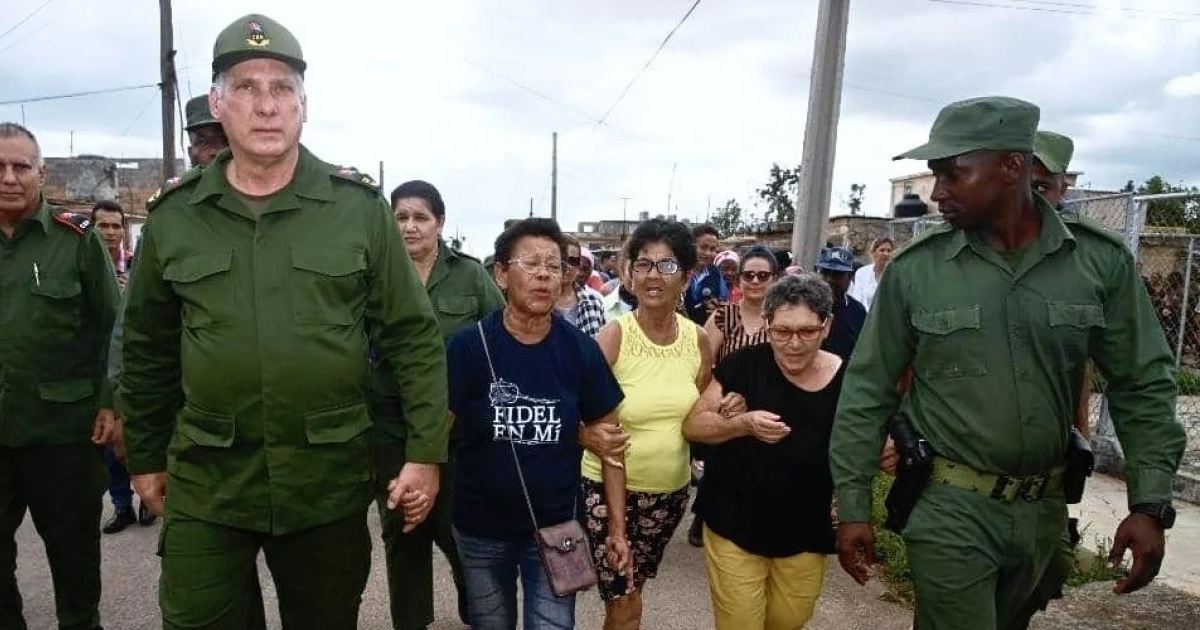
Díaz-Canel constantly travels surrounded by bodyguards, both inside and outside the country.
According to images circulated on the Internet, in Cuba he is accompanied by at least eight agents, three high-end BMW trucks, and a larger vehicle.
It is a display that even surpasses the ostentation used by Fidel Castro during his tours.
The videos that circulate always show the same script: the leader arrives in a municipality, surrounded by officials who prevent citizens from approaching freely, hurriedly greets people, takes a photo or talks with local leaders, and within a few minutes retreats back to his luxury convoy.
There is no room for spontaneity or for listening to a people who suffer daily blackouts, hunger, and illnesses without adequate medical care.
The official operations include the transport of dozens of "clarias" - government supporters - from other municipalities to the location where the leader is, in order to simulate popular support.
Despite all that display of power, the dictator's bodyguards are not without their flaws.
In April of last year, during a visit to a hospital in Matanzas, a confusion occurred when Díaz-Canel took the wrong exit and the security personnel panicked.
This led to a chaotic scene in which the visibly anxious security personnel started to impede the movement of people walking through the area until the presidential convoy made its way to the exit.
Criticism from both inside and outside the island
The reactions to Díaz-Canel's recent message reflect widespread discontent.
"There is no food in Cuba, people eat from the trash, children begging for money, and you, fat lady, have a $1,500 mobile phone. You are a damn disgrace," a young man exclaimed.
Another user wrote: "The president of Chile can ride his bike from the government palace to his home without escorts. That is only possible in a democracy."
While the country is experiencing record levels of misery, with a meager salary and a transportation crisis that prevents people from getting to work, Díaz-Canel travels with more bodyguards than many heads of state.
His priority is his personal security, not the food, health, or economic security of the Cubans.
The contrast between real Cuba and the theater that the regime tries to stage during each visit is once again evident: a shielded ruler who praises his bodyguards while the population survives amid blackouts, endless queues, hunger, and repression.
Frequently asked questions about the security deployment of Díaz-Canel and its impact on Cuba
Why does Díaz-Canel's security generate criticism in Cuba?
Díaz-Canel's security is perceived as a disproportionate display typical of fearful dictators, in stark contrast to the reality of a Cuban people facing poverty and economic crisis. This contrast stirs indignation among citizens, who criticize the lack of resources allocated to improve their living conditions.
What is Díaz-Canel's personal security detail like?
Díaz-Canel travels surrounded by at least eight security agents and three high-end BMW vans. This deployment, even within Cuba, is designed to protect him and prevent direct contact with the population, which has been criticized for its lack of spontaneity and responsiveness to the needs of the Cuban people.
What is the impact of Díaz-Canel's congratulations to his security team on public opinion?
Díaz-Canel's congratulations to his security team have generated indignation among the public, as they are perceived as a reflection of the disconnect between the luxurious life of the leader and the reality of a people suffering from basic shortages. This type of message reinforces the impression of a government out of touch with the needs of its citizens.
How does Díaz-Canel's security deployment compare to that of Fidel Castro?
The security measures of Díaz-Canel are more ostentatious than those of Fidel Castro. While Fidel Castro also had a significant protection scheme, the current measures not only match but exceed the ostentation of those used in the past, reinforcing the perception of a regime focused on protecting its leaders rather than addressing the needs of the people.
Filed under: