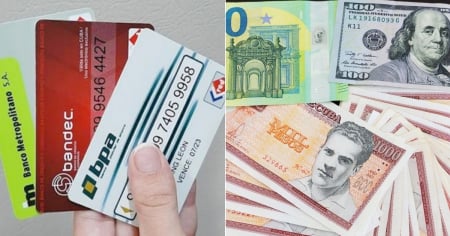
The informal currency market in Cuba began the week with new increases that reinforce the upward trend of foreign currencies against the Cuban peso and set a new all-time record for the euro.
According to the reference rate from elTOQUE, this Monday, September 8, the European currency reached 463 Cuban pesos (CUP), while the Convertible Currency (MLC) rose to 195 CUP, after several days of fluctuations.
The dollar, on the other hand, remains stable at around 412 CUP reached this Sunday, two pesos more than the value it held (410 CUP) from August 28 until September 5.
Informal exchange rate in Cuba Monday, September 8, 2025 - 04:00
Exchange Rate Evolution
- Exchange rate of the dollar (USD) to Cuban pesos CUP: 412 CUP
- Exchange rate of the euro (EUR) to Cuban pesos CUP: 463 CUP
- Exchange rate from (MLC) to Cuban pesos CUP: 195 CUP
One euro on a constant rise
In the last month, the euro showed a clear upward trend in the Cuban informal market, establishing itself as the reference currency with the most growth against the peso.
At the beginning of the period, on August 8th, the European currency was trading at around 445 CUP. During the first half of the month, it advanced slowly, reaching 450 CUP by August 12th, a level at which it remained relatively stable until the 25th.
Starting from the last week of August, the currency began to rise more sharply. Between August 26 and 28, the euro went from 450 to 460 CUP, an increase of 10 pesos in just three days. This jump marked the beginning of a more sustained rebound that led it to break a new psychological barrier in September.
In the early days of the month, the euro fluctuated between 460 and 461 CUP, with minimal variations indicating a level of consolidation. However, around September 7, it regained momentum and reached 463 CUP, its current price in the informal market, the highest on record.
The balance of the last thirty days reveals an increase of nearly 20 pesos, rising from 445 to 463 CUP, which represents a significant appreciation compared to the dollar, which has shown a more stable behavior.
This growth is attributed to the strong demand for the European currency, used not only as a store of value but also in commercial transactions in an increasingly currency-dependent market.
MLC: A Slight Breather
In the last month, the MLC has shown a clearly downward trend in the Cuban informal market, consolidating its loss of value against the peso and moving away from the levels it maintained earlier in the year.
On August 8, the MLC was priced at around 213 CUP, and since that date it began a gradual decline that brought it down to a low of 190 CUP by the end of the month.
Between August 10 and 14, the currency fell from 210 to 200 CUP, where it remained stable for several days, until it dropped again on August 21 to 195 CUP. This figure marked a new low that was soon broken: by August 28, the MLC had decreased to 190 CUP, its lowest level in the last quarter.
During the first days of September, the state digital currency saw a slight increase, with movements ranging between 191 and 193 CUP, though it did not recover the 200 barrier.
It was not until September 7 that the MLC approached that threshold again, reaching 195 CUP, still far below the prices it maintained months earlier.
The monthly balance reveals a loss of nearly 20 pesos compared to the start of the period, which confirms the growing distrust among Cubans towards this currency as a savings alternative or means of payment.
Unlike the euro and the dollar, which maintain a sustained upward trend, the MLC continues to weaken, reflecting the market's lack of interest in this state-controlled virtual currency.
In conclusion, the MLC is undergoing a phase of chronic depreciation, with minor corrections that do not succeed in reversing its downward trajectory. While strong currencies are consolidating at historic highs, the MLC continues to lose ground, reinforcing the perception that its value is in a structural crisis.
Dollar in Cuba: Relative stability above 400 CUP
In the past month, the US dollar showed a moderately upward trend in the Cuban informal market, with slower growth than the euro, but enough to reach new historical highs in September.
On August 8, the US dollar was trading at around 398 CUP, just below the psychological barrier of 400 pesos. In the following days, the dollar stabilized at that figure, and then began a slow rise that brought it to 400 CUP by mid-month.
Starting from August 18, the currency regained momentum and jumped to 405 CUP, a level it maintained for several days. The most significant increase occurred at the end of August, when it reached 410 CUP, solidifying that figure until early September.
In recent days, the dollar experienced a slight additional rise, reaching 412 CUP on September 8. Thus, the greenback has accumulated a gain of 14 pesos in just one month, which corresponds to an appreciation of approximately 3.5%.
Although its growth rate is slower than that of the euro—which rose by nearly 20 pesos during the same period—the dollar maintains its position as the most used currency in everyday transactions in the informal market.
Its progress, although less accelerated, reflects the same structural trend: the devaluation of the Cuban peso against strong currencies and the increasing inflationary pressure on the domestic economy.
In conclusion, the dollar in Cuba has managed to surpass and stabilize above the 400 CUP barrier, confirming its strength in the parallel market, although without the abrupt fluctuations that characterize the euro. Its behavior reflects sustained demand and the need for Cubans to safeguard their income in more secure currencies against the constant deterioration of the peso.
A fragmented market
The erratic behavior of the three currencies once again highlights the instability of the Cuban exchange system.
As the euro continues its rise and the MLC attempts to recover, the dollar seems to have slowed down, although it remains the reference for most transactions. For Cubans, these fluctuations translate into more uncertainty and into a gradual increase in the cost of living.
Filed under: