
Related videos:
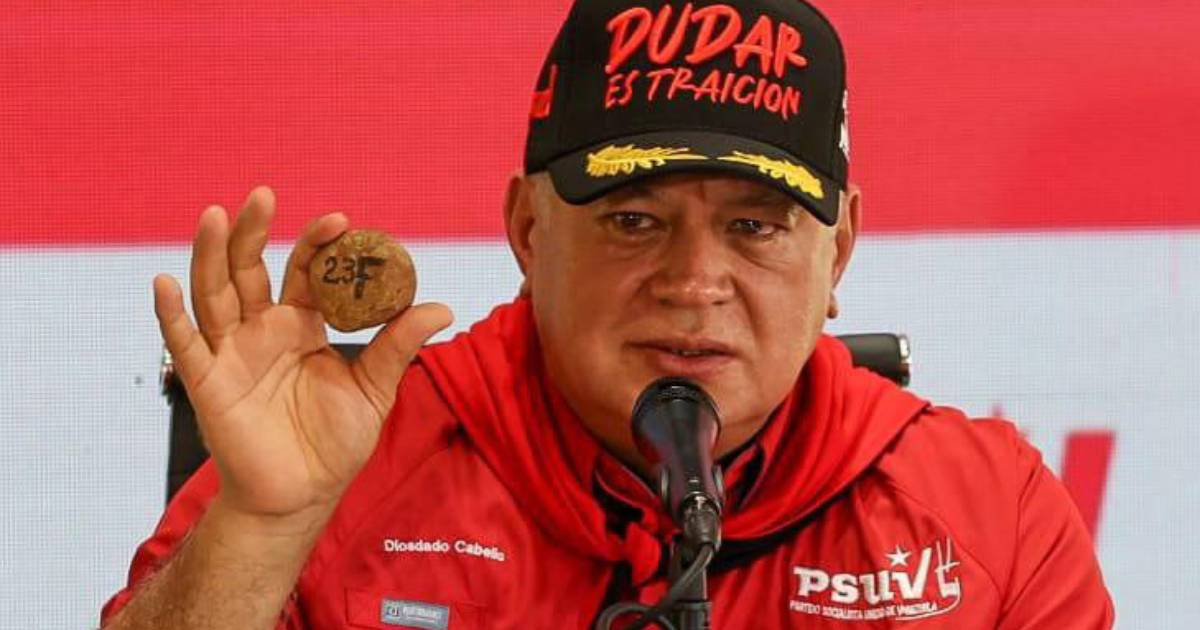
In the midst of military escalation in the Caribbean, Diosdado Cabello called this Monday to "prepare on all fronts" and to "move towards the armed people" to defend Venezuela against the naval reinforcement from the United States.
"We are not calling for any kind of war, nor do we have a war, nor do we want war with anyone, but our people must be prepared and alert in all instances, on all fronts; in every way and form, the people must be prepared, and the party is a fundamental part of this," said in his weekly press conference of the United Socialist Party of Venezuela (PSUV), held at a training camp in La Guaira.
The message arrives amidst a climate of maximum tension. In recent weeks, Washington has increased its presence with ships, submarines, and Marines under the auspices of anti-drug operations, while Caracas reports to the UN that this deployment is a “serious threat” to regional peace.
Cabello, who had already warned in his television program “we are preparing for the worst”, intensified his tone: “With maximum pressure comes maximum preparation.”
"Transition to the People in Arms": the New Stage
Cabello announced that the plenary session of the PSUV Congress, scheduled for Thursday, September 11, and Friday, September 12, will focus on security, defense, and the "transition to the people in arms," with the party "at the service" of the militias.
He asserted that the mobilization is not limited to the Chavista structure and that "there are sectors that, without being Chavistas, have said: we are going to defend the homeland." The message he repeated in front of youth leaders and militiamen was clear: "To doubt is to betray."
On the ground, the government has revitalized its military and civil apparatus. Cabello boasted about the “special training for resistance” of young people who, he said, “do not want to be left out” and “want to be on the front lines” if the country needs defense.
The other front: psychological warfare and accusations
Cabello accused the United States of seeking provocations to escalate the conflict and questioned an operation in international waters that resulted in the deaths of 11 people allegedly linked to drug trafficking. He labeled it a “massacre” and asserted that Washington is trying to impose a narrative to justify its military presence.
He also rejected threats from U.S. Congress members and sanctions that are "the order of the day," which he frames as a "psychological war" aimed at breaking the morale of the population: "They underestimate us. They will not be able to defeat this people."
His speech revisited a familiar script within chavismo, referencing national dignity, civic-military unity, and anti-imperialism, but this time included an explicit call for mobilization through the Patria System and to expand “preparation on all fronts” with training, communication, and territorial defense.
The backdrop: displays and counter-displays
The Defense Minister, Vladimir Padrino López, has confirmed reinforcements on the Caribbean and Atlantic fronts, with special attention to Zulia, Falcón, Nueva Esparta, Sucre, and Delta Amacuro.
According to their data, the "Peace Zone N.1" increased from 10,000 to 25,000 personnel with naval, riverine, and drone support, and recruitment points for militia members have been opened throughout the country. Weeks earlier, Cabello had mentioned an additional 15,000 mobilized in the states bordering Colombia.
On the other side, the United States operates missile-launching cruisers, destroyers, submarines, and surveillance aircraft in the Caribbean, citing the aim of cutting off drug trafficking routes. Chavismo denies the existence of illicit crops and interprets it as tactical pressure to force concessions.
Tension grips the region: Cuba stands united with Caracas; France strengthens its capabilities in Guadeloupe within its own drug policy agenda; and Trinidad and Tobago has taken a stance as a deterrent against a potential clash over Esequibo.
Meanwhile, Cabello, in his closing remarks, emphasized the epic of resistance: "Accuse us of being Bolivarians, anti-imperialists, Chavistas; we are guilty. But do not invent what you cannot prove... No matter what happens, we will overcome."
Filed under: