
Related videos:
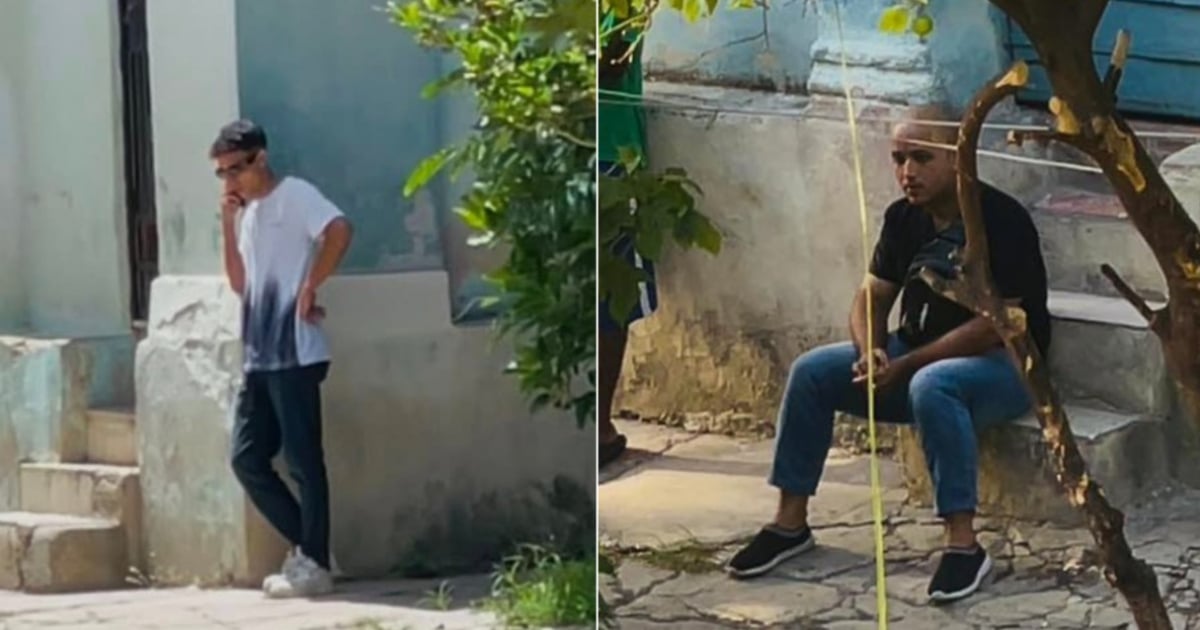
The independent journalist Camila Acosta reported this Sunday that two State Security agents are constantly monitoring her home in Havana. In a post on her Facebook profile, she shared photos of the repressors and explained that "the patrol (there is at least one), according to friends and neighbors, is nearby, waiting for the order to arrest in case I go out."
"These are the two G2 officers who are keeping watch over my home. The one in the white sweater is very young, probably no older than 22, a rookie enforcer eager to make a name for himself: during this, his first operation at my residence, he was trying to engage in conversation and introduced himself to the neighbors as a SE agent. The bald one has been a regular in these types of operations; in one of them, he also introduced himself to me as a SE agent," he detailed.
Acosta explained that he managed to photograph them while he was out shopping: "I walked less than a block. Neither of them spoke to me or approached me to explain the reason for the surveillance. But they did move as soon as they saw me and followed me, closely watching my movements."
Regarding the reaction of the repressors when they noticed she was documenting the event, she noted: "The bald man walked away as soon as he saw me take out the phone. The young man in the white sweater pretended to be waiting for someone and talking on the phone. But his performance was terrible. They're too obvious. And we already know them."
Although the operation was less aggressive than in previous instances, he noted that the pattern remains the same: “That is to say, there are more people (there is usually only one officer from the G2), but they didn't prevent me from going out to shop nor did they approach me to talk, as usually happens. Apparently, the order is not to provoke scandals or draw attention.”
In her post, Camila also referred to the social situation in the country: "The situation in the country is becoming increasingly tense: prolonged blackouts, the water crisis in Havana shows no signs of easing, inflation is rising, there is a shortage of food and medicine... the desperation of the people."
Finally, he linked this repression to the approach of a significant religious date: “We are on the eve of the Day of the Virgin of Charity, the Patroness of Cuba. Today, I will light a candle for Cuba, and for those thugs who prevent me from leaving my house, and for those who send them to represent this criminal dictatorship, that one day they answer before justice.”
The complaint was supported by other Cuban intellectuals. The writer Jorge Fernández Era backed his testimony with a similar denunciation, citing fellow writer Ángel Santiesteban, who stated: “Since yesterday they have been there, including early morning, and they remain there, I suppose to prevent us from participating in the processions of the Virgins of Regla and Charity.”
"To screw over, harass, and violate rights, there are indeed resources," concluded Fernández Era.
This Monday, September 8, Camila Acosta confirmed that the operation was ongoing: “Second consecutive day of surveillance by the Cuban political police to prevent me from leaving my home,” she wrote in a new post.
The siege against independent journalists, activists, and opponents is a common practice of Cuban State Security, especially on symbolic dates or when participation in public activities is anticipated. These actions are part of a sustained pattern of repression against dissent on the island.
This is not the first time that Camila Acosta has been subjected to surveillance or repression. Last May, during the Independence Day of Cuba, she reported the presence of six individuals in front of her house, including uniformed agents and members of the squad known as Las Marianas, tasked with repressing opposing women. “Even though I am arbitrarily confined in my home, I am free because I speak my mind,” she stated at that time.
This is not an isolated incident. On July 4th, the regime prevented activists and journalists—including Acosta and Santiesteban—from attending a celebration at the United States embassy in Havana. Reports of arrests, house arrests, and coordinated surveillance were made in several provinces.
Jorge Fernández Era has, for his part, been the target of beatings and death threats. In July, he reported that State Security officers physically assaulted him and threatened him with "rampaging cars," "contaminated food," and "potholes in the sidewalks." “So many people didn’t die for this”, he wrote at the time, after showing bruises on his face and body.
Frequently Asked Questions About Repression in Cuba and the Situation of Independent Journalists
Why is State Security monitoring Camila Acosta?
The State Security is monitoring Camila Acosta as part of a sustained pattern of repression against dissent in Cuba. This surveillance is common during symbolic dates or when participation in public activities is anticipated. Acosta, an independent journalist, has been subjected to monitoring and repression on multiple occasions, as part of the regime's actions to control and silence critical voices.
What is the current social situation in Cuba according to Camila Acosta?
According to Camila Acosta, the social situation in Cuba is becoming increasingly tense due to prolonged blackouts, a water crisis, inflation, and shortages of food and medicine. This situation has heightened the desperation among the population, and government repression intensifies in response to any attempts at protest or dissent.
How does the repression of the Cuban regime manifest against journalists and activists?
The repression of the Cuban regime manifests through surveillance, arbitrary detentions, house arrests, and internet cuts. These actions are aimed at silencing independent journalists, human rights activists, and opponents, especially during symbolic dates and high-visibility events. Repression is a common tool used to control political and social dissent on the island.
What is the relationship between repression and religious and symbolic dates in Cuba?
Repression in Cuba tends to intensify during religious and symbolic dates, such as the Day of Our Lady of Charity or the anniversary of the Maleconazo. These dates are used by the regime to justify surveillance and repression operations, preventing activists and opponents from participating in demonstrations or public activities. In this way, the government seeks to avoid any form of protest or commemoration that could challenge its control.
Filed under: