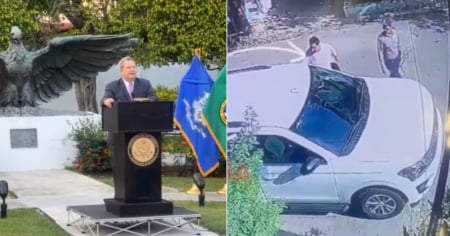
At an emotional reception for the Independence Day of the United States held this Wednesday at the U.S. Embassy in Havana, the head of the diplomatic mission, Mike Hammer, shared a message filled with symbolism, political support, and hope: "You will soon be free", he stated, quoting words from U.S. Secretary of State, the Cuban-American Marco Rubio.
During his speech, Hammer recounted a meeting with Rubio in Washington last May, at the Secretary's office in the White House. “When I met with Secretary of State Marco Rubio, he made a request: that every time I met with a Cuban, I should convey that the United States supports them,” said the diplomat before an audience made up of Cuban and foreign guests.
"I want you to know that we support you. That we always put your cause first. That we speak about you everywhere we are given the opportunity. And that we pray every day for God to bless all of you and for Cuba to soon be free, sovereign, and independent, and for the fate of Cuba to be in the hands of the people," Hammer read, quoting the influential former Republican senator.
The direct and emotional message was received with attention by those present, in a context of increasing international pressure on the Cuban government and amid an ongoing economic and social crisis that continues to drive thousands of Cubans to flee the country.
Hammer also highlighted Rubio's political rise as a symbol of the opportunities in the United States: “A son of Cubans has reached the high rank of Secretary of State. That is my country,” he emphasized, referring to the leadership role Rubio, who was born in Miami to Cuban parents, plays.
Hammer's gesture is significant. In diplomatic language, conveying such explicit words as "soon they will be free" represents a sign of support that, although symbolic, resonates deeply with those who see international backing as a potential pathway for change in Cuba.
However, while flags waved at the diplomatic mission and the future was being discussed, a new wave of repression was unleashed in the streets of Havana and other provinces, with operations, arrests, and house detentions aimed at preventing independent voices from attending the celebration.
Since the morning of July 2, State Security agents began to monitor the homes of activists and journalists. Among those arrested are:
Berta Soler, leader of the Ladies in White, detained as she left her home in Lawton.
Osvaldo Navarro, a protest rapper, and his partner Marthadela Tamayo, intercepted in Cerro.
Camila Acosta, a journalist for the ABC newspaper, and her partner, the writer Ángel Santiesteban, were besieged.
Oscar Elías Biscet and Elsa Morejón, also under house arrest.
In other provinces, similar actions were reported. In Villa Clara, the opposition member Librado Linares reported constant surveillance. In Cienfuegos, the brothers Bárbaro and Juan Alberto de la Nuez were threatened by the political police. In Pinar del Río, authorities prevented Eduardo Díaz Fleitas and his mother, Nilda García, mother of a political prisoner, from traveling to Havana.
The journalist Yunia Figueredo and her husband, the writer Frank Correa, were detained for refusing to attend a police interrogation.
The repression was not only physical but also symbolic. As journalist Reynaldo Escobar from 14ymedio pointed out:
"During the American War of Independence, part of George Washington's effort was financed from Havana. Today, even attending a commemorative party is prohibited."
The Cuban government has accused mission chief Mike Hammer of "interference" and threatened with his expulsion for meeting with opponents and members of civil society. However, rather than softening his stance, Hammer responded by reaffirming the U.S. support for the Cuban people, clearly and unequivocally.
Filed under: