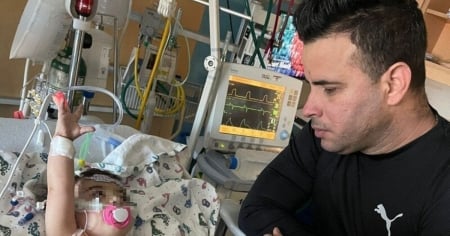
The Cuban Deivy Alemán Oropesa, a resident of Orlando, Florida, for the past seven years, decided to voluntarily leave the United States after receiving a departure order from the Immigration and Customs Enforcement (ICE).
Making this decision has been a painful moment for the family of Cuban immigrants, as their daughter suffers from a serious heart condition and requires new open-heart surgeries.
"During the appointment with ICE, I was informed that if I remained, they would have to detain me and deport me on their own accord. Otherwise, I had to present my ticket for leaving the United States this Sunday. I believe the best option is to leave voluntarily," Alemán stated in remarks to journalist Javier Díaz.
The Cuban father confessed what hurts him most about having to leave the United States in such an abrupt manner: "What worries me the most is leaving my family here, the little girl who is waiting for another surgery," he said.
The news has left her family in shock
Deivy Alemán Oropesa attended a routine appointment with ICE on September 8, where he was informed that he must leave the country before September 14. If he refuses, he would face immediate detention and subsequent forced deportation.
His wife, Yisel Miguel Sarduy, acknowledged that they are still in shock and do not know how they will resolve the situation in the short term.
"The hope I have left is that when I am in Cuba, I receive the reunification request that my wife submitted. And to be together here as soon as possible," Alemán added.
The story of this family had come to light weeks earlier when it was revealed that the youngest had undergone three open-heart surgeries and needed more medical procedures. While the mother focuses on caring for the girl, Deivy is the sole breadwinner of the household.
Javier Díaz, quien ha seguido de cerca el caso, denunció en sus redes sociales que ni las razones humanitarias ni la conducta intachable del migrante han sido suficientes para detener su deportación.
"A sad case where it doesn't matter if you have humanitarian reasons or are an exemplary migrant; if you have a deportation order, you will be deported," the journalist emphasized.
Why is ICE requesting the deportation of Deivy Alemán Oropesa?
Alemán Oropesa has no criminal record. His only "offense" was entering the country irregularly through the border. Since then, he has remained free, with an active deportation order.
The voluntary departure order states that if he does not leave the country by the indicated date, he may be arrested at any time and sent to an immigration detention center.
The situation has sparked a wave of solidarity on social media, where many people have questioned ICE's lack of sensitivity in a clearly humanitarian case.
Yisel also warned that the situation at the ICE office in Orlando is becoming increasingly complicated for several Cuban families. She reported that they presented medical evidence and all the necessary documentation, but it was not enough: "It was all for nothing," she lamented.
The family has an approved I-130 petition, part of the family reunification process. Stories like this reflect the reality of thousands of Cubans in the United States who, despite years of residency, continue to face the threat of deportation. For many of them, legal avenues are exhausted, and life becomes a daily struggle for permanence.
Deivy Alemán is scheduled to leave the United States on September 14, the deadline set by ICE. After that, any attempt to stay could result in forced detention and deportation without return.
Frequently Asked Questions about the deportation of Deivy Alemán Oropesa and immigration policies in the U.S.
Why did Deivy Alemán Oropesa decide to self-deport from the United States?
Deivy Alemán decided to self-deport to avoid being arrested and forcibly deported by Immigration and Customs Enforcement (ICE). Despite having humanitarian reasons to stay, such as his daughter's critical health, current policies do not take these factors into account, so he chose to leave voluntarily to avoid detention.
What impact does Deivy's deportation have on his family?
The deportation of Deivy Alemán has a devastating impact on his family, as it leaves his wife and daughter, who requires open-heart surgeries, without their primary economic and emotional support. The family separation at a critical time for his daughter's health further exacerbates the situation.
What legal options did Deivy Alemán have to avoid deportation?
Legally, Deivy Alemán could have attempted to request deferred action through form I-246 to temporarily suspend deportation for humanitarian reasons. However, current immigration policies do not prioritize humanitarian factors, complicating his situation, and his family also sought political support to stop the deportation.
How does the tightening of immigration policies affect Cubans in the U.S.?
The tightening of immigration policies has increased the detention and deportation of Cubans in the U.S., including those without criminal records and with active legal proceedings. This creates fear and uncertainty within the community, as many arrests happen during routine immigration appointments, affecting families and separating parents from their children.
Filed under: