
Related videos:
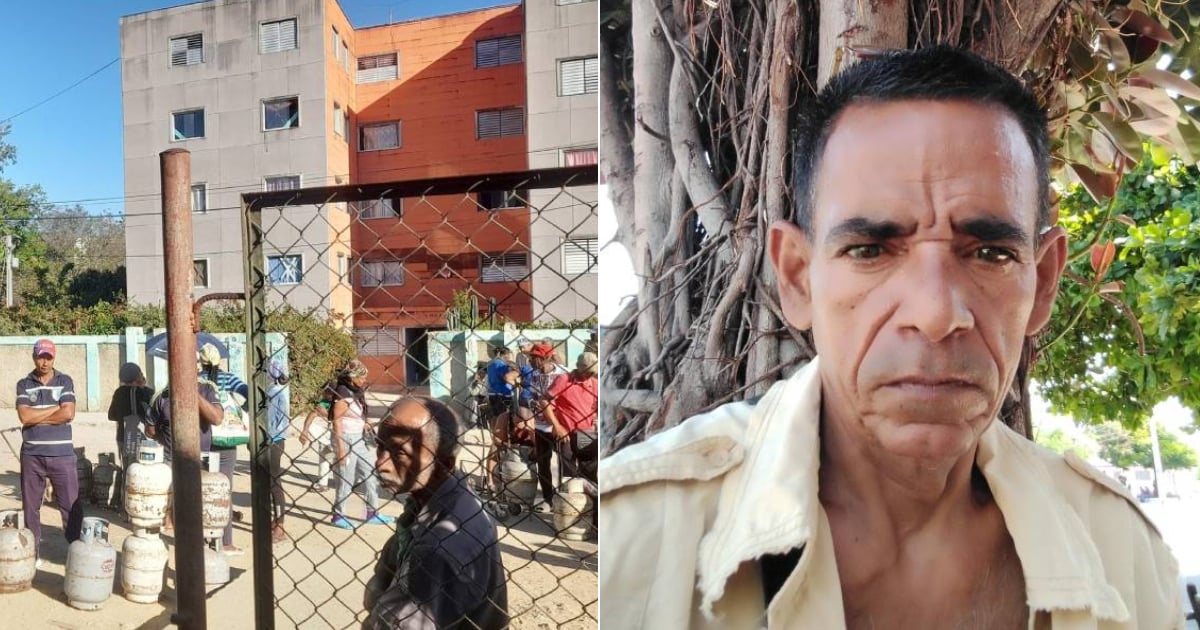
The Municipal People's Tribunal of Santiago de Cuba sentenced Julio César Duque de Estrada Ferrer, 56 years old, to four years and six months of imprisonment for recording a queue to buy liquefied gas with his cellphone. The ruling finds him guilty of the alleged crimes of disobedience and assault, according to a report by the Cuban Observatory of Human Rights (OCDH), which had access to the judicial document.
The events occurred on September 5, 2024 at noon, when Duque de Estrada was filming a crowd of people waiting in line to buy household gas in a neighborhood of Santiago de Cuba. The counterintelligence officer Mario Raciel Soulary Garcés intercepted him and, after identifying himself as military personnel, ordered him to stop recording and hand over his identification document.
According to the official version included in the ruling, the citizen refused to identify himself, hurled insults, and ended up assaulting the officer during a struggle. The court was composed of judges Irina Díaz Delis (rapporteur), Hugo Liens Martínez, and Noelia Rodríguez Martínez.
The OCDH described the process as a "farce" and stated that "the entire judicial process has been rife with human rights violations." In its analysis, the Madrid-based organization denounced that the sentence "exposes the illegal and disproportionate actions of the political police officer who attacked Duque de Estrada Ferrer."
"It is a custom for these agents to intervene with violent repression and then portray themselves as the victims," added the Observatory. In their criticism of the ruling, they pointed out that Officer Soulary Garcés "identifies as military, which is already problematic," and that his initial intervention "is already questionable" from the perspective of international human rights standards.
“Filming a queue to buy liquefied gas does not qualify as a threat to national security,” emphasized the OCDH. “The official's action was not motivated by his official duties. Therefore, his initial intervention is already questionable in itself.”
Regarding the imposed restrictions, the Observatory warned that "requiring him to stop recording and to store the mobile phone directly restricts freedom of expression and information, a fundamental right enshrined in Article 19 of the International Covenant on Civil and Political Rights (ICCPR), to which Cuba is a signatory."
The organization also questioned the use of force: “The detention and use of force were disproportionate, violating the rights to personal freedom and privacy.” They added that “the officer had no legal grounds to prohibit filming or to request identification in the absence of a crime or offense.”
"Your intervention is therefore an extralegal, illegal, and unconstitutional act that exceeded your functions, and for which, following the provocation of the event, the imputation of any crime would not proceed," stated the OCDH. They even recalled that previous rulings from the Cuban Supreme Court have established that defendants should be acquitted when their reaction is a consequence of the state's agent's "misconduct, abusive, violent, and/or illegal" behavior.
Before the sentencing, the OCDH had reported that the Prosecutor's Office was seeking a total sentence of five years and six months, including charges of disobedience, assault, and resistance, in addition to the suspension of civil and political rights.
Julio César Duque de Estrada, who remains detained in Aguadores prison, is the father of Dairon Duque Estrada Aguilera, one of the demonstrators imprisoned following the protests on July 11, 2021 (11J). Although he does not belong to political organizations, his critical stance has made him a target of state surveillance.
OCDH demands their immediate release and reiterated that “filming in a public space is not a crime.” “The Cuban regime is more worried about hiding the serious crisis than solving the people's problems,” concluded the organization.
Frequently Asked Questions about the Conviction of Julio César Duque de Estrada Ferrer in Cuba
Why was Julio César Duque de Estrada Ferrer sentenced to prison in Cuba?
Julio César Duque de Estrada Ferrer was sentenced to four and a half years in prison for recording with his cellphone a line to buy liquefied gas in Santiago de Cuba. The verdict was based on the alleged crimes of disobedience and assault, although the Cuban Observatory of Human Rights (OCDH) has described the process as a "farce" filled with human rights violations.
What irregularities have been reported in the judicial process against Duque de Estrada?
The OCDH reported that the judicial process against Duque de Estrada was "filled with violations of human rights" and that the actions of the officer who arrested him were "illegal and disproportionate." His intervention was questioned as an extralegal, illegal, and unconstitutional act, restricting freedom of expression and the right to document social reality.
What role does the Cuban Observatory for Human Rights play in this case?
The Cuban Observatory of Human Rights (OCDH) has been a critical voice in the Duque de Estrada case, denouncing human rights violations and demanding his immediate release. The OCDH has emphasized that filming in a public space does not constitute a crime and has condemned the repression by the Cuban regime against those who document the social crisis on the island.
How is the case of Duque de Estrada related to the situation of human rights in Cuba?
The case of Duque de Estrada reflects a broader pattern of repression in Cuba, where the judicial system is used to silence critical voices and documenting social reality is penalized. The human rights situation in Cuba is concerning, with a systematic use of the repressive apparatus to punish dissent and limit freedom of expression and information.
Filed under: