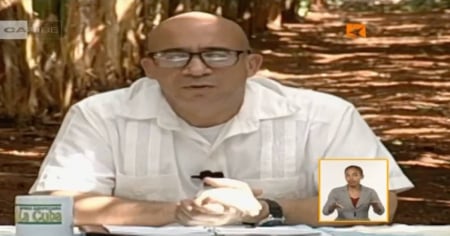
A 55-year-old Cuban citizen with no criminal record, known for their critical stance against the government, could be sentenced to five years and six months in prison for simply recording a line to purchase liquefied gas in Santiago de Cuba.
Julio César Duque de Estrada Ferrer was arrested on September 5, 2024, while filming one of the many everyday scenes that illustrate the severe economic crisis in the country: a crowd of people trying to get domestic gas. What happened next has left him behind bars today, awaiting trial.
According to the Cuban Observatory of Human Rights (OCDH), the case exemplifies the use of the state's repressive apparatus to punish the citizen documentation of social reality. The organization claims that Duque de Estrada was assaulted by a counterintelligence officer who snatched his phone, but the prosecutor's file argues that it was he who became aggressive and slapped the officer.
The version of the Prosecutor's Office, reflected in the file accessed by OCDH, claims that the accused refused to put away the phone, was taken to a nearby market, and there attempted to record again.
The officer Mario Raciel Soulary Garcés then demanded his identification card. While checking the information, Duque de Estrada supposedly took advantage of a lapse in attention to slap him, which allegedly led to a struggle that resulted in his arrest and subsequent transfer to the Aguadores prison.
An disproportionate punishment for documenting the crisis
The Prosecutor's Office requests a one-year sentence for disobedience, four years for assault, and ten months for resistance, totaling a combined sentence of five years and six months of deprivation of liberty. Additionally, it is proposed that he be prohibited from leaving the country and have his civil and political rights suspended.
“The Cuban regime is more concerned with hiding the serious crisis than with solving the problems of the people,” denounced the OCDH, which demands an immediate review of the case, the release of the accused, and respect for their right to document and freely express what is happening on the streets of Cuba.
Julio César does not belong to any political or mass organization, but he is the father of Dairon Duque Estrada Aguilera, one of the protesters from July 11 who were imprisoned following the historic protests of July 2021.
The case is reminiscent of so many others in which the Cuban judicial system has been used as a tool of intimidation against citizens who raise their voices or simply turn on the camera on their cell phones to show the reality.
Frequently Asked Questions about Repression in Cuba and the Case of Julio César Duque de Estrada Ferrer
Why does Julio César Duque de Estrada Ferrer face a sentence of more than five years in prison in Cuba?
Julio César Duque de Estrada Ferrer could be sentenced to more than five years in prison for recording a line to purchase liquefied gas in Santiago de Cuba. The case has been reported by the Cuban Human Rights Observatory as a use of the state's repressive apparatus to punish the citizen documentation of Cuba's social reality. The Prosecutor's Office claims that Duque de Estrada committed offenses of disobedience, resistance, and assault.
What is the context of repression in Cuba concerning the recording of public events?
In Cuba, recording public events can be seen as a subversive act by the regime, which seeks to control the narrative surrounding the situation in the country. The case of Duque de Estrada highlights how the government uses the judicial system to silence critical voices and prevent the dissemination of images that evidence the social and economic crisis. This type of repression also extends to protests and activities critical of the government on social media.
What role does the Cuban Observatory of Human Rights play in the case of Duque de Estrada?
The Cuban Observatory of Human Rights (OCDH) has denounced the case of Julio César Duque de Estrada as a serious violation of human rights. The organization demands an immediate review of the case, his release, and respect for the right to document and freely express the reality of Cuba. The OCDH has also highlighted other cases of repression and has continually advocated for the release of political prisoners on the island.
What consequences does Julio César Duque de Estrada face besides imprisonment?
In addition to the prison sentence of five years and six months, the Prosecutor's Office proposes to prohibit him from leaving the country and suspend his civil and political rights. These measures aim to further limit Duque de Estrada's ability to participate in civic and political activities and reflect the Cuban regime's strategy to silence and isolate dissidents.
Filed under: