
Related videos:
Houses made from shipping containers have become a rising housing alternative in many countries, and Cuba wants to start developing communities with this type of housing.
Its main appeal lies in the low cost, the speed of construction, and its sustainable approach. In countries like Spain, there are companies that offer customized homes by repurposing shipping containers and install them within a period of 2 to 5 days on the owner's land.
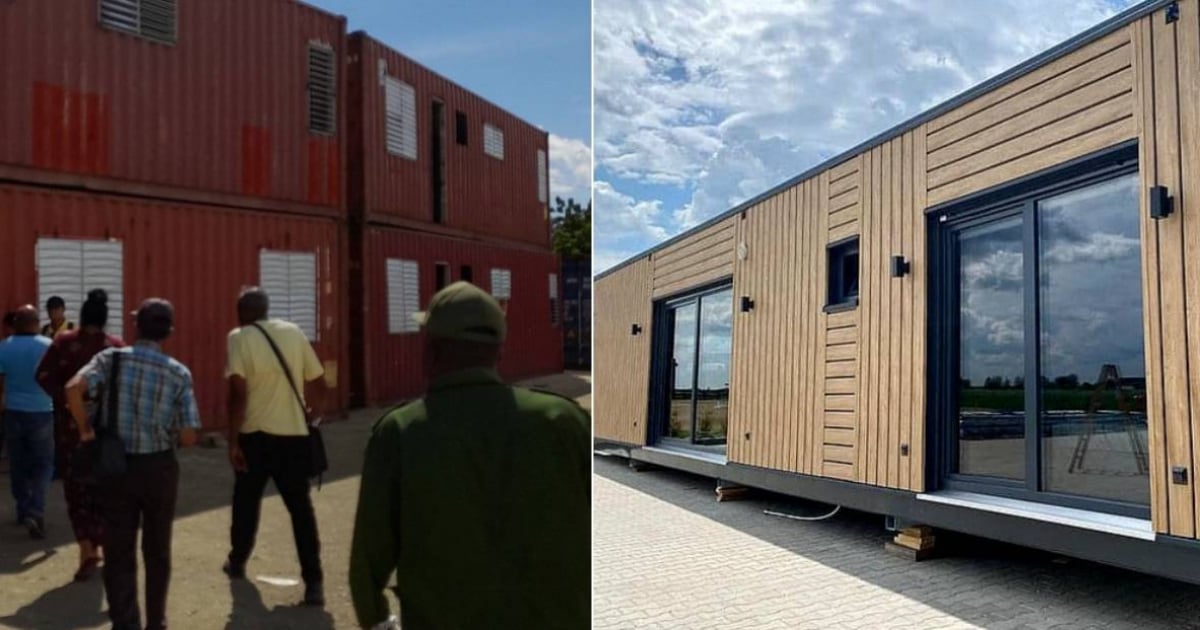
These containers are prepared by applying layers of thermal insulation, elevated ceilings, climate control systems, and interior finishes with wood, glass, and ceramics, ensuring comfort and livability.
The price for these houses in Europe varies depending on the size. A unit of 15 m² can cost starting at 7,500 euros, while a 90 m² unit can be around 95,500 euros.
The key lies in how the container is treated and in making the most of the available space. They use closed-cell insulating foams to prevent moisture and regulate temperature, allowing a metal box to be transformed into a true home.
How do these models adapt to the Cuban context?
In San Antonio del Sur, Guantánamo, and in other provinces across the country, the Cuban government has started to install homes made from recycled containers in response to the devastation caused by Hurricane Óscar.
The shared images show stacked metal structures on two levels, with no elevated roofs or visible insulation, in an environment where temperatures can exceed 35 degrees.
The authorities have promised to install thermal insulation and additional roofing to mitigate the heat, but at least in the initial installed units, those features are not observed.
No mention has been made of any air conditioning system. Instead, the homes are equipped with aluminum blinds for ventilation, which is insufficient for the area's extreme climate.
Container houses in Cuba: Lacking materials and minimal conditions
Unlike projects in Europe, where each container house includes complete insulation, proper flooring, and functional electrical systems, the Cuban model faces significant limitations.
The lack of construction materials has compelled the government to improvise solutions that are presented as "temporary." The regime asserts that they have minimal guarantees of habitability.
Initially, Granma reported that the homes will be anchored on concrete pilings and will have a small plot for future expansions. However, the direct placement of containers on the ground—without visible thermal bases—and the stacking of structures, as seen in the official photos, raises questions about the safety and effectiveness of the design.
Citizen reaction
The project has generated outrage on social media, where users criticize the extreme heat that can accumulate inside these metal containers without thermal insulation. Some have nicknamed the new settlement as "the microwave" and question whether those responsible would live under such conditions.
These homes would include a living room, bathroom, kitchen, and two bedrooms. Construction progress is slow. Only 23 of the 60 planned units have started to be installed, and this October marks the first anniversary of the cyclone's passage.
The reuse of containers as housing isn't necessarily a bad idea. In fact, in many countries, it's seen as an innovative option. However, its implementation requires investment, design, and conditions that are notably lacking in Cuba.
Instead of a functional and sustainable model, the government seems to have opted for an emergency solution with no real guarantees for those who need it most.
Frequently Asked Questions about Container Houses in Cuba
What are container houses?
Container homes are residences built from recycled shipping containers. In many countries, they have gained popularity as a sustainable, economical, and quick-to-build alternative. However, they require proper treatment to be livable, including thermal insulation, climate control systems, and interior finishes.
How are container houses being implemented in Cuba?
In Cuba, the government has begun to install container homes in response to the housing shortage, especially following natural disasters such as Hurricane Oscar. These homes are presented as a temporary solution but face criticism for their lack of thermal insulation and adequate climate control systems. The extreme temperatures and tropical climate of Cuba make it possible for container homes to become uninhabitable without these elements.
What are the main issues with container houses in Cuba?
Container homes in Cuba face several challenges. The lack of insulation materials and the absence of climate control systems make these houses unsuitable for the extreme climate of the island. Furthermore, the improvisation and lack of planning in their implementation have led to criticism and doubts about their effectiveness as a housing solution.
Why are container houses a controversial solution in Cuba?
The implementation of container homes in Cuba has been controversial due to the perception that they are a hasty and low-quality solution to a structural problem. On social media, citizens have expressed their outrage, considering that these homes do not provide the minimum conditions for habitability. Additionally, the lack of transparency and historical issues in government housing management fuel the criticism.
Filed under: