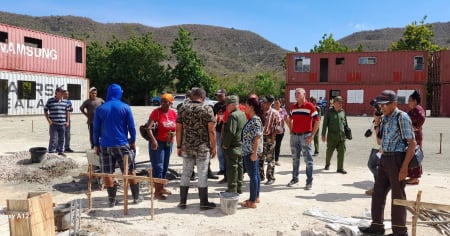
The Cuban government's project to house victims of Hurricane Oscar in container homes in Guantánamo has sparked a wave of criticism and outrage on social media.
Citizens report the precariousness and the risk of these structures in the extreme climate of eastern Cuba, characterized not only by the blazing sun but also by frequent thunderstorms and heavy rains.
"Metal is a good conductor for adapting to this climate. The new houses are a gem of Cuban engineering," said a user on Facebook sarcastically.
Internet users quickly nicknamed the new settlement "the microwave", referring to the extremely high temperatures that these containers can reach without thermal insulation or adequate ventilation.
A user questioned whether the government plans to install eco-friendly air conditioners "that do not use electricity because there is no electricity 90% of the time."
That is a lack of respect... Poor people, they are going to roast with these blackouts," wrote another Cuban, while someone sarcastically commented: "The cooking time for anyone living there is 45 minutes."
Reactions on social media were not limited to sarcasm. There were also many comments about the electrical hazards posed by these metal-walled homes in an area prone to storms and lightning.
"When it starts to thunder, you need to get out of the containers or ground them," warned a user.
Others wondered why the authorities do not allocate this type of housing to high-ranking officials: “I would like to see a boss living there in the middle of the day and without electricity.”
The initiative was presented as a "temporary" solution. Authorities claim that each unit will have two bedrooms, a living room, a kitchen, and a bathroom, and that they will be protected against corrosion.
However, so far no details have been provided regarding air conditioning systems or thermal insulation, which are essential for making these metal structures habitable in the Cuban climate.
Housing crisis in Cuba
The images shared from the Buena Vista community in San Antonio del Sur, depict the installation of these makeshift homes in a province where temperatures can exceed 35 degrees in the shade.
In October 2024, in Guantánamo, the cyclone destroyed more than 13,000 homes. Major General Ramón Pardo Guerra, head of the National Civil Defense General Staff, visited the site on September 22, 2025, to oversee the progress of the work.
A total of 60 recycled containers are planned for installation, but only 23 have begun to be set up to date. The goal was to complete two modules per day, but the images suggest a slower pace than announced.
The projects are undertaken by state-owned companies such as Génedis, Muebles Imperio, Valbo, Cedai, the Provincial Housing Directorate, and the Ministry of Construction, which has been failing to meet its plans for more than a decade,without seeming to concern the regime.
A patch for the housing collapse
The reuse of containers as housing is not new globally, but in developed countries, its implementation is carried out under strict livability standards, including thermal insulation, climate control, and appropriate interior design. None of this seems to be met in the Cuban case.
On social media, many agreed that this measure is yet another example of how the Cuban people are forced to accept “makeshift” solutions in a context of deep resource, material, and electricity crisis.
Some Cubans defended the concept of container recycling, noting that "in many parts of the world, there are" such houses. However, most emphasized that in those cases, there is investment, planning, and minimal living conditions, which are very different from the context of the island.
The government claims that this is a “creative” alternative to tackle the devastation caused by the hurricane, but for many, it is simply another example of the collapse of the housing system in Cuba.
"With freedom, Cubans would not have to be treated like slaves. Only in Cuba can they call 'solution' putting people in metal cans without electricity or a future," concluded an internet user.
Frequently Asked Questions about the container homes project in Guantánamo
Why are containers used as housing in Guantánamo?
The Cuban government has implemented the use of containers as a "temporary" solution for those affected by Hurricane Oscar, which devastated the region in October 2024. This measure aims to alleviate the housing deficit in a province where over 13,000 homes were impacted, although it has faced criticism for the lack of adequate living conditions in these structures.
What are the main criticisms of container houses in Cuba?
Criticism focuses on the precariousness and risks associated with living in metal containers. In the extreme climate of Guantánamo, these structures can turn into ovens without proper thermal insulation. Furthermore, the lack of ventilation and efficient climate control endangers the health of the inhabitants, especially children and the elderly. There are also concerns about electrical risks in an area prone to storms.
What measures are being taken to improve the conditions of the container houses?
The authorities have stated that the containers will be protected against corrosion and will include two bedrooms, a living room, kitchen, and bathroom. However, no details have been provided regarding climate control systems or thermal insulation, which are essential for making these homes livable in the Cuban climate.
What is the current status of the container house project in Guantánamo?
As of now, 23 of the 60 planned containers have begun to be assembled. The project, managed by several state-owned companies, is progressing at a slower pace than expected, with the initial goal of completing two modules per day still unmet. The visit of authorities such as Major General Ramón Pardo Guerra reflects the pressure to expedite the process.
Why has the container house project generated so much outrage on social media?
The indignation stems from the fact that many believe these solutions are improvised and reflect a lack of proper planning and investment by the government. In a context of economic crisis and housing deficit, the perception is that container homes are a temporary fix that does not address the real needs of the Cuban population.
Filed under: