
Related videos:
The Cuban regime once again resorted to its bureaucratic rhetoric filled with empty slogans this week to present, as an achievement, the review of the so-called “Government Program to correct distortions and revitalize the economy.”
The meeting of the State Council, reported in Granma, with a display of standardized and content-less phrases, highlighted the contrast between the official discourse and the harsh reality faced by citizens.
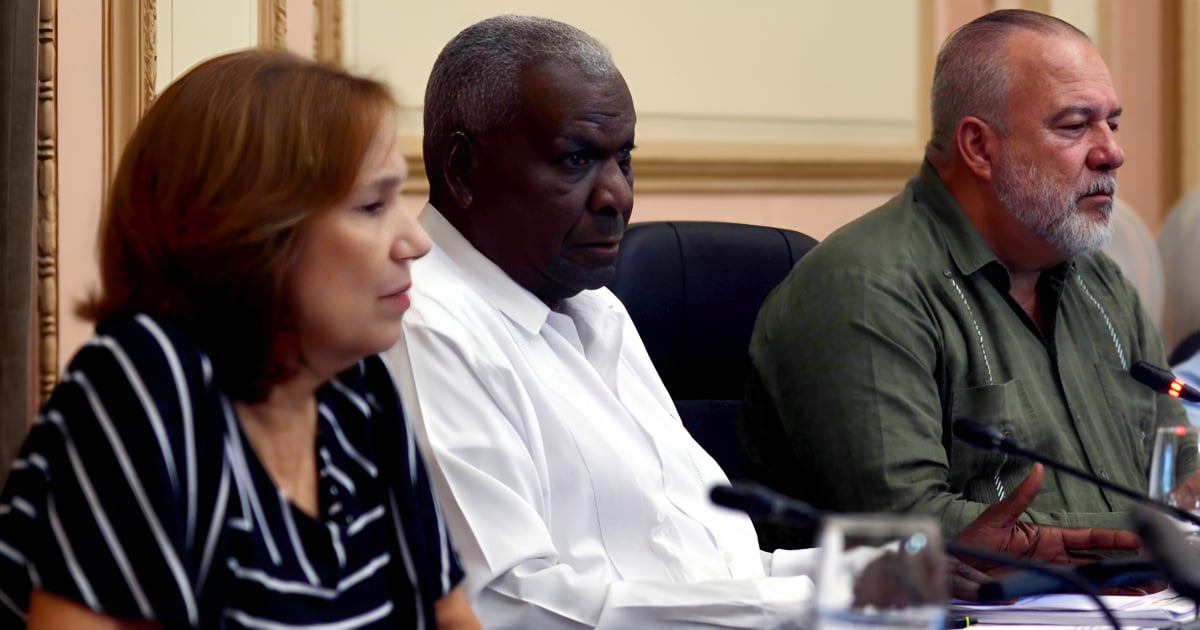
According to the official organ of the Communist Party, Prime Minister Manuel Marrero Cruz reported on the "progress" of the plan during a session led by Esteban Lazo Hernández.
The report listed timelines, general objectives, and "implemented actions," but did not provide a single concrete piece of data on how these measures have impacted the daily lives of Cubans, which are characterized by inflation, scarcity, and the collapse of basic services.
The language used in the official note reflected what has become a pattern: an abundance of abstract terms such as "scope of the general objectives," "municipal development strategies," or "collective contributions of the deputies."
However, the actual content of these policies remains opaque, and their implementation ineffective. For the readers of Granma, the result is a text where propaganda replaces analysis and statistics dissolve into slogans.
The contrast with the critiques from independent specialists is evident. The economist Pedro Monreal has repeatedly pointed out that the program does not correct the "distortions" it claims to address, but rather deepens them.
According to his analysis, each expansion of trade in foreign currency reinforces the segmentation of the internal market, while the fiscal austerity imposed by the government further diminishes the purchasing power of most Cubans.
In contrast, the official narrative preferred to focus on the fact that the "updated proposal" of the program has been "completed" and that "more than 70 proposals" from the deputies have been "evaluated," as if listing administrative steps were equivalent to tangible results.
Not a single mention appeared in the Granma report regarding the effects of the plan on inflation, the currency market, or food production, three of the main concerns of citizens.
The meeting also addressed oversight of the Ministry of Food Industry and the Fisheries Law, from which emerged "12 recommendations and 71 measures." Once again, the official report was limited to tallying numbers, without explaining how these actions would tackle the shortages affecting family tables.
In the regime's rhetoric, the mere act of approving measures is presented as proof of effectiveness, even though, in practice, the problems persist and worsen.
The report from Granma also dedicated space to the approval of a decree law regarding honorary titles and decorations, serving as a reminder of the disconnect between the political power's priorities and the national crisis.
While the country experiences a scenario that economists describe as stagflation —high inflation combined with stagnant production—, the government is spending time regulating medals and honors.
According to Monreal and other experts, the root of the failure is structural: the centralized and state-controlled model hinders the creation of a real productive environment, while inflation erodes salaries and pensions.
Without deep reforms that unleash private initiative, ensure foreign investment, and stabilize the national currency, any government program will remain an exercise in rhetoric. The note from Granma about the State Council confirmed this trend.
The official speech is filled with technical jargon and timelines, but it avoids any critical assessment. There is no self-criticism regarding the impact of the measures, nor is there transparency in the results. It follows a repeated script: meetings, reports, objectives, and the eternal promise that the worst is about to be overcome.
In practice, Cubans know that these grandiloquent phrases do not translate into economic improvement. The propaganda aims to obscure with words what daily experience reveals harshly: a country where salaries aren't enough to eat, the currency is collapsing, and the future remains mortgaged.
The State Council meeting, far from providing solutions, again showcased the divide between the totalitarian power and society. And the article from Granma is proof that, in Cuba, the official narrative matters more than the reality it seeks to conceal.
Filed under: