
Related videos:
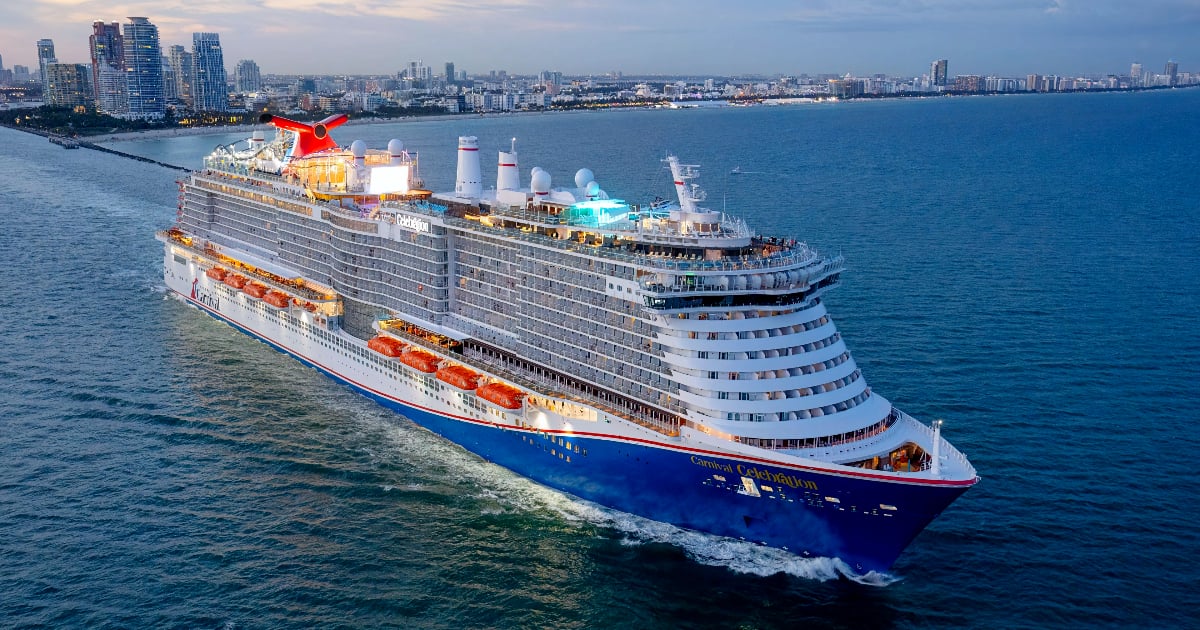
A federal judge in Miami ordered Carnival Corporation to pay $344,051 to Vivian Ruiz Rondón, a 62-year-old passenger who was seriously injured after tripping over a poorly installed threshold aboard the Carnival Celebration cruise ship.
The ruling, issued on September 4 by Judge Roy Altman in the Southern District Court of Florida, held the Doral-based company accountable for negligence in the maintenance of the vessel.
Although the passenger initially claimed nearly 14 million dollars, the final compensation was much lower, following a drastic reduction during the process: first to 4.1 million, and finally to just over 344 thousand.
A "non-obvious" defect
The accident occurred on May 12, 2023, when Rondón was walking down the hallway towards his cabin. His sandal got caught in a gap between the carpet and a metal threshold on deck 12, resulting in a severe fall.
The judicial investigation determined that the threshold had been improperly installed, with a slope of 0.6%, creating an irregular edge exceeding 0.25 inches, the maximum recommended by safety standards for pedestrian surfaces. There was neither a ramp nor any signage warning of the risk.
The judge dismissed the idea that it was an "open and obvious" condition, as Carnival had claimed, and emphasized that neither passengers nor crew could detect it simply by looking. In fact, during the trial, it was shown that the problem was only noticeable when pushing service carts over the threshold, some of which would get stuck.
Constructive notice: Carnival “should have known it”
One of the most significant aspects of the ruling is that the judge rejected the “actual notice” thesis but ruled in favor of the passenger under the principle of “constructive notice”: Carnival, he explained, should have been aware of the defect since it had been present since the construction of the ship and persisted for the six months leading up to the accident.
The court emphasized that cleaning staff and security officers were obligated to check and report irregularities at the thresholds, but they did not do so. This omission contributed to the situation not being corrected in a timely manner.
Recognized and ruled out injuries
The judge acknowledged the direct consequence of the fall:
- a fracture in the right arm,
- a dislocation of the right shoulder,
- and partial tears in two tendons (subscapular and infraspinatus).
In contrast, he dismissed the allegations regarding injuries to the head, knee, finger, and the complete tears of the supraspinatus tendons, which he deemed chronic and pre-existing. The court even noted that the passenger had experienced shoulder issues prior to the cruise.
Detailed compensation
The compensation of 344,051.24 dollars was distributed as follows:
- $29,051.24 in past medical expenses,
- $200,000 in past non-economic damages (pain, suffering, limitations, distress, etc.),
- $115,000 in future non-economic damages.
The judge denied granting pre-trial interest, which is common in some maritime cases, considering that the damages were uncertain until the ruling. He also did not award attorney's fees.
Reactions and context
"We are considering the ruling, as well as the available options, to determine the next steps," Carnival stated in a statement sent to the Miami Herald.
The plaintiff's attorney, John H. Hickey, described the ruling as a clear victory in terms of liability, although he expressed disappointment that the monetary compensation was less than what had been requested.
The case is significant because the majority of lawsuits against cruise companies do not go to trial. According to maritime law experts, over 90% of civil claims are settled through confidential agreements, making this verdict hold special value as a public precedent.
For Vivian Ruiz Rondón, the trip on the Carnival Celebration, which was supposed to be a relaxing experience in the Caribbean, ended in a prolonged legal battle. Her case could encourage other injured passengers to take their complaints to court rather than accepting private settlements.
The case of Havana Docks against Carnival and other shipping companies
The Carnival company, along with Royal Caribbean, Norwegian, and MSC, has been facing one of the most high-profile lawsuits under Title III of the Helms-Burton Act since 2019, filed by Havana Docks Corporation, the former concessionaire of the Havana port docks.
The company, led by Mickael Behn, claims that shipping companies benefited from properties confiscated by the Cuban regime while operating tourist trips to the island between 2016 and 2019.
In December 2022, federal judge Beth Bloom ruled that the companies had engaged in "trafficking" and "prohibited tourism," imposing a joint compensation of 400 million dollars in favor of Havana Docks.
However, in October 2024, the Eleventh Circuit Court of Appeals overturned that ruling. The court found that Havana Docks' concession rights had expired in 2004, meaning there was no valid property interest during the period when the cruise ships used the facilities.
The dispute, however, did not end there. In January 2025, the Eleventh Circuit suspended the enforcement of its ruling to give Havana Docks time to request a review of the case by the Supreme Court of the United States. If the high court agrees to hear it, it could set a key precedent regarding the application of the Helms-Burton Act to foreign companies doing business in Cuba.
Meanwhile, shipping companies have avoided paying the hefty compensation, but they remain under the shadow of a lawsuit that combines economic, diplomatic, and political interests, which continues to be closely monitored in both the United States and Cuba.
Filed under: