
Related videos:
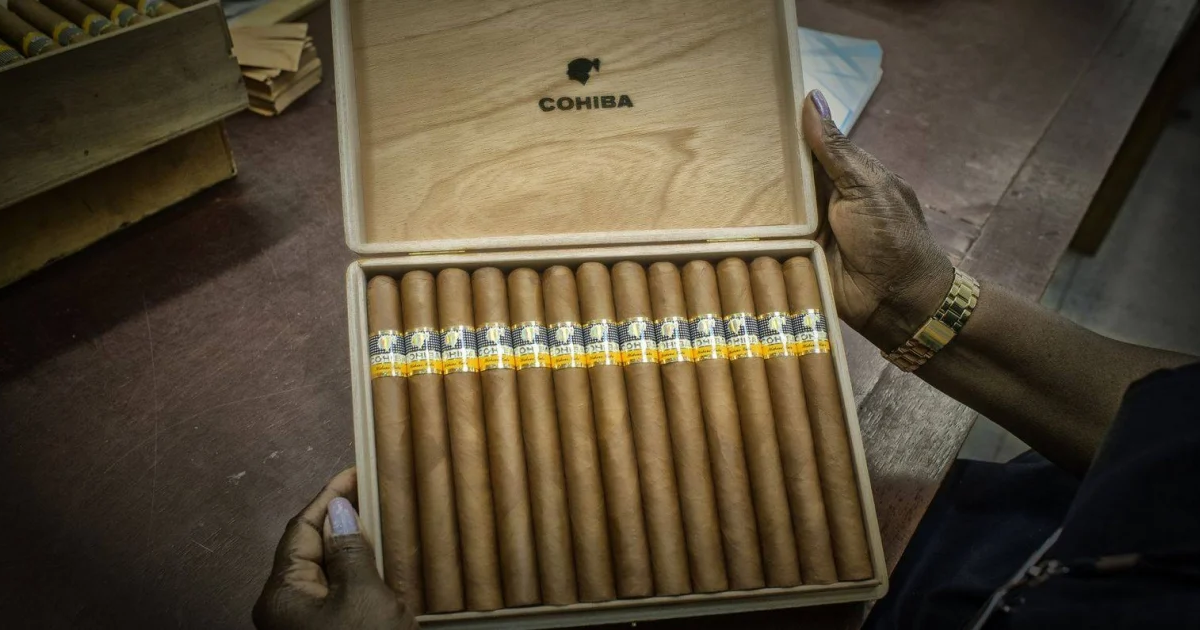
The Cuban regime has been exposed after admitting, through a statement from Tabacuba, that incarcerated individuals on the Island participate in the production of the renowned Habanos cigars.
The statement, issued following a report from the NGO Prisoners Defenders and published by the specialized outlet Halfwheel, confirms what has been reported for years: the exploitation of prisoners as part of the production chain of one of Cuba's most lucrative industries.
The report from Prisoners Defenders, based in Madrid, detailed that at the Quivicán prison, at least 40 inmates work as rollers, alongside two civilians who serve as instructors and administrators.
According to the NGO, prisoners work more than 14 hours a day, six days a week, in exchange for just 3,000 pesos a month, compared to civilians who earn 40,000 pesos for regular eight-hour shifts.
Each inmate must roll between 50 and 130 cigars daily, a production that feeds the international market.
The document also identified other prisons in Artemisa, Mayarí, Bayamo, Havana, Santiago de Cuba, and Villa Clara, where the same pattern is observed.
The NGO estimates that between 400 and 500 prisoners are directly involved in the twisting of cigars, within a system of prison exploitation that affects about 60,000 people in various industries, from marabou charcoal to agriculture.
The response from Halfwheel was to inquire with Habanos S.A. - the entity responsible for the marketing of the cigars - and Tabacuba, the state-run company in charge of production.
In its response, Tabacuba claimed that the main objective of this plan is to provide vocational training to inmates, in preparation for future employment opportunities.
"Participation in this program is voluntary and inmates receive incentives and prison benefits for their work," the official statement said.
Regarding production, Tabacuba concluded: "The production at these centers - which have the same resources and quality standards as the factories - is symbolic."
Although the organization responsible for the tobacco twisting industry attempted to present the program as a "training" initiative, its own statement constitutes an admission that the inmates are effectively producing cigars, dismantling the official narrative that this is merely training.
Moreover, the claim that production is "symbolic" contrasts with the magnitude of the figures revealed by the NGO, which estimates that 11.6 million cigars annually could come from prisons, representing 7.5% of the national production.
The report from Prisoners Defenders also documents physical abuse, threats, and racial discrimination within the Cuban prison system.
Afro-descendant prisoners, who make up 34% of the general population but 58% of the incarcerated, are more frequently assigned to the hardest jobs, while white individuals tend to receive less demanding tasks.
Testimonies also point to sexual violence against female inmates and reprisals against those who refuse to work, such as losing family visitation rights or benefits of freedom.
The international repercussions were immediate. Canada has requested an investigation into the importation of Cuban tobacco amid suspicions that it may be tainted by forced labor, in line with its policy against modern slavery in supply chains.
In Europe, where cigars and marabou charcoal have their largest market, there is growing pressure to clarify the origin of these products.
The recognition of Tabacuba not only validates the reports from international organizations but also exposes the contradiction of a regime that showcases cigars as a symbol of luxury and tradition while exploiting thousands of Cubans behind bars as captive labor.
What is sold on the shelves of Europe and America as a premium product carries with it, invisible, the stamp of suffering and coercion in the prisons of the Island.
Frequently Asked Questions about the Use of Prisoners in the Tobacco Industry in Cuba
What did Tabacuba reveal about the use of prisoners in cigar production?
Tabacuba admitted that incarcerated individuals in Cuba are involved in the manufacturing of habano cigars. The state-owned company acknowledged that inmates participate in the production process as part of a vocational training program.
What are the conditions under which prisoners work in tobacco production in Cuba?
Prisoners work in conditions that international organizations describe as exploitative, fulfilling shifts of over 14 hours a day, six days a week, for significantly low wages. Prisoners Defenders reported that inmates receive around 3,000 pesos a month, in contrast to civilians who earn 40,000 pesos for the same work.
What impact does the use of prison labor have on the Cuban tobacco industry at an international level?
The use of prison labor has raised concerns and international pressure to investigate the origins of Cuban products, especially in markets such as Europe and Canada. Canada has requested an investigation into the imports of Cuban tobacco due to suspicions of forced labor, aligning with its policy against modern slavery.
How does the use of forced labor affect the image of Cuban cigars?
The use of forced labor tarnishes the image of Cuban cigars as luxury and traditional products. What is presented in international markets as a premium product carries with it the mark of suffering and coercion in Cuban prisons.
Filed under: