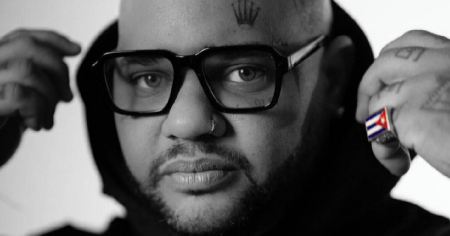
Teresa Padrón, former manager and close friend of El Taiger, publicly commented on the release of graphic evidence regarding the murder of the Cuban reggaeton artist.
His reaction came after a hearing held this Wednesday, October 8, in a Miami-Dade court.
“No one should share those photos; it’s a person, not a dog,” stated Teresa in an interview with Univision, visibly affected by the images of El Taiger's body following the gunshot, which are part of the more than 1,200 photographs from the case that the Prosecutor's Office shared with the press.
Teresa believes that the release of these photographs, some of which are extremely explicit, violates the dignity that the artist's memory deserves and the respect that should be shown to his family
Padrón also questioned the prosecution's strategy and its media handling.
“Why are they releasing so much evidence? For me, that puts the trial process at risk,” he declared, warning about the possible effect that the oversaturation of the case could have on the impartiality of the jury.
He also added that the gun seen in some of the images does not belong to the reggaeton artist, which strengthens the hypothesis that it was the aggressor's, Damián Valdez-Galloso, who is currently being prosecuted as the alleged perpetrator of the crime.
"It makes me very sad... it wasn't the way we wanted his image to be portrayed."
In other statements, in this case for Telemundo 51, Teresa expressed her pain at seeing how El Taiger's visual legacy is marked by images that will circulate forever on the internet.
“It makes me very sad because the internet doesn’t forgive, and those images will stay there forever,” he said.
"It was not the way we wanted his image to be projected," he emphasized.
He also spoke on behalf of his family, his fans, and the people who loved him, insisting that this public exposure is unnecessary and harmful.
A rosary in hand: Symbol of faith and farewell
Among the images released by the prosecutor's office, one shows the artist holding a rosary.
Teresa explained that it was a personal item he had asked her for days earlier.
"I had a rosary in my car; he had asked me for it, and I had told him I would buy him one, but not that one because the one I had was mine," he recounted.
Finally, when El Taiger was admitted to the hospital, she put it in his hand.
Teresa also shared her belief that, in his final days, the artist lost the will to live
I had all the hope that he was going to pull through, but I believe in my heart that at some point during those days, he gave in. He no longer wanted to keep fighting,” she said, recalling how she was harshly criticized for staying optimistic when the medical situation was critical.
A slow process, with new uncertainties
The trial has been ongoing for more than a year, but it is expected to officially begin in December.
Meanwhile, the next hearing has been scheduled for October 15th.
A new line of questions revolves around a sedan Mercedes registered in the name of Néstor Domínguez Márquez, included as evidence in the case, although his involvement has not yet been clarified.
A voluminous and disturbing collection of evidence
The Miami-Dade Prosecutor's Office has declassified a substantial and disturbing collection of evidence related to the murder of the Cuban reggaeton artist José Manuel Carvajal Zaldívar, artistically known as El Taiger.
Over 1,200 photographs, court documents, and forensic records have been included as evidence by the county against Damian Valdez Galloso, the only accused in the crime, who faces first-degree murder charges.
Most of the evidence was collected inside Valdez Galloso's house in Hialeah, where the investigation suggests the crime occurred in the early hours of October 3, 2024. The photographs show an apparently normal home, but with clear signs of a scene that has been disturbed and hastily cleaned.
One of the most shocking discoveries was made inside the black Mercedes Benz GLC 300 with Florida license plate JJWG55, the vehicle where the artist was found at 8:00 a.m. on October 3rd.
The car was parked on NW 17th Ave, with the trunk open and one of the back doors ajar. There, police officers found El Taiger dying, with a bullet wound to the forehead and severe head injuries.
The trunk displayed blood stains, and inside it were gallons of fuel, jewelry, a knife, and a sheathed blade.
Bottles of beverages, personal clothing, and food remains were also found, indicating that the car was used not only for transport but possibly to attempt to erase evidence during the trip to the hospital.
Meanwhile, the investigators searched the motel room where El Taiger lived. Several of those photographs—part of the evidence presented by the Prosecutor's Office—detail the conditions inside that motel room in Hialeah, where the artist used to stay occasionally.
The images reveal a disorganized and chaotic space: blood-stained napkins, bags containing what the police claim is fentanyl, items of clothing, as well as cigarette butts scattered throughout the room. Jewelry and remnants of fast food can also be seen on the surfaces.
The trial against Damian Valdez Galloso is scheduled to begin on December 8, 2025.
If found guilty, Damian Valdez Galloso could face life imprisonment.
Filed under: