
Related videos:
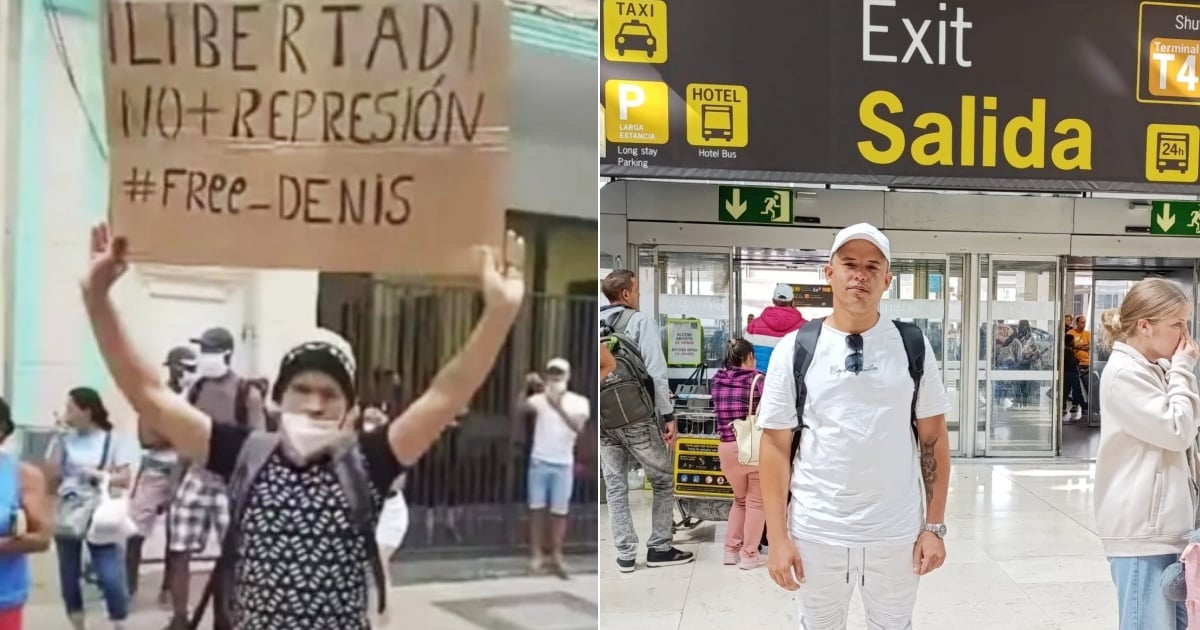
Luis Robles Elizástigui, known as "the young man with the banner," has arrived in Spain after years of imprisonment, harassment, and repression by the Cuban regime.
Their arrival in Madrid this Monday, along with their mother Yindra Elizástigui and their seven-year-old son, marks the beginning of a new chapter in freedom.
Tired and visibly emotional, they refrained from making statements upon their arrival at Adolfo Suárez Airport, according to the independent media 14yMedio, which witnessed their arrival and reported the information.
As of the closure of this note, no further details regarding the arrival of the political exile in Spain have emerged.
From political prisoner to exile: A story of peaceful resistance
Robles, 32 years old and originally from Havana, was declared a prisoner of conscience by Amnesty International after being arrested in December 2020.
What was their "offense"?: holding a sign with a peaceful message right in the Boulevard de San Rafael, in the heart of Havana.
The poster said: “Freedom, no more repression, #FreeDenis”, in support of the rapper Denis Solís, sentenced to eight months in prison in a summary trial, and who was subsequently exiled.
That solitary act, recorded by bystanders and spread on social media, became a symbol of protest. The images were later included in the music video for Patria y Vida, the anthem of the Cuban resistance.
Paradoxically, that same video was the only evidence used by the prosecution to convict him.
During the trial, held nearly a year after his arrest, Robles was charged with "resistance" and "enemy propaganda."
However, the video shows that he did not resist arrest and that the message on his sign did not refer to any enemy nor incite violence. Even bystanders tried to intervene on his behalf.
An arbitrary sentence and sanctioned officials
Robles was sentenced to five years in prison.
The ruling, dated March 28, 2022, nearly four months after the trial, justified its sentence by stating that Robles “responded to a call” from the influencer Alexander Otaola and that his message opposed “the decisions of the authorities.”
According to the Provincial Court of Havana, their actions aimed to "destabilize internal order" and attack "the Cuban economic and social system."
This resolution was heavily criticized by international organizations.
In May, the United States sanctioned the three judges and the prosecutor involved -Gladys María Padrón Canals, María Elena Fornari Conde, Juan Sosa Orama, and Yanaisa Matos Legrá- for their “crucial role in the arbitrary detention” of Robles, describing it as a “serious violation of human rights.”
They and their family members are prohibited from entering U.S. territory.
The family as the target of punishment
While Luis Robles was serving his sentence in the maximum-security Combinado del Este prison, the regime expanded its repression to his family.
His brother, Lester Fernández, was arrested while building a vessel and fined 7,000 pesos on the charge of "illegal departure from the country," despite no evidence being presented.
The complaint was made public by his mother, who never stopped bringing attention to the abuses committed against her son.
Yindra Elizastigui has become one of the most active voices in defense of political prisoners in Cuba.
"We must continue to defend the innocent, because our children and our family members are innocent," he stated in a broadcast in May 2023, when his son was once again denied parole.
"What they did, they did for a right that all human beings have," he added then.
A rebellious young man even before the cartel
Graduated in Computer Science, Luis Robles was already expressing dissenting ideas before his historic protest.
Three days before his arrest, he recorded a video in which he reflected on the state of the country, which would be made public much later. In it, he stated:
"We sincerely wish for a change, a change of system, a change of country, because communism has truly turned this nation into a hell, a hell where it is practically impossible to breathe, not only to breathe air but to breathe peace, to breathe tranquility."
And he/she continued:
"Freedom is the greatest thing one can have in life, and these shameless communists have taken away all kinds of freedoms since they arrived [...] They have even taken away our freedom to think; they want to control even what we think."
In March 2022, from prison, Robles published a letter in which he reaffirmed his commitment to the democratic cause:
"I decided to break the silence because I am tired of watching my country be destroyed while the government does nothing to fix it [...] because I believe that Cuba's greatest enemy is not outside, but sitting in the presidential chair."
Exile as the only way out
Luis Robles was one of the released prisoners in January of this year as part of an agreement between the Cuban regime and the Joe Biden Administration, which allowed for the release of dozens of political prisoners.
Although he was still under house arrest, it was formally terminated in June.
His arrival in Spain symbolizes both a partial victory and a bitter defeat: the freedom gained outside the country where he was born and that he once dreamed of seeing transformed.
UNDER CONSTRUCTION
Filed under: