
Related videos:
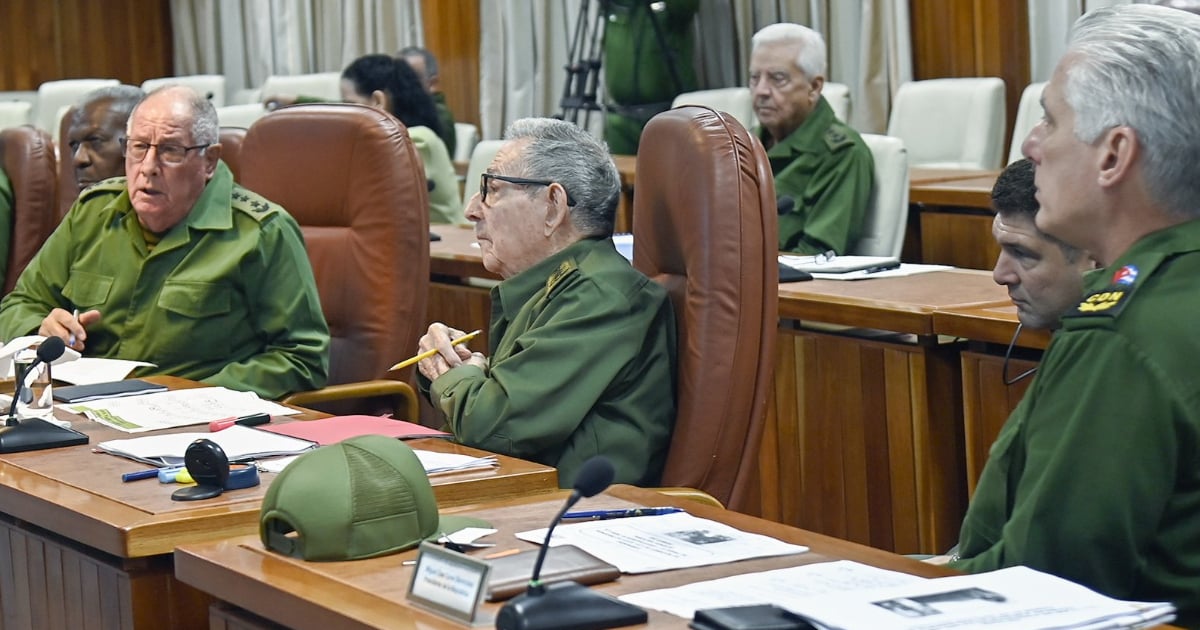
The Army General Raúl Castro Ruz, 94 years old, presided over a session of the National Defense Council (CDN) at the Ministry of Revolutionary Armed Forces (MINFAR) on Wednesday and was introduced as the "leader at the forefront of the Revolution."
He was accompanied by his grandson Raúl Guillermo Rodríguez Castro, known as "El Cangrejo," and to his right was the ruler Miguel Díaz-Canel.
The meeting aimed to "approve the decisions and plans of its working and assurance bodies," according to what the Presidency of Cuba published on the social media platform X.
However, the detail that has caught attention both inside and outside the country is the official description of the veteran leader as “chief at the forefront of the Revolution,” a phrase that demonstrates that Raúl Castro remains the true leader of power in Cuba, despite his supposed political retirement in 2021.
"The event was chaired by Army General Raúl Castro Ruz, leader of the Revolution, and the President of the Republic, Miguel Díaz-Canel," wrote the official account of the Presidency of Cuba.
The publication confirms what many Cubans have been saying for years: Díaz-Canel only holds the position of president, but he does not have real control over the country. Raúl continues to be the highest military and political authority in Cuba, even though he officially stepped down from all his positions over four years ago.
The man who never left
Raúl Castro, younger brother of Fidel Castro, has held the highest positions in the State since 1959. He served as Minister of the Revolutionary Armed Forces (1959–2008), First Vice President of the Council of State (1976–2008), President of Cuba (2008–2018), and First Secretary of the Communist Party (2011–2021).
His exit from power was portrayed as an “orderly transition,” but the army's control structure, especially the GAESA conglomerate, which dominates a large part of the national economy, remains under his direct influence and that of his military circle.
This new public appearance, and his presentation as the “leader of the Revolution,” sends two strong messages to the world. Firstly, it refutes the rumors about health issues and death of the general. Secondly, it makes it clear that Raúl Castro does not entrust the helm of the country, not even to his political heir.
A message between the lines
The use of that expression in an official statement, instead of "historical leader" or "Army General," has been interpreted by analysts and citizens as a reaffirmation of the military's power, in a context of economic crisis, social discontent, and growing distrust towards the Díaz-Canel government.
As the country faces blackouts, inflation, and mass migration, the image of Raúl at the helm of MINFAR serves as a reminder that real power in Cuba remains in the hands of the military, and ultimately, in the hands of Raúl Castro and the commanders themselves.
Frequently Asked Questions about Raúl Castro's Influence on the Cuban Regime
Does Raúl Castro still hold power in Cuba?
Raúl Castro remains the real leader of power in Cuba, pese a su supuesta jubilación política en 2021. Su reciente aparición y la descripción oficial como "jefe al frente de la Revolución" subrayan su dominio sobre el régimen, incluso sobre el presidente Miguel Díaz-Canel.
What is Raúl Castro's role in Cuba's economic crisis?
Raúl Castro has been a key player in the Cuban "state capitalism" system, controlled by the GAESA conglomerate, which he and his military circle manage. This system contributes to the control of a large part of the national economy, which has perpetuated the economic collapse and social discontent, while the population faces shortages and blackouts.
How does Raúl Castro's figure influence current Cuban politics?
Raúl Castro continues to be a symbol of continuity and legitimacy for the regime. His presence at public events is strategically used to maintain the image of unity and control of the government, especially in contexts of growing social discontent and economic crisis.
What has been the public reaction to Raúl Castro's ongoing influence?
The continuous presence of Raúl Castro in power is seen by many Cubans as a sign that the regime has not truly changed and continues to rely on the old guard to maintain control. The population faces deep distrust towards Díaz-Canel's government, which is manifested in protests, massive migration, and growing social discontent.
Filed under: