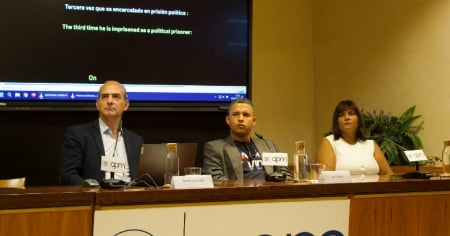
Yindra Elizástigui, mother of Cuban activist Luis Robles, delivered a moving testimony this Wednesday about the repression her family has suffered at the hands of the Cuban regime, during a press conference organized after her arrival in Spain.
“Today in Cuba, the greatest suffering that political prisoners experience is the silence of their families. Because if you remain silent, you become complicit,” he said in his testimony, broadcast live by CiberCuba Noticias, in which he revealed how his life changed drastically since the arrest of Luis Robles in 2020 for holding a sign with the message: “Freedom, no more repression, #FreeDenis”. That peaceful act made him a symbol of civic resistance and led to him being declared a prisoner of conscience by Amnesty International.
Yindra explained that she worked in a state program, and although she was offered a position in the Communist Party, she never accepted: “I have always considered myself a liberal person, in charge of my own decisions.” Following her son's case, she began to be harassed by State Security.
She recounted that they began to harass her at her workplace and even at the school where her niece studied. “The security agents came to my job to check the documents I worked with, looking for a list to have a reason, perhaps even to imprison me as well,” she explained.
She also said that she had to request leave without pay in order to move to Havana and see her son, and that the pressures ultimately forced her to leave her job.
During her speech, she confessed that for years she believed she had some degree of freedom, but the experience she went through opened her eyes: “I was just another prisoner, having to follow orders. I had to raise my hand to support things that I now regret.”
According to Elizástigui, the entire experience made her see "the dirty politics of Cuba," and understand that for years she was "just another prisoner."
Regarding the fear that paralyzes many Cubans, he stated: “Yes, there are people who have realized the truth, but they lack the courage to speak. Because in Cuba, one cannot speak freely. You have to be there to understand it.”
He called on the families of political prisoners to raise their voices and not abandon their loved ones. "Our children did not speak out just for themselves; they did it for all Cubans. And what do we do? Remain silent? That silence also supports the dictatorship."
Luis Robles, known as the young man with the banner, arrived this week in Madrid with his mother and his seven-year-old son, after successfully leaving Cuba without being intercepted by State Security. In his first statements to the press, he stated: “They wanted me to leave, but without speaking.”
His departure caught the regime by surprise, which had tried for months to silence him in exchange for allowing him to leave. “I left without revealing how. By the time they learned about it, I was already gone,” he stated to CiberCuba.
Robles was sentenced to five years in prison for the crimes of "resistance" and "enemy propaganda," in a trial harshly criticized by international organizations. In 2024, the United States sanctioned the judges and prosecutors involved in his case for "serious violations of human rights."
During the conference, Yindra emphasized the importance of continuing the fight for freedom from both inside and outside the island. “Spain and other countries can support us, but change must also come from us, those who are there. We cannot remain silent any longer.”
"We are more. The people are more than the authorities, more than the police, more than those from State Security," he declared.
Frequently asked questions about the situation of Luis Robles and repression in Cuba
Who is Luis Robles and why did he become a symbol of resistance in Cuba?
Luis Robles is a Cuban activist known as "the young man with the sign," who was arrested in 2020 for holding a placard that called for freedom and an end to repression in Cuba. His peaceful act made him a symbol of civic resistance and he was declared a prisoner of conscience by Amnesty International.
How did Luis Robles manage to leave Cuba?
Luis Robles managed to leave Cuba for Spain discreetly, without the State Security being able to intercept him. His departure caught the regime by surprise, which had tried to impose silence on him in exchange for allowing his exit. He stated that he chose not to reveal how he would do it to avoid being intercepted.
What repercussions did the Luis Robles case have internationally?
The case of Luis Robles was criticized internationally, particularly by human rights organizations. In 2024, the United States imposed sanctions on the judges and prosecutors responsible for his case for serious human rights violations, prohibiting them from entering U.S. territory.
What message did Yindra Elizástigui, mother of Luis Robles, send to the families of political prisoners in Cuba?
Yindra Elizástigui, mother of Luis Robles, urged the families of political prisoners not to remain silent. She emphasized that the silence of the families supports the regime, and that it is crucial to raise their voices in defense of freedom and human rights. Her testimony underscores the importance of public denunciation to highlight repression in Cuba.
Filed under: