
Related videos:
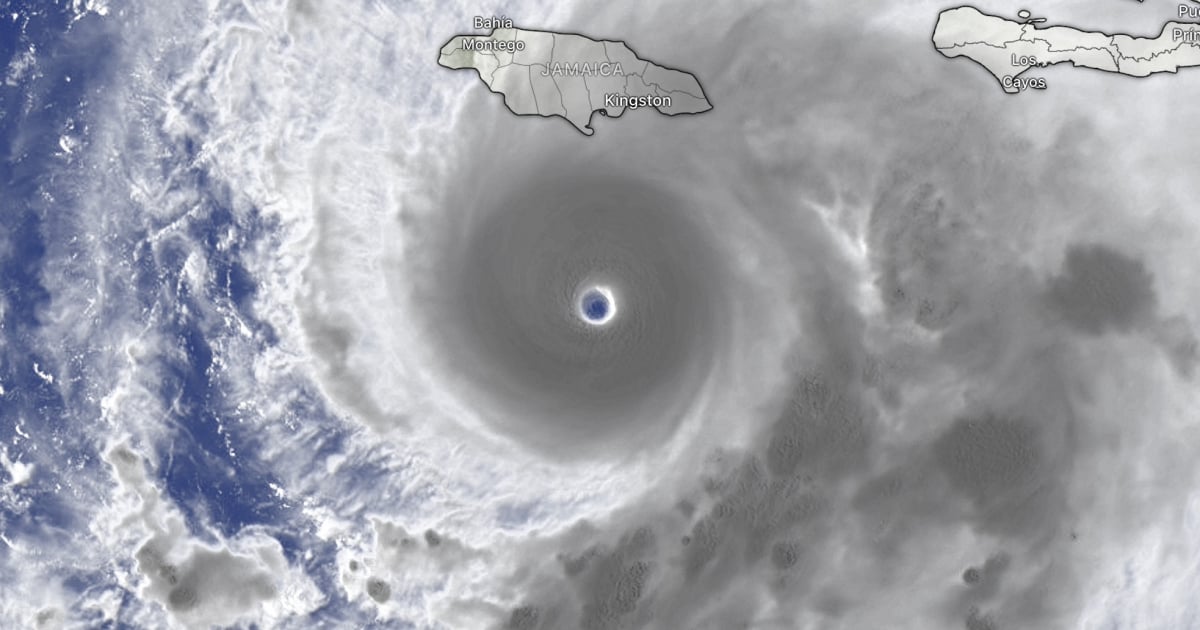
Hurricane Melissa continued to strengthen its winds, which have now reached 230 km/h with higher gusts.
According to the 5 PM report from the National Hurricane Center (NHC) of the U.S. the eye is located at latitude 16.4 North, longitude 77.2 West.
The category 4 hurricane on the Saffir-Simpson scale is moving west at around 5 mph (7 km/h). A slow westward motion is expected tonight, followed by a turn to the north and northeast on Monday and Tuesday.
The center of Melissa will move near or over Jamaica on Tuesday, and across southeastern Cuba Tuesday night, then over the southeastern Bahamas on Wednesday.
The NHC forecasts additional intensification over the next day or so, followed by fluctuations in intensity.
"It is expected that Melissa will be a powerful major hurricane when it makes landfall in Jamaica on Monday night or Tuesday morning and in southeastern Cuba late on Tuesday," the report warns.
Melissa has hurricane-force winds extending 30 miles (45 km) outward from the eye and tropical storm-force winds extending up to 205 miles (335 km) outward.
The estimated minimum central pressure is 941 mb (27.79 inches).
Rain and storm surge
The report forecasts a total storm rainfall of 10 to 15 inches for eastern Cuba, with localized amounts of up to 20 inches, from Monday to Wednesday, which could lead to life-threatening flash floods and numerous landslides.
There is also a potential for significant storm surge along the southeastern coast of Cuba during the late hours of Tuesday or Wednesday.
The maximum heights of the storm surge could reach 6 to 9 feet above normal tide levels, near and to the east of where the center of Melissa makes landfall. This storm surge will be accompanied by large and destructive waves, the information adds.
Evacuations in Cuba
More than 650,000 people will be evacuated in Eastern Cuba due to the approach of Hurricane Melissa.
A total of 258,573 people from the province of Santiago de Cuba, about 69,000 from Holguín, 139,914 from Guantánamo, 72,000 from Las Tunas, and around 110,000 from Granma will have to leave their homes and seek shelter in the houses of friends or family or in evacuation centers, the Presidency of Cuba reported in a thread on X.
The information was revealed during the virtual expanded session of the Extended Defense Council chaired by the leader Miguel Díaz-Canel.
In Santiago de Cuba, it was also revealed that the Baraguá and Carlos Manuel de Céspedes reservoirs are under surveillance.
In Granma, the situation is complex with swollen rivers, reservoir overflow, and coastal flooding due to the nighttime high tide in the Gulf of Guacanayabo, which hinders the natural drainage of water. As a result, 15% of the population will be evacuated, totaling 66,000 people in evacuation centers.
In Guantánamo, 30% of the population will be safeguarded in 108 centers.
Finally, in Las Tunas, there are 133 evacuation centers, and most of those seeking refuge will stay with family and friends.
It had been reported earlier that in the easternmost province, out of a total of 108,000 evacuees, many will stay in the homes of family and friends.
According to the state media, there are 83 centers for food preparation and 69 schools designated as evacuation centers in that province.
In Baracoa, specifically, 10,000 people will remain evacuated, while the recent rains have affected the mountainous roads, drainage system, and the main bridge in the area.
Filed under: