
Related videos:
The United States is preparing to launch targeted airstrikes against military facilities in Venezuela that, according to U.S. officials, are used by Nicolás Maduro's regime for drug trafficking activities.
The decision, revealed by The Wall Street Journal, would mark a new phase in President Donald Trump's pressure strategy against Caracas, which Washington accuses of running a transnational criminal network known as the Cartel of the Suns.
The Pentagon has identified the objectives
Cited sources have stated that the Pentagon has already identified a series of military targets in Venezuelan territory, including clandestine airstrips, fuel depots, logistical centers, and bases allegedly linked to drug trafficking.
If the attacks materialize, the objective would be -according to the source- "to send a clear message" to the Venezuelan dictator: his time in power is "running out".
Although there is no confirmation of a ground invasion, preparations suggest a precision aerial offensive focused on structures where the operations of the regime and allied cartels converge.
A senior U.S. official, quoted by the Nuevo Herald, stated that Maduro "could find himself trapped in his own country" if the operation goes forward. "There is more than one general willing to turn him in," the source assured.
"Precision operation, not invasion"
Although the presence of U.S. military forces has raised alarms in the region, military analysts consider a large-scale invasion unlikely.
Retired Colonel Mark F. Cancian, from the Center for Strategic and International Studies (CSIS), explained that the current strength "is not sufficient to occupy Venezuela," but it is "enough to launch precision attacks or cruise missiles against strategic targets."
For his part, Elliott Abrams, former U.S. special envoy to the Andean country, revealed to columnist Andrés Oppenheimer that Trump "does not seek a prolonged war," but rather quick and decisive actions, similar to the attack he ordered in 2020 against Iranian General Qasem Soleimani.
An unprecedented military force in the Caribbean
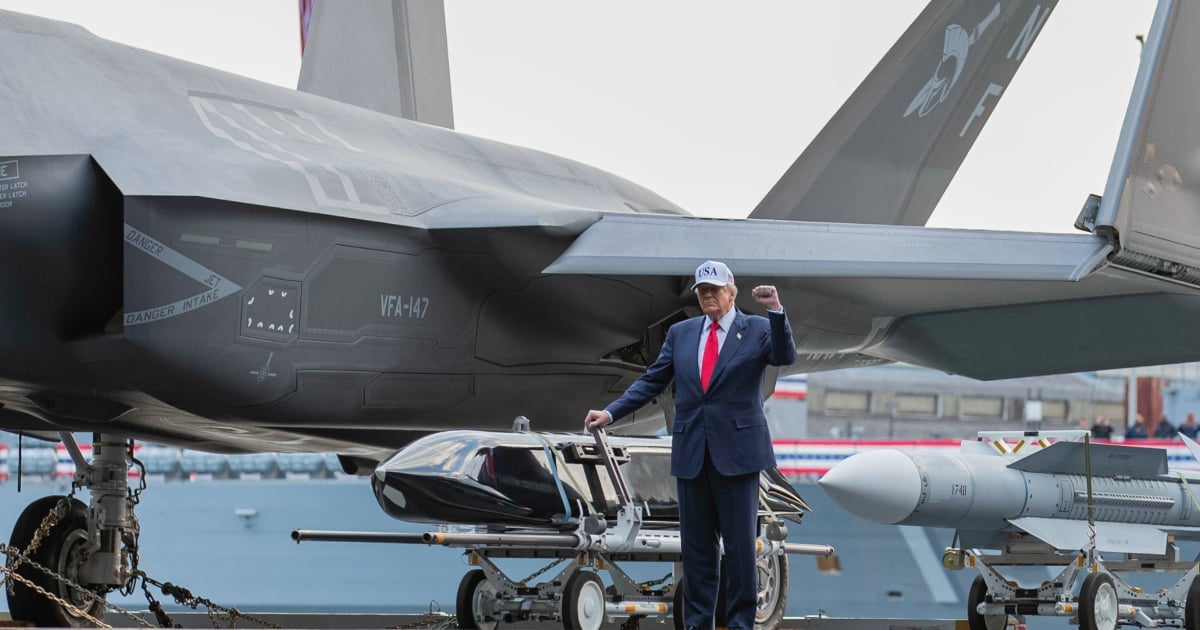
Since August, the United States has maintained a Joint Task Force in the southern Caribbean Sea, equipped with destroyers, F-35B fighter jets and armed MQ-9 Reaper drones, based in Puerto Rico.
In the middle of the month, Trump confirmed that he authorized operations by the Central Intelligence Agency (CIA) in Venezuela and suggested the possibility of a ground intervention to halt drug trafficking and the influx of irregular immigrants from that country.
Ten days later, Secretary of Defense Pete Hegseth ordered the deployment of the aircraft carrier USS Gerald R. Ford along with its strike group—comprising over 4,000 personnel and 90 combat aircraft—to the Caribbean, in what analysts describe as the largest U.S. military buildup in front of Venezuela in decades.
So far, operations have been limited to maritime interdictions.
In recent weeks, the U.S. fleet has destroyed fast boats suspected of transporting cocaine, leaving 61 alleged drug traffickers dead.
However, senior officials at the Pentagon have confirmed that the next phases could move operations to solid ground, targeting laboratories, command centers, and regime convoys.
Maduro and his inner circle under scrutiny from Washington
The Trump administration directly accuses Nicolás Maduro and high-ranking civilian and military officials of leading the Cartel of the Suns, which is estimated by U.S. authorities to export up to 500 tons of cocaine annually to Europe and the United States.
Washington has doubled the reward for information leading to the capture of Maduro to 50 million dollars, the largest bounty ever offered by a sitting head of state.
Additionally, he offers 25 million for several of his key collaborators, including Diosdado Cabello and Vladimir Padrino López, both accused of drug trafficking.
Attorney General Pam Bondi recently referred to Maduro as "one of the world's largest drug traffickers" and "a direct threat to the national security of the United States."
A new phase of confrontation
The military escalation occurs amidst the tightening of economic sanctions and the designation of several Latin American criminal groups—among them the Tren de Aragua—as terrorist and transnational criminal organizations.
With the Caribbean turned into a stage for a show of force, Washington appears determined to escalate its pressure against chavismo into the military realm, after years of sanctions, diplomatic isolation, and failures in negotiation attempts.
If the attacks materialize, the United States would once again engage in a direct military operation in the Western Hemisphere, something that hasn't happened since the invasion of Panama in 1989.
The great unknown, analysts warn, is not whether Trump will order the attacks, but when and with what political and regional consequences.
UPDATE: Trump denies plans to attack military targets in Venezuela
Following the publication of this news, President Donald Trump denied that the United States is preparing an imminent attack on the military installations of Nicolás Maduro.
According to reports from Europa Press, Trump denied on Friday that the Armed Forces are finalizing plans to bomb military targets in Venezuela.
The president responded no to the question of whether, as reported by The Wall Street Journal and Nuevo Herald, a decision had already been made.
In statements quoted by Fox News Digital, White House Deputy Press Secretary Anna Kelly emphatically stated: "Anonymous sources don't know what they're talking about. Any announcement related to policy towards Venezuela would come directly from the president."
Filed under: