
Related videos:
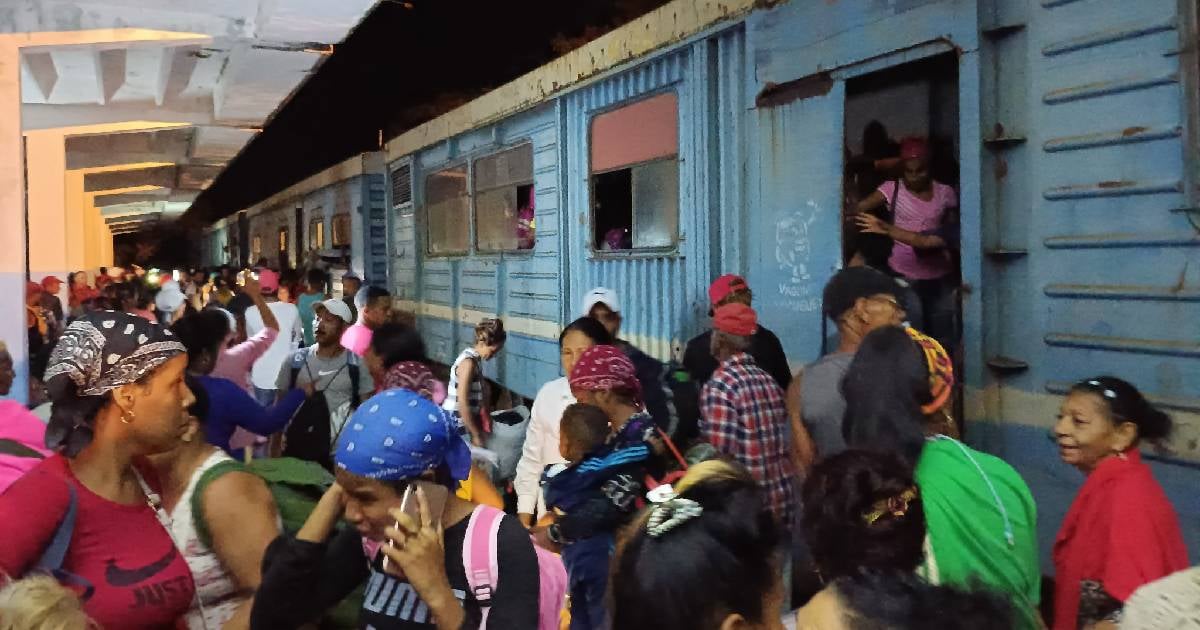
An incident on a train transporting hundreds of people evacuated due to the flooding in the municipality of Río Cauto, in the province of Granma, marked one of the most tense days of the rescue operation that has left Cubans on edge.
According to the Cuban Railroad Union (UFC), locomotive 52554, carrying thirteen cars and more than 2,600 passengers on board, arrived in Guamo this Friday to transport residents who were anxiously waiting to be taken to safe areas. However, during the return journey to Jobabo, in the province of Las Tunas, the train encountered a flooded section of track that caused a technical incident on the line.
According to the official report disseminated on Facebook and initially shared by Transport Minister Eduardo Rodríguez Dávila, a subsidence caused by the rise of the river led to the fourth and fifth cars uncoupling, which split the train into two sections: one led by the locomotive with four cars that continued moving forward, and another consisting of nine cars that remained behind, with dozens of passengers on board.
The UFC clarified that there was no derailment or injuries, although it described the moment as one of “extreme complexity” due to the water level and the distance separating the two trains. “It was not a train accident, but rather a difficult situation that was managed collectively,” the state entity stated as justification.
Some of the passengers who were left in the rear cars returned to the Guamo station, while others remained inside the carriages under critical conditions, with the water level at the height of the rails. Local authorities explained that a rescue operation was organized to reach that part of the train and evacuate the remaining travelers.
During the early hours of Saturday, motor vehicles sent from Jobabo returned to Guamo to pick up passengers stranded in the flooded area, where the water level continues to rise.
The president of the Provincial Defense Council of Las Tunas, Osbel Lorenzo Rodríguez, confirmed that the train would continue its trips "as many times as necessary" to ensure the evacuation of the entire population.
The Transport delegate in Las Tunas, Reinaldo Reyes, reported that buses have been made available in Jobabo to transport evacuees to the municipality of Colombia, where they were welcomed with medical assistance, food, and temporary shelter.
The Ministry of Transportation announced on Friday that a special train operation started from Camagüey with additional locomotive units and crews to evacuate isolated communities in Río Cauto, one of the areas most affected by the rising waters of the river of the same name.
On social media, family members and residents described the situation as "a nightmare", while seeking information about relatives who remained in Guamo. The anguish went viral as calls from Cubans pleading to expedite the evacuation of families trapped by the water emerged.
Although authorities assert that there are no human casualties, the incident highlights the vulnerability of the Cuban railway system amid extreme weather conditions.
In recent days, the rains associated with the hurricane Melissa have left vast areas of Granma underwater, with damaged homes, blocked roads, and thousands of displaced people.
The Ministry of Transport and the Union of Railways stated that they are continuing rescue operations and repairs on the affected section, with the support of the Armed Forces and technical crews.
Filed under: