
Related videos:
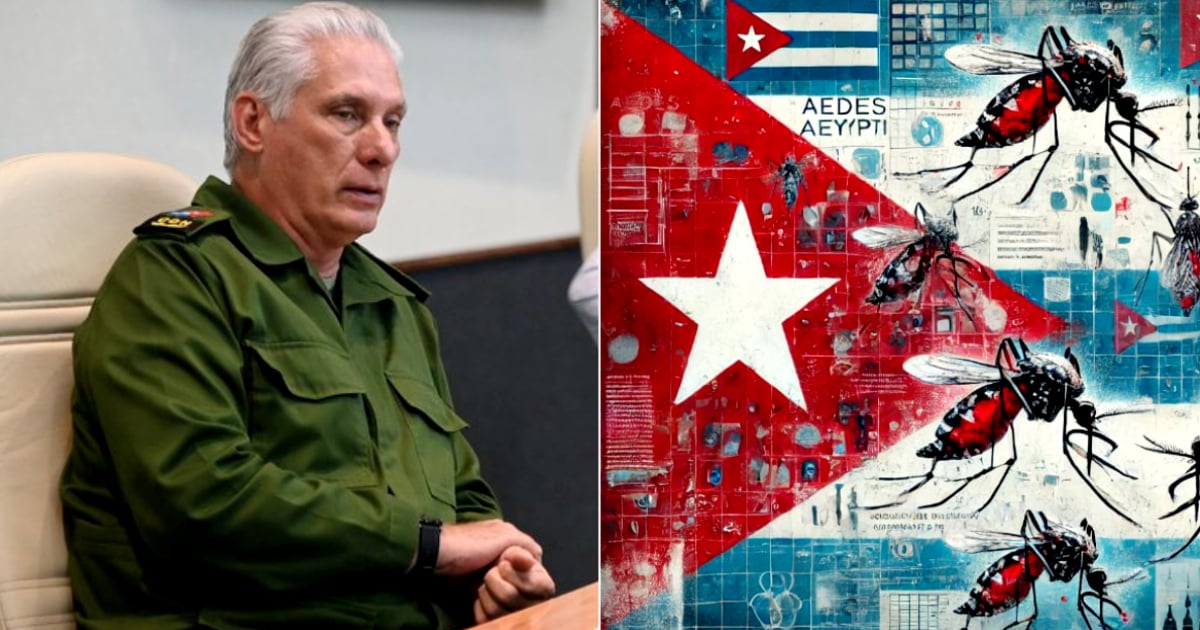
The Cuban regime itself has come to recognize what millions of citizens have been denouncing for months: the country is experiencing an epidemic out of control.
However, instead of admitting his responsibility and implementing effective measures, the designated leader Miguel Díaz-Canel resorted once again to the usual formula of the system: televised meetings, triumphant speeches, and empty promises wrapped in scientific rhetoric.
We are going to tackle this epidemic just as we did with COVID-19, declared Díaz-Canel during a meeting held this Tuesday in the Palacio's halls. The phrase, instead of instilling confidence, sends chills through a population that remembers the chaos, censorship, and secrecy that characterized the management of the pandemic in Cuba.
A late and poorly timed admission
The official report itself acknowledges the magnitude of the problem: 38 municipalities with active dengue transmission, over 21,000 cases of chikungunya, and fever outbreaks in 68 municipalities across the country. The figures, although somewhat manipulated, reflect a national expansion.
Despite this, the government insists that the situation has "improved" in recent weeks, a narrative that is disconnected from the reality faced by overwhelmed hospitals, neighborhoods infested with mosquitoes, and families improvising treatments without medications or medical care.
Instead of acknowledging the lack of systematic fumigation, the shortage of reagents, and the absence of healthcare personnel—a result of the massive exodus of doctors and nurses—the regime blames "population indiscipline" once again and calls for "community participation," a euphemism used to shift its own inefficiency onto the citizens.
Propaganda instead of management
The report from the Cuban Presidency is a textbook example of how propaganda replaces public information.
Each paragraph repeats slogans of "intersectorality," "discipline," and "revolutionary science," but does not provide a single verifiable piece of data regarding mortality, hospitalizations, or availability of supplies.
While the doctor in charge of vector surveillance acknowledges that "not all areas have been reached" due to a lack of equipment, fuel, or personnel, the text hastens to emphasize the "training of brigades" and the "quality of the work," as if mere rhetoric were sufficient to exterminate mosquitoes or cure the sick.
The insistence on "facing the epidemic like COVID-19" feels almost sarcastic: that management resulted in thousands of unrecognized deaths, overwhelmed hospitals, a shortage of oxygen, and repression against doctors and citizens who reported the truth. Today, history is repeating itself, with new diseases and the same lies.
Although the official article does not mention it explicitly, the language used —with an emphasis on "home isolation," "entry into the home," and "discipline of patients"— suggests that Díaz-Canel's government may be laying the groundwork to declare partial or selective lockdowns in areas with the highest number of infections.
It would not be the first time that the regime resorts to restrictive measures under the guise of health protocols: during the COVID-19 pandemic, “social discipline” became synonymous with territorial control, repression, and neighborhood surveillance.
The parallelism with that discourse anticipates the possibility of covert closures, militarization of neighborhoods, and restrictions on mobility in the name of "epidemiological surveillance."
Institutional blindness and informational opacity
Opacity is already a structural part of the Cuban healthcare system. There is no public access to actual data on incidence, mortality, or the geographical distribution of outbreaks.
The reports from MINSAP have been reduced to vague statements and broadcast meetings where officials speak of "accumulated experiences" and "lessons learned from COVID" while the entire country is falling ill.
It is revealing that the official text refers to “identifying the problem from the moment the patient presents with a fever,” as if the island had not been facing an explosive increase in fever syndromes for months.
Only now, faced with the impossibility of hiding it, the regime admits to the epidemic, although it wraps it in its discourse of "revolutionary science" to disguise the administrative incompetence that has allowed its spread.
An exhausted system
The healthcare collapse is not a result of chance, but rather the outcome of years of neglect, the export of services and medical professionals, lack of investment, and prioritizing military, propaganda, and tourism infrastructure spending over healthcare.
Hospitals lack beds, laboratories have no reagents, and pharmacies are empty. However, the regime continues to fund the construction of hotels that remain unoccupied, political campaigns, and events for ideological reaffirmation, while calling on medical students to "reinforce" tasks that should be carried out by qualified professionals.
The reality is that Cuba is facing a widespread health crisis without resources or transparency. The regime's response is once again the same as always: controlling the narrative, disguising the data, and blaming the people.
Meanwhile, arboviruses are spreading, hospitals are overwhelmed, and the entire country is once again reliving the hell of the pandemic, this time with no excuses, no vaccines, and no hope.
Filed under: