
Related videos:
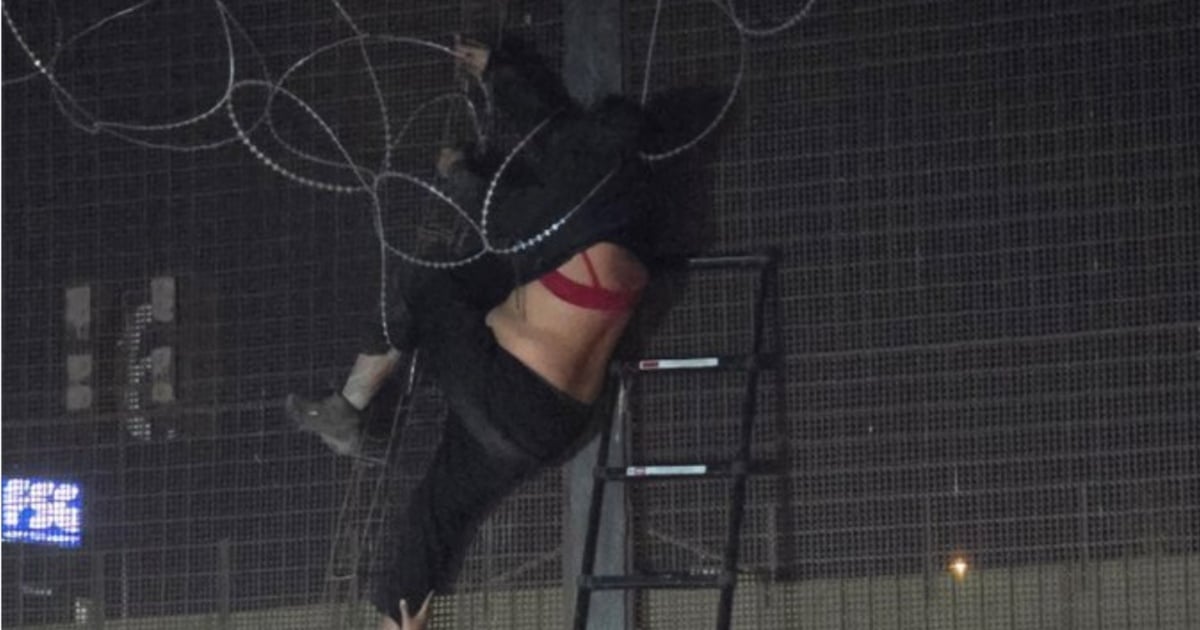
The United States Border Patrol rescued a migrant woman who became trapped in the barbed wire installed on the border wall with Mexico while attempting to cross irregularly.
According to reported by the agency itself on its official X account (formerly Twitter), the agents successfully secured her release and subsequently transported her to a processing center for her “disposition and immigration processing.”
In the message posted on X, the Border Patrol explained that the woman was found entangled in concertina wire, a metal barrier with sharp edges that has recently been installed to reinforce the wall in various sections of the border.
The agents arrived at the scene, disconnected her from the metal, and checked her health condition.
According to the official version, the migrant had "minor scratches" and it was not necessary to transfer her to a hospital; instead, she was taken to the CPC, where she will await the determination of her situation under U.S. immigration laws.
Another message from the Border Patrol not only reaffirmed the narrative of “closed border” that the Trump administration advocates.
“How do you sleep at night? Easy: knowing that the border is closed to illegal entries. For our agents, protecting communities brings peace of mind,” the agency pointed out, before emphasizing that “there are no new asylum programs,” “illegal foreigners do not receive work permits,” and “there are no shortcuts: the law is clear and is enforced.”
At the beginning of the year, the United States Army reinforced several sections of the border wall in the Tijuana area with barbed wire, facing the city of San Diego (California).
The Department of Defense reported that members of the 1st Marine Division, from the 1st Combat Engineer Battalion, deployed concertina wire along the southern border, "adding additional security that will reduce illegal border crossings.
Residents of the area reported that in the days leading up to the event, they observed military machinery arriving and then heard ongoing work to install wire and reinforce the metal bars.
In another message, the Pentagon specified that the United States Northern Command is working alongside the Department of Homeland Security (DHS) to enhance border protection, and detailed that an initial deployment of 1,500 active-duty military personnel has raised the total number of Title 10 forces assigned to the southern border to nearly 4,000 personnel.
The installation of barbed wire and the increase of military presence at the border are part of Trump's strategy to, according to his administration, "protect the country from an invasion of irregular migrants."
The DHS claims that the policy has achieved “historic” results: In October 2025, the first month of fiscal year 2026, only 30,561 encounters were recorded across the entire border, the lowest figure since the Office of Customs and Border Protection (CBP) began collecting statistics, and 79% less than in the same month of 2024.
The Secretary of Homeland Security, Kristi Noem, hailed this data as evidence that this is "the safest border in history," emphasizing that the Border Patrol has gone six consecutive months without releasing any undocumented immigrants within U.S. territory, which she called "unprecedented."
The CBP commissioner, Rodney Scott, stated that the government's goal is to "secure the border and protect the nation," attributing the results to an "unapologetic and apolitical" enforcement of immigration laws.
However, human rights organizations have strongly criticized these measures for the , the prolonged use of detention and expedited deportations, as well as the risks associated with the widespread use of dangerous physical barriers, such as barbed wire, for individuals attempting to cross.
The case of the woman caught in the wires of the wall—who was able to be rescued with minor injuries—illustrates, on a smaller scale, the growing dangers faced by migrants at an increasingly militarized and hostile border.
Filed under: