
Related videos:
While the Cuban government boasts about its healthcare system as one of its main "revolutionary achievements," a family in Granma is publicly pleading for something as basic as an ambulance.
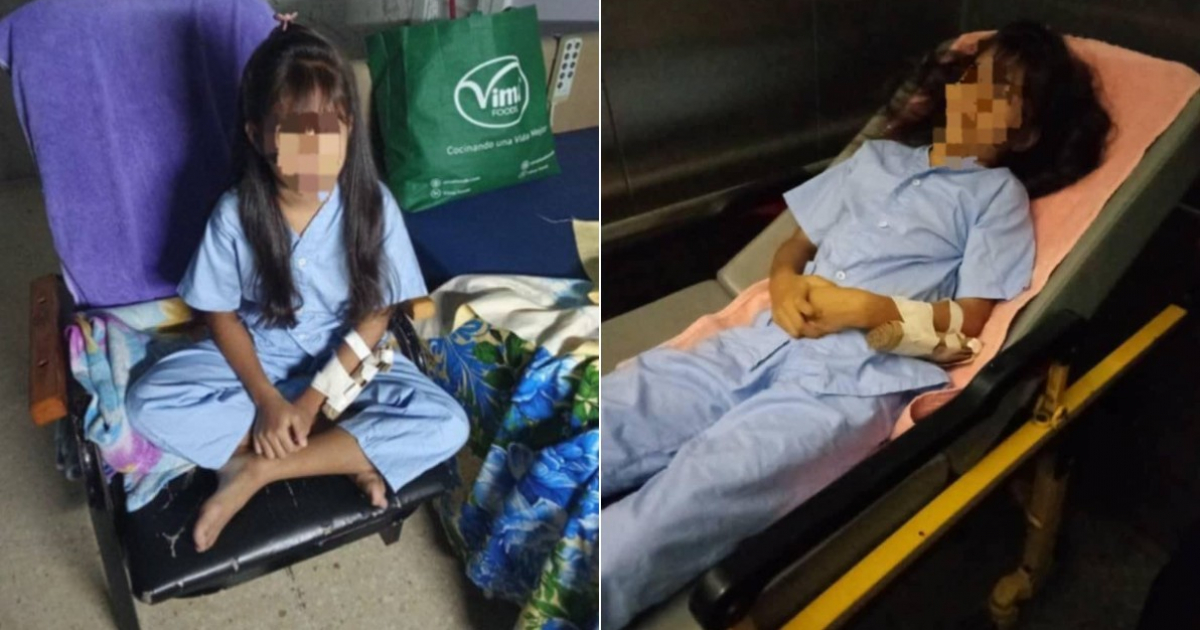
The case of little Érika Sabrina—a girl with an irreversible illness who only wishes to spend her last days at home with her sisters—has once again highlighted the precariousness and institutional neglect that patients experience in Cuba.
"I need an ambulance."
Neldis Maceo Cabrera, the girl’s mother, sought help on Facebook with a message that shocked hundreds of users: "All I can do is take care of her and fight to give her the best. I need an ambulance."
According to him, the doctors at the Juan Manuel Márquez Children's Hospital in Havana informed him that there is no possible treatment.
The youngest was given a death sentence with a single phrase that shattered her mother: there is nothing more that can be done. Now, all that is left is to fulfill the little girl's wish, which is to return home.
But there is an obstacle: the transfer must be by ambulance, and the State does not guarantee the service even in the most critical cases.
The family fears that if they wait for the state ambulance, they could spend up to another month in the hospital, a time that the child likely does not have.
"The regime does not guarantee the ambulance."
In the face of desperation, activist Idelisa Diasniurka Salcedo Verdecia, a resident of Miami, offered to pay for a private ambulance to transport the girl from the Juan Manuel Márquez Children's Hospital in Havana to Granma province.
In his message, he makes it clear that the public health system - which should ensure that transportation - will not do so: "The regime does not guarantee the ambulance."
The doctors had already explained that the minor must return home, as her diagnosis is irreversible: complex arteriovenous malformations of grade V located in the main arteries of the brain, and any surgery could lead to brain death or something worse.
Due to her condition, Érika is at high risk of cerebral hemorrhage and progressive brain tissue damage, which can lead to seizures, loss of bodily functions, neurological deterioration, and severe headaches.
"It is a very serious situation where any sudden movement, stress, or inappropriate transfer can worsen it fatally. That is why the transfer must be carried out strictly by ambulance, with medical personnel, oxygen, constant monitoring, and emergency equipment to act in the event of a crisis," Diasniurka detailed in another post.
For all these reasons, the specialists indicated that she should be taken home to fulfill her wish of being with her family.
However, the Cuban state, which prides itself on having a "free and universal" system, cannot—or does not want to—provide an ambulance to transfer a dying girl to her home.
The government took away the Internet from the girl's mother
Hours after offering to pay for an ambulance, Diasniurka Salcedo reported in another post that the government cut off internet access for the minor's mother.
"One must be very shameless to leave a mother cut off from all communication when all she asks for is humanity," he stated.
"This is not just a lack of respect. It is cruelty. It is a violation of human dignity. Punishing a sick girl and her mother for asking for something as basic as the ability to return home is the clearest reflection of a system that has long ceased to protect lives," he emphasized.
A reality that contradicts the official narrative
The girl Erika, described as a little one full of zest for life and "one of the best in the class," only wants to spend her last days with her little sisters.
The basic human right to die surrounded by loved ones at home now depends on donations, Facebook posts, and solidarity among Cubans.
Meanwhile, the government continues to celebrate its healthcare model at international events, while critically ill children must wait for a digital miracle to receive an ambulance.
In Cuba, the official discourse speaks of dignity. The reality, however, continues to demand assistance.
Filed under: