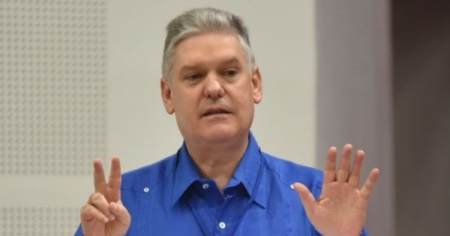
The Cuban leader Miguel Díaz-Canel appeared as a prosecution witness in the trial for economic crimes against the former Minister of Economy Alejandro Gil Fernández, whom he presented for years as his trusted man, provided academic guidance to, and praised publicly even after his removal, as reported by his sister, attorney María Victoria Gil, in an interview this Saturday with journalist Mario J. Pentón.
The process, which has been underway since November 26 in strict secrecy and behind closed doors, constitutes the second trial against the former minister: the first was for espionage, in which the prosecution sought a life sentence and that was indeed announced on the National Newscast of Cuban Television.
On this occasion, however, not a single official notice has informed the public about the trial for corruption, money laundering, influence peddling, and other economic crimes, which has outraged the accused's family.
María Victoria, who resides in Spain, confirmed that she has direct sources within the process and that the trial lasted four days and is now concluded for sentencing, although under “absolute secrecy.”
"The population has not even received information through the national television news... It is a disrespect to the people of Cuba," she remarked, noting that in Spain even the trials against high-ranking state officials are made public.
One of the most controversial points revealed by María Victoria is the presence of Díaz-Canel as a witness for the prosecution.
"The President of the Republic of Cuba, Miguel Mario Díaz-Canel, has appeared in the trial against my brother as a prosecution witness. A prosecution witness is a witness for the accusation," he emphasized.
The lawyer recalled that the relationship between the two was very close: Díaz-Canel was Alejandro Gil's thesis advisor in Economics.
On February 2, 2024, a day after his dismissal, he publicly congratulated him for his “excellent work.”
On February 6, on his birthday, he congratulated him again and even invited him to continue working for the revolution.
“Once they were one, they were one. My sister-in-law would say ‘it’s that they adore each other, they can't live without each other’. And now, merely to clean their severely damaged image both nationally and internationally, they are willing to testify against my brother as a witness for the prosecution in a corruption trial. I find it shameful,” María Victoria stated to Pentón, describing Díaz-Canel’s actions as a personal and political betrayal.
The sister of the former minister also reported direct pressure on the family to maintain silence.
He mentioned that his nephews and sister-in-law were allowed to enter the room “after signing a document of confidentiality and complete secrecy” and that they have asked him not to give interviews.
“My niece begged me: ‘Aunt, please don’t talk anymore, because instead of helping, it harms my father’,” she recounted.
Despite that request, María Victoria decided to speak publicly, claiming that “the people of Cuba have the right” to know the details of a high-level corruption case.
"I speak because I have the truth in my hands and because it seems incredible to me that the people are being denied the right to know what has happened to one of the most important ministers in the country," he asserted.
The lawyer acknowledged that her brother has admitted to several of the economic crimes he is accused of. “I know my brother committed economic crimes… Power corrupts, and when you are in a corrupt circle, the environment leads you without you realizing it,” she said, while emphasizing that no minister comes out “clean” from a system she described as structurally corrupt.
A "scapegoat"
Maria Victoria insisted that Gil is being used as a "scapegoat":
“It is impossible that all this corruption has occurred and only Gil is held accountable… The important figures have disappeared along the way and only small players remain. Here, the only one paying for everything is Alejandro Miguel Gil Fernández,” he denounced.
He announced that he will take the case "to the very end," even to the International Court of Justice, and emphasized that his goal is that, if economic crimes are proven, "those who need to fall will fall with him," including other high-ranking officials who may have participated or turned a blind eye.
Another point discussed during the trial, according to the lawyer, is the possible confiscation of the home Gil occupies in Miramar, Havana, a house belonging to a government official obtained through a state exchange.
María Victoria explained that this house is not the result of illegal activities, but rather the outcome of a process in which she herself intervened upon seeing the conditions in which her brother lived while serving as minister.
She recounted that the family inherited a previous house “from before the triumph of the Revolution,” which belonged to her parents and that she later donated to her niece.
That property was the one exchanged for the current house in Miramar, after multiple negotiations with the Central Committee. "They can't just take the house away like that, because it's not a bad life nor the result of a crime," he emphasized.
However, he admitted that in a dictatorship “that’s Cuba, they will take it away from you,” because “there are no rights in dictatorships.”
María Victoria also questioned the abandonment by the elite surrounding the former minister during his time in power.
He mentioned the names of public figures who used to frequent his home and benefited from their closeness to power, and who, he claims, have now vanished.
“At what point during these difficult years have they gone to see my brother in prison, or asked my family if he is okay?” he wondered, asserting that “those who used to honor him and ask for favors are no longer there.”
While the regime keeps the trial shrouded in opacity, the only news that emerges comes through independent media and from María Victoria herself, who has chosen to confront the imposed silence and denounce what she sees as a political operation aimed at protecting the image of the leadership, headed by Díaz-Canel, at the expense of one of his closest allies.
Filed under: