
Related videos:
The trial that began this Tuesday in Havana against the former Minister of Economy -identified in the court documents as Alejandro Miguel Fernández and referred to by his family as Alejandro Gil- is being held behind closed doors, with the family practically cut off from communication.
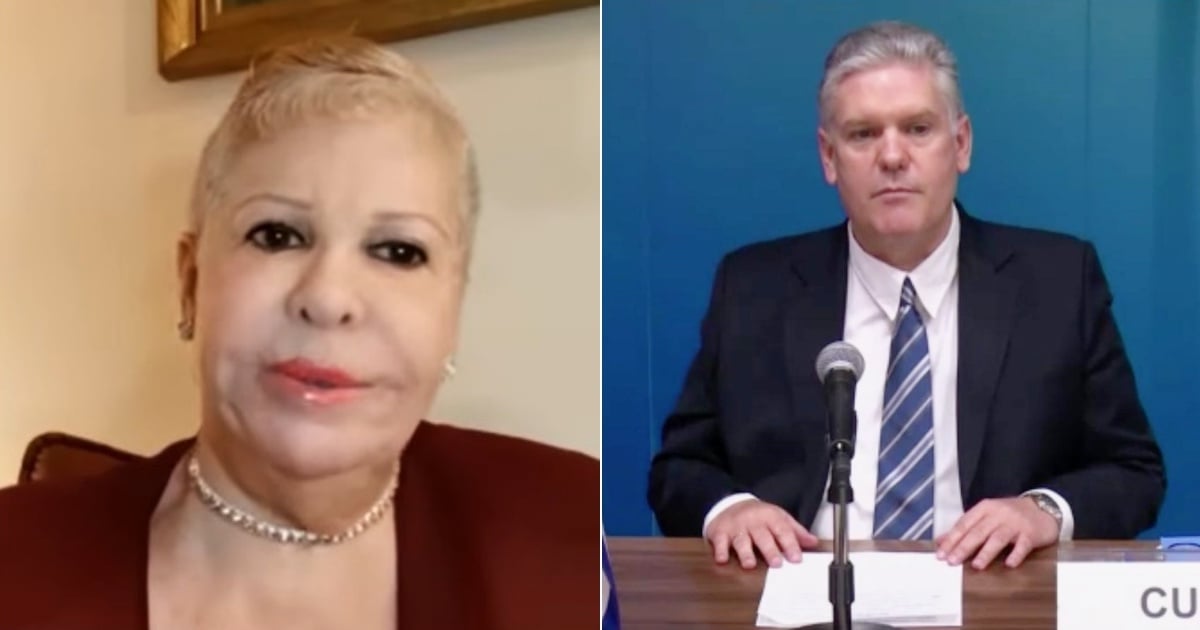
In an interview with Univision journalist Javier Díaz, his sister María Victoria Gil, a lawyer by profession, provided a harsh, direct, and deeply emotional testimony regarding the situation of the accused and the family.
María Victoria described from the outset the lack of information and the communication barriers: "the trial is completely shielded... I have no communication because my niece and nephew have been cut off from the internet since yesterday and their WhatsApp has been blocked."
"A brutal onslaught"
The sister of the former minister did not hold back on adjectives to define what, according to her, is a political persecution with personal overtones: "this is a typical case of brutal vendetta."
Gil recalled that her brother has been "detained for over a year in a high-security prison" - a situation she describes with horror and detail - and added: "he is suffering... degrading treatment... he has lost 50 pounds, he has no hair, he has alopecia areata caused by stress."
Although he acknowledges that one "gets into that" when in power and that corruption is systemic, he defended the hypothesis that his brother was not a typical spy: "I seriously doubt... that my brother was capable of becoming a spy. What I do believe is that my brother wanted to change things... he became bothersome because he wanted to change things within the economic structure of Cuba."
For her, the real "crime" would have been her willingness to promote changes favorable to private property and the non-state sector.
When asked if they believe the regime could execute him, he firmly shook his head: "I don't think so."
Trust - and skepticism - in justice
María Victoria combines her skepticism about the system with a personal investment in the figure of the president of the Supreme People's Court who is overseeing the process.
"I have faith in today's judgment because the President of the People's Supreme Court... is Rubén Remigio... I know he will not allow any disloyalty or anything that could harm the accused in this case," he claimed.
He explained that he studied at the university with Rubén Remigio and that this professional relationship leads him to hold "a certain hope and optimism" that the process may conclude with a dismissal.
Nonetheless, he acknowledged the paradox: "undoubtedly we all know that Cuba is not a rule of law… without being a rule of law, anything can happen."
He emphasized the importance of a technical defense: "the lawyer we have... is Dr. Abel Solar, he specializes in this type of crime and we have full confidence in his ability to defend us."
The prosecutor's office, as explained by María Victoria, charges for the crime of espionage—"a highly dangerous crime... one of the gravest in the Cuban penal code"—and, in its formulation, the request from the prosecution for that crime "is for life imprisonment."
The family asks that you speak up, that you don't sacrifice yourself in vain
In the face of the possibility that the accused may remain silent to protect others or to avoid sacrificing his own integrity, the sister offered a sharp piece of advice: "I told my brother… speak up, don’t fold, don’t be afraid… it's better to die with dignity than to live humiliated."
And he added: "dignity has no price… freedom has no price… truth has no price."
In the interview, he also defended that, although his character is "sanguine" and in the past he has uttered phrases that the government manipulated—"I would execute her completely," he said, referring to the clique that, in his opinion, has harmed the Cuban people—this should not be interpreted as a desire for them to kill his own brother.
"If the Cuban government interpreted that I also wanted to kill my brother, then what the Cuban government interprets has no value to me," he asserted.
What does María Victoria Gil ask for?
Closing the conversation, María Victoria made a recommendation to her brother: "don't have someone else's back when they don't deserve it... go all in."
"To die for a cause that truly exposes all the corruption of a Castroist elite... it is worth dying and becoming a hero of the homeland," he added.
The interview raised not only concerns about the detention conditions and the lack of family communication but also left open questions regarding the exact nature of the evidence and the classification of the crime (whether it involves espionage for a foreign power or some other type of conduct). It emphasized the closed and opaque nature of the process that began in Havana this Tuesday.
As the trial progresses behind closed doors, the family, the defense, and the country await answers that, for now, are only found in the public version of a prosecutor's office seeking the maximum penalty for a crime deemed "against state security."
The sister, a lawyer and a grieving witness, opted for the legal route: "I hope there is a possibility for a free and definitive dismissal... due to absence or lack of conclusive evidence."
The judicial process, which began this Tuesday in the Court of Crimes against State Security, in the Havana municipality of Marianao, is taking place under heavy military presence and strict secrecy, according to reports from independent media.
The Cuban regime has justified holding the trial behind closed doors for "national security reasons."
Laura María Gil, the daughter of the former minister who recently described the accusations against her father as "complete manipulation," had expressed her intention to attend the trial despite the restrictions, but she was denied entry.
Alejandro Arnaldo Gil González, the other son, was indeed authorized to be present.
In an audio message shared on social media, Laura María Gil stated that her family learned about the date of the trial through television, and that their communications were restricted on the same day as the official announcement.
“A nothing will change my mind that he is not a spy,” she said, defending her father's innocence and assuring that she would do “everything possible” to support him during the process.
The trial of Alejandro Gil Fernández, dismissed in February 2024 and regarded as one of the most dramatic political falls of Miguel Díaz-Canel's government, includes charges of espionage, embezzlement, bribery, tax evasion, money laundering, and forgery of public documents. The prosecution is seeking a life sentence for the former official.
Filed under: