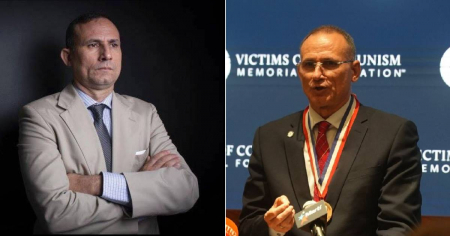
The Cuban opposition leader José Daniel Ferrer García, head of the Cuban Patriotic Union (UNPACU), reported this Saturday the detention of several citizens in Santiago de Cuba, accused by the regime of having painted anti-government graffiti in the city.
Through a post on his official Facebook account, Ferrer indicated that among those detained are Liusban John Utra, an activist from UNPACU and Cuba Decide, who was sent to the province of Las Tunas.
Additionally, four local residents who are not part of any organized opposition group: Josefina Reyes Londres, Ulises Reyes Ramis, his son, and a neighbor.
"Due to suspicions of graffiti, the tyranny has arrested and is prosecuting Liusban John Utra, an activist from UNPACU and Cuba Decide. Also arrested are four residents from Santiago who are not organized opponents," the dissident reported.
According to Ferrer, the arrests are part of a new wave of repression in Santiago de Cuba, where in recent weeks graffiti with phrases such as “Down with the dictatorship,” “Homeland and Life,” or “Freedom for political prisoners” have appeared on walls, streets, and electric poles.
"The more innocents are detained, the more graffiti against tyranny and in favor of the freedom of political prisoners appear in towns and cities across Cuba," asserted the opposition leader.
Local sources cited by human rights activists assert that State Security conducts nighttime raids and home searches, in search of the alleged authors of the messages.
Some neighbors report the presence of patrols and civil agents monitoring areas where the graffiti appeared.
Cuban legislation considers graffiti or political messages opposing the government as "enemy propaganda" or "disrespect for authorities", offenses that may carry sentences of up to eight years in prison.
Organizations such as Prisoners Defenders and the Cuban Observatory of Human Rights (OCDH) have denounced that these actions are part of a systematic campaign to criminalize peaceful activism and freedom of expression.
"Painting a wall or writing a slogan is not a crime; it is a legitimate form of civic protest. Arresting people for this demonstrates the regime's fear of public opinion," a spokesperson for the OCDH stated from Madrid.
In recent months, several Cuban provinces —including Santiago, Holguín, and Matanzas— have reported an increase in graffiti and anonymous posters against the government, amid economic decline, power outages, and shortages of food and medicine.
Messages, mostly written at night or during dawn, have become one of the few visible forms of protest on the Island, against censorship and state control of public spaces.
Filed under: