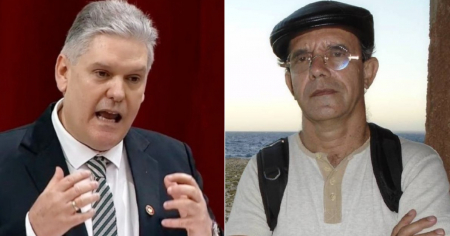
María Victoria Gil, sister of former Cuban Minister of Economy Alejandro Gil Fernández, has made new statements regarding the practical implications of the recent life sentence handed down against her brother.
In an exclusive interview with CiberCuba, the former television presenter and attorney, residing in Spain, publicly listed the assets that, according to her testimony, would be subject to confiscation by the Cuban regime.
“They are going to take away the house in Miramar, they are going to take away the mother-in-law's house, Conchita, they are going to take the dilapidated jeep from my nephew, and they asked for all the bank accounts,” she declared.
"I don't know if it's to confiscate the accounts or to review them," he added, hinting that he has not yet been informed of the exact scope of the measure.
“We recharge my nephews' phones from here. What they have is their payroll account for what they earn at work,” María Victoria commented in a resigned tone.
Although he does not rule out the possibility of other bank accounts linked to the former official, he clarified: “I’m not saying that my brother has another account somewhere else in the world. I can't take that for granted. I can’t speak about what I don’t know.”
Confirmation of a punishment policy
María Victoria Gil's statements come just days after the Cuban Supreme People's Court announced the life sentence for Alejandro Gil on charges of espionage, corruption, and bribery.
This is the harshest sentence imposed on a high-ranking former official in recent decades, and it has raised suspicions both within and outside of Cuba.
The family has reported a politically motivated harassment from the very beginning.
The sister of the former minister stated that the original family home had already been handed over to third parties, which meant that the new confiscation would leave the family completely destitute.
"They are going to leave my niece with a three-year-old girl, literally on the street," she reported.
In the same interview, María Victoria expressed that she fears for her brother's life.
"If he dies in prison from a heart attack or commits suicide, they are the ones who killed him. Because it’s a mouth that needs to be silenced," he said, pointing directly at the Cuban government.
Appeal and international complaint plans
The family of the former minister has not remained idle.
According to María Victoria herself, they are in the process of appealing the ruling and will turn to international bodies if the decision is not overturned.
The son of the former Cuban television host, who is a lawyer based in Europe, will lead the legal team in presenting the case before the International Court.
"This has not said the last word yet. We will pursue all internal avenues and then we will go to the International Court," he asserted.
María Victoria also questioned the lack of transparency in the trial, especially regarding the alleged espionage.
Public opinion: between skepticism and rejection
On social media, the public reaction was almost immediate. The original post by CiberCuba on the subject on Facebook sparked an avalanche of comments.
Many users expressed their frustration with corruption, others vented their anger against the former minister and his family, and some also questioned María Victoria's behavior. Here are some of the most notable opinions:
“Still, we have to keep watching as the castles built on our pain crumble one by one.”
“Well, it seems that the brother did indeed get involved.”
“They should take away much more from him if he hasn’t tired of stealing and making the Cuban people suffer.”
“Everything has consequences... He lived off the suffering of an entire nation... It’s not the time to play the victim.”
“My God, I want to see Gil’s family without a home, without a car, without food, without electricity, and without water like ordinary Cubans.”
“With Gil’s sister, what more enemy do we need? She doesn't talk about what she doesn't know, and when it comes to what she knows, she talks too much.”
“I don’t take pleasure in anyone’s misfortune... But he lived like a king and forgot the people, now he must face the consequences.”
“Take everything from him so that he learns to live the suffering of the ordinary Cuban. And now he will experience the suffering of the Cuban prisoner.”
“With his punishment, and everything taken from him, he won't compensate for the harm he caused to the Cuban people.”
“If you knew everything, why didn’t you warn him about the consequences?”
Although some wondered if María Victoria's attitude was a way of "snitching" on her own brother, others interpreted her intervention as a warning to the international community about the lack of procedural guarantees in Cuba.
The backdrop: The regime's crisis
The case of Alejandro Gil takes place in a context of deep institutional and economic deterioration of the Cuban regime. Following the failure of the Tarea Ordenamiento and the subsequent economic collapse, the government has sought to send a message of "zero tolerance" towards corruption.
However, for many, Gil is a scapegoat.
María Victoria says it plainly: “Then they talk about capitalism, but how do they have no shame when they are the first to break all the rules, to scam, to lie, to deceive?”
With this public confession regarding the disputed assets, the former minister's family seeks to reinforce their narrative of political persecution, while simultaneously opening another front in the official narrative: the response from the Cuban system not only falls upon the accused but also upon their nearest associates.
The story is not over yet. The appeal is underway. But with each new statement, the gap between the official version and the family’s experience grows wider.
Filed under: