
Related videos:
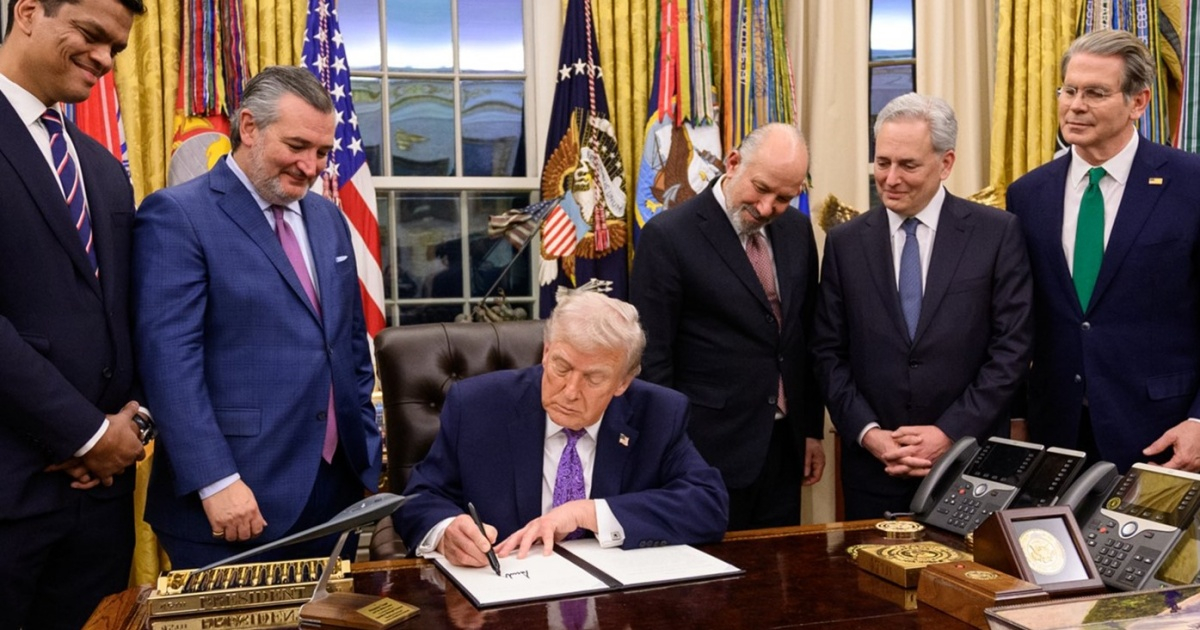
On December 11, President Donald Trump signed an executive order focused on the regulation of artificial intelligence (AI), which has sparked intense political and legal reactions across the United States.
The document, whose publication coincided with a ceremony in the Oval Office, limits the ability of states to establish their own regulations on AI, seeking a unified federal approach that, according to the Trump administration, ensures the country's global leadership in this technology.
The White House presented the text as an effort to "sustain and improve the global dominance of U.S. AI through a minimally burdensome national policy framework for AI."
According to Trump, the regulatory fragmentation among states poses an obstacle to business and technological development.
"If they had to obtain 50 different approvals from 50 different states, they could forget it," he warned during the signing event.
The debate about artificial intelligence has become a key focus of political discourse in the United States, especially in the context of competition with China.
During the ceremony, Senator Ted Cruz emphasized: “It’s a race, and if China wins, no matter who wins, the values of that country will impact all of AI.”
"We want the American values of freedom of expression, individual liberty, and respect for the individual," he added.
Working group and pressure on the states
The executive order instructs the Department of Justice to actively act against state regulations that conflict with this vision.
The Attorney General Pam Bondi will have 30 days to establish a "Working Group on AI Litigation", whose sole mission will be to legally challenge state laws that restrict the deployment of this technology.
At the same time, the Secretary of Commerce, Howard Lutnick, must identify which state laws “require AI models to modify their truthful outcomes,” clearly referencing the concerns previously expressed by the president regarding what he refers to as “conscious” or ideologically biased AI.
Jurisdictions with regulations deemed "burdensome" could be pressured to sign agreements not to enforce their own laws if they wish to access discretionary federal funds.
Heading Toward a Unified Federal Standard
The decree also directs the White House AI czar, David Sacks, and the director of the Office of Science and Technology Policy, Michael Kratsios, to formulate recommendations for a federal law that could permanently replace state regulations.
However, the text clarifies that certain sensitive areas such as child protection, data center security, or public procurement of AI systems will remain outside this regulatory harmonization for the time being.
"We have 50 states running in 50 different directions. It just doesn't make sense," said Sacks, who firmly defended the measure.
"We are creating a confusing mosaic of regulations, and what we need is a single federal standard, and that's what the Executive Order states," he added.
Previous legislative attempts and criticisms of the decree
The executive order comes after several legislative failures to centralize the regulation of AI.
In November and July of this year, attempts in Congress to include a clause granting the federal government exclusivity over AI legislation did not succeed.
One of these attempts occurred during the debate on the National Defense Authorization Act, but it generated so much criticism that the clause was ultimately removed.
Various political actors and experts see this executive order as an attempt to block any significant regulation, especially at the state level, while Congress continues to make no progress on a consensus national law.
Brad Carson, director of the bipartisan group Americans for Responsible Innovation and former congressman, was blunt.
"The big tech companies have failed twice in their attempt to include an amnesty for AI in the legislation," he stated; and added that the executive order signed this Thursday will soon be blocked in the courts.
From the left, Democratic Senator Ed Markey described the decree as “an early Christmas gift for his billionaire colleagues and CEOs.”
A contested regulatory landscape
The regulation of AI in the U.S. faces a legal, technological, and political crossroads.
On one hand, innovation is progressing rapidly, raising concerns about social, environmental, and ethical impacts.
On the one hand, states are trying to legislate in response to the inaction of Congress, while the Trump administration is now proposing a centralized executive response.
Legal experts such as Mackenzie Arnold from the Institute of Law and AI warn about the dangers of this extreme federalist logic:
"By that same logic, states would not be able to pass product safety laws, which almost all affect companies from other states selling their products nationally. However, these laws are the classic example of acceptable state legislation."
The decree signed by Trump represents a turning point in the technology policy of the United States.
Under the banner of global leadership and regulatory simplification, the document reconfigures the relationship between states and the federation, igniting the debate on the limits of state intervention in an era marked by automation and artificial intelligence.
Without a clear federal law and with rising tensions between innovation and regulation, the future of AI in the U.S. is at stake both in the courts and in the political arena, where the battle to define the values that should govern this technology is just beginning.
Filed under: