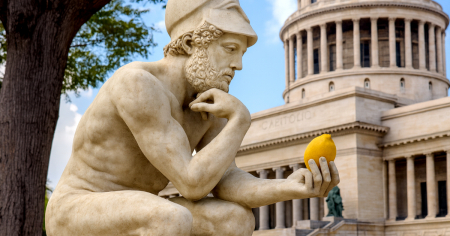
The ruler Miguel Díaz-Canel acknowledged the critical situation facing the Cuban economy, with a decline in the Gross Domestic Product (GDP) of 4% at the end of the third quarter.
"With the close of the third quarter, GDP has declined by more than 4%, inflation is skyrocketing, the economy is partially paralyzed, thermal generation is critical, prices remain high, deliveries of regulated food are not being met, and agricultural and food industry production does not meet the population's needs," admitted this Saturday during the closing speech of the XI Plenary of the Central Committee of the Communist Party of Cuba.
The leader painted this picture "after finishing another tough year," which he blamed primarily, as is customary in the regime's rhetoric, on the U.S. embargo and the Cuban-American exile community.
"To all of this, we must add the costly losses caused by the devastating passage of Hurricane Melissa," he complained.
Díaz-Canel then portrayed a picture far from the Cuban reality, with supposed "popular participation," support for his government, and marked by the prestige of the "leaders and cadres to address the main issues with the populace."
“There is poverty in Cuba, the media created by those who applaud the blockade and suffocating measures say every day. Yes, there is a tremendous material scarcity in Cuba, generated by the genocidal policies that generously reward those who celebrate that poverty. No one can be satisfied with this, and we will work relentlessly for the prosperity that this people deserves,” he assured in the same vein.
He, also the head of the PCC, emphasized that the latest project to "correct distortions and revitalize the economy is not just a slogan; it is a concrete battle for the stability of daily life, for wages to be sufficient, for food to be available on the table, for blackouts to end, for transportation to be revived, and for schools, hospitals, and basic services to operate with the quality we deserve."
"We have debated harshly, without triumphalism, and we have defended an economic agenda that addresses the root of the problems and involves every agency, every territory, and every member," he stated, despite the disastrous economic policies of his government in recent years.
Empty rhetoric and crisis
In the midst of an unprecedented national crisis—blackouts, soaring inflation, repression, chronic shortages, and an exodus that empties the country—the power elite repeated the old script of the so-called “revolution”: resist, blame the enemy, defend unity, and promise corrections that never come.
As Cubans strive to survive an increasingly precarious reality, their leaders cling to a narrative that no longer describes the country but rather disguises it.
The PCC plenaries have turned into ceremonies of ideological reaffirmation rather than spaces for real politics. Each new meeting confirms the same: that the regime's power does not know how to coexist with reality and facts, and retreats into the empty and deceitful rhetoric of a supposed "battle of ideas," in which only the "heirs" and architects of "continuity" have a voice.
Díaz-Canel, in his dual role as ruler and first secretary of the PCC, reiterated that "unity is the guarantee that Cuba will continue to be free, independent, and sovereign," according to the website of the Presidency.
Filed under: