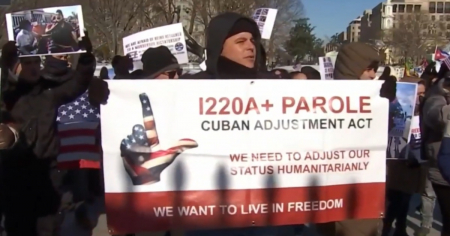
The word hope has once again gained significant traction among thousands of Cubans caught in the migratory limbo of the I-220A. There was no ruling, but there were signs. And for a community accustomed to waiting, hearing that “we're doing well” was enough to rekindle their faith.
The oral arguments hearing held in the Eleventh Circuit Court of Appeals in Atlanta left a clear impression among lawyers, activists, and migrants who followed the live broadcast: the Government faced intense scrutiny, and the defense successfully challenged the official narrative regarding the use of the I-220A instead of parole.
One of those who shared their thoughts was the user from TikTok, Manuel Valle Labord, who followed the live hearing and described what transpired as a pivotal day.
In their view, the judges expressed frustration at the government's inconsistencies. "You can't use the part of the law that suits you and ignore the other," he stated, referring to the panel's persistent questioning of the prosecution.
According to his assessment, there was even an implicit acknowledgment of procedural errors. “It has been a great victory. There is a great light. Although the decision may be delayed, we believe it can be very positive. We are doing well, we are moving forward,” he said, making it clear that he was speaking from his personal interpretation and not as a legal advisor.
The same sentiment was echoed in the broadcast of DORADO ALL SERVICES, where its owner, visibly moved, described a scene that resonated with the accumulated suffering of thousands of Cuban families.
"I'm watching the trial live, and what a defense they put up. They completely wiped the floor with the government, literally," he affirmed.
He recounted that he set aside his work routine to follow every minute of the hearing and confessed that the defense seemed "masterful" to him, while the government lawyer appeared nervous. "We are hoping this will be more than just a wonderful decision for so many people who have been suffering for so long," he expressed.
The expectation does not arise from nothing. In the hearing, immigration attorney Mark Prada argued that thousands of Cubans were improperly processed by receiving an I-220A when, by law, they should have been released under parole. This misclassification is what today prevents them from benefiting from the Cuban Adjustment Act and moving toward permanent residency.
Attorney José Guerrero, present in court, described the defense's presentation as "masterful" and stated that the Government was left without solid arguments in the face of the judges' scrutiny.
In statements to the media, he explained that the court's questions pointed to a fundamental contradiction: one cannot apply the strictest aspects of the immigration process and then deny the legal mechanism that corresponds to release.
For Guerrero, the news "could be very favorable," although he insisted that no decision has been made yet and that the process could take weeks or months.
If a positive ruling is reached, the impact would be profound, especially for Cubans, who rely on the Cuban Adjustment Act as their only means to regularize their status after a year and a day in the United States.
Although the direct reach would initially be limited to the states under the jurisdiction of the Eleventh Circuit, Florida, Georgia, and Alabama, the precedent could become a key argument for other cases across the country.
For now, nothing has changed in legal terms. But something did shift. The hearing left the impression that, for the first time in a long while, Cubans with I-220A not only heard silence or refusals but also uncomfortable questions directed at the Government.
Filed under: