
Related videos:
The controversy surrounding the new law on license plate frames in Florida reached a critical point following the arrest of Demarquize Dawson, a resident of Broward County, whose story has sparked outrage on social media and forced local police to acknowledge their mistake.
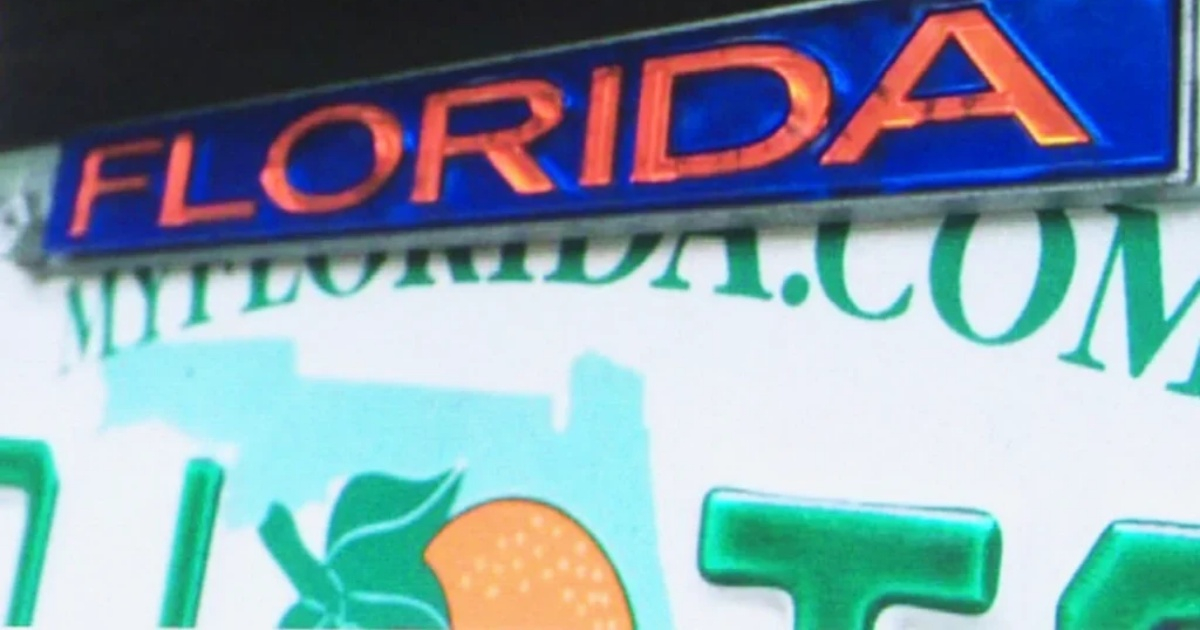
Dawson was arrested by agents from the Davie Police Department because the decorative frame of his rental car's license plate partially covered the letter "S" in the phrase "Sunshine State".
“He said: ‘I’m arresting you because the ‘S’ on your license plate is hidden: the ‘S’ of Sunshine,’” Dawson recounted to Telemundo 51, still astonished by what happened.
The man stated that he did not break the law and announced that he would file a formal complaint against the police department.
The situation escalated to the point that Dawson, emotionally affected by the experience, was taken to a hospital after suffering a panic attack. He was later released on bail.
The police acknowledge their mistake
After the media uproar, the Davie Police Department publicly acknowledged that the arrest was "invalid" and offered apologies.
In a statement, the police department acknowledged that when the new law was enacted, the wording was “vague, unclear, and open to misinterpretations.”
"Since the publication of a clarifying memorandum by the Florida Police Chiefs Association, our officers have been trained in the enforcement and application of this law. Unfortunately, it appears that this arrest was not valid, and we offer our apologies to Mr. Dawson," the statement noted.
The department spokesperson, Julia Ross, clarified that “it is not necessary to discard the frame of the plate as long as the license plate can be read clearly and the registration sticker is visible.”
Furthermore, he clarified that even if part of the slogan “Sunshine State” is partially covered, that should not pose a legal issue.
Widespread confusion: It is not an isolated case
Dawson's case is not unique. In the same city of Davie, the family of José Cuellar, a Salvadoran gardener, reported that he was also detained by the Highway Patrol for similar reasons related to his license plate.
Unlike Dawson, Cuellar remains detained, which reinforces criticism regarding the lack of clarity and the misapplication of the law by some agencies.
This situation arises in a context of growing public concern over the tightening of sanctions for minor offenses.
What was once a simple traffic violation can now constitute a second-degree misdemeanor, with penalties of up to 60 days in jail and fines of $500
What does the law really say?
The state law, which came into effect on October 1, aims to prevent the use of devices that conceal or alter license plates, especially tinted covers or rotating mechanisms, often used to evade tolls or cover up crimes such as car theft.
However, its initial wording generated so much ambiguity that even the police forces misinterpreted the regulation.
The Florida Department of Highway Safety and Motor Vehicles (FLHSMV) had to issue an official clarification: license plate frames are permitted, as long as they do not obscure essential elements, namely:
-The alphanumeric identifier (unique numbers and letters).
-The registration sticker in the upper right corner.
"Whenever agents can read your numbers and see the sticker on your license plate, you can have a frame," explained Officer Ross.
Reactions and informative measures
In response to the confusion, Miami-Dade's tax collector, Dariel Fernández, disseminated images and brochures to visually illustrate which types of frames are permitted.
"It is important to explain to the community that if you have one of these frames that do not block any information from your plate... For now... there is no problem," he explained.
It was also recommended, both by the police and the Department of Security, a preventive stance: if there are doubts about the legality of the framework, it’s best to withdraw it.
The police chief of Doral, Edwin López, was blunt: "Frankly, it's that simple. It’s a recommendation I gave to my parents."
Between Aesthetics and Legality: A Controversial Law
The new law does not categorically prohibit custom frames, but it does impose a strict legal framework. The following are prohibited, among others:
-Markers that cover the key identifiers.
-Aerosols or films that modify the color or brightness of the plate.
-LED lights or reflective coatings.
- Rotating mechanisms or those that alter the visibility of the plate.
Although authorities insist that the goal is not to punish ordinary drivers but to curb criminal practices, cases like Dawson's have raised alarms about police excesses, legal ambiguities, and disproportionate penalties.
Conclusion: The weight of a poorly explained law and its wording
The arrest of Demarquize Dawson not only highlighted a specific error in police interpretation but also brought to light the risks of applying ambiguous laws with criminal consequences.
The lack of initial clarity and the pressure to enforce new regulations have led to situations that, as the affected party himself stated, require urgent review:
“There was a great controversy in court regarding what is right and what is wrong with this new statute... Something must be done because that is not acceptable.”
The story of a partially covered "S" ultimately revealed a much deeper issue: the need for laws to be clear, proportionate, and applied with common sense.
Filed under: